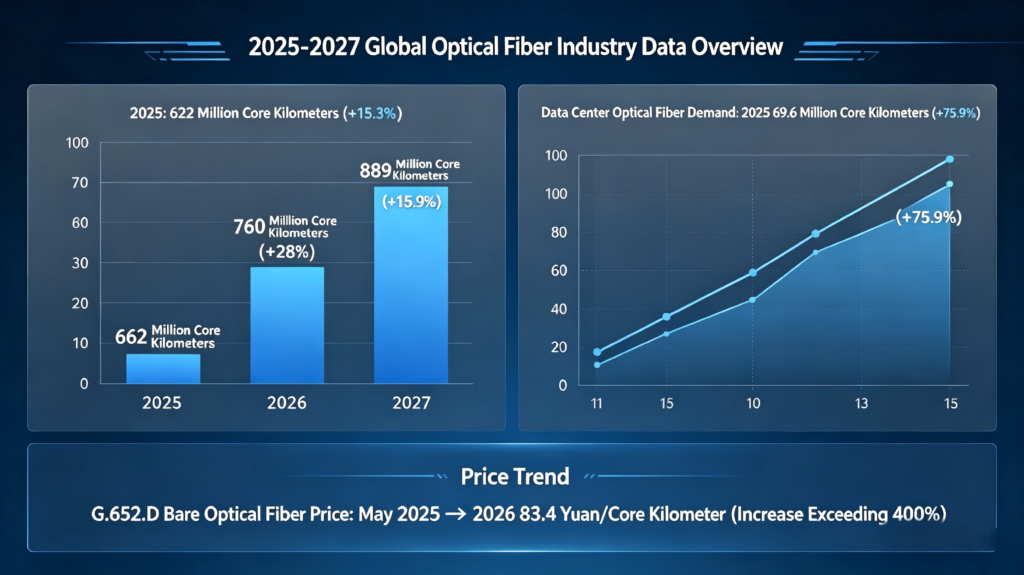
In 2026, the global optical fiber and cable market is entering a historic boom driven by both rising demand and prices,According to CRU data, global optical fiber shipments reached 662 million fiber kilometers in 2025, a year-on-year increase of 15.3%. It is projected that in 2026 and 2027, global optical fiber demand will reach 760 million and 889 million fiber kilometers, respectively, with year-on-year growth rates of 28% and 17%. The core driving force of this growth has shifted significantly from traditional telecommunications construction to emerging applications such as AI data centers and drones. In 2025, the global data center demand for optical fiber and cable surged by 75.9% year-on-year, reaching 69.6 million fiber kilometers, and is expected to exceed 100 million fiber kilometers in 2026. Meanwhile, in March 2026, the spot price of G.652.D bare fiber in China reached a record high in China, a cumulative increase of over 400% since May 2025. The supply-demand gap in the global optical fiber and cable market continues to widen. As a professional optical cable equipment manufacturer, Hongkai provides turnkey production solutions from fiber coloring to finished product output for global optical cable and network cable manufacturers.
1.AI Is Driving Global Optical Fiber Demand
According to industry forecasts, the share of optical fiber used in AI data centers as a proportion of total global demand is expected to surge from 5% in 2024 to 30% in 2027. Data center construction has become the core driver of optical fiber demand. A hyperscale AI computing center requires five to ten times more optical fiber than a traditional data center, and the AI race is triggering an unprecedented explosion in optical cable consumption. At the same time, China already accounts for over 60% of the global optical fiber and cable market. In the first quarter of this year, Chinese optical fiber companies saw their overseas sales increase by more than 55% year-on-year, with orders on hand already scheduled through the first quarter of next year. This strong market growth presents enormous market opportunities for upstream optical cable production equipment manufacturers.
2. Indoor and Outdoor Optical Cable Production Process: A Complete Process Chain from Fiber to Finished Product
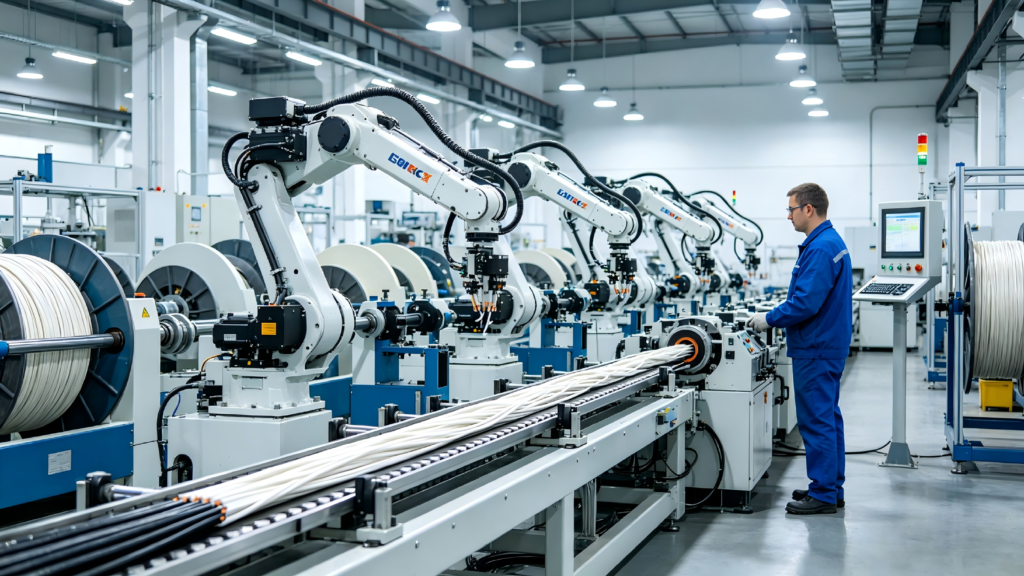
Optical cable manufacturing is a precision engineering process. Whether for indoor or outdoor optical cables, the production process follows a strict standard process system. The following describes the general process of optical cable production using a stranded outdoor optical cable as an example, while also explaining the differentiated processes for indoor optical cables.
Step 1: Fiber Coloring
The drawn optical fiber is coated with coloring ink using an optical fiber coloring and rewinding machine and cured with ultraviolet light, giving each fiber a unique color for identificationfor easy distinction during cable assembly. The coloring layer thickness is generally 3–5 μm, and after curing, it must not fade or migrate when wiped with organic solvents. The quality of this process directly affects subsequent fiber identification efficiency and transmission performance.
Step 2: Secondary Coating (Loose Tube Extrusion)
The colored fiber passes through PBT (polybutylene terephthalate) melt and is coated with a loose tube protective layer using a secondary coating extrusion line. The tube is filled with water-blocking gel. Controlling the fiber excess length is a key technical point to ensure good tensile and temperature characteristics of the optical cable.
Step 3: Cabling (Stranding)
The loose tubes after secondary coating are stranded around a central strength member to form the cable core. An SZ stranding machine controls the direction and pitch of the tubes while adding water-blocking tape and cable gel to ensure full water-blocking performance, making the cable core compact and firm. Filler rods may be added as needed to ensure the roundness of the core.
Step 4: Sheathing (Armoring)
Corrugated steel tape or aluminum tape is longitudinally wrapped around the cable core to enhance side pressure resistance. Then, a layer of PE or LSZH (Low Smoke Zero Halogen) sheath material is extruded through an optical cable sheathing extrusion line to form the final finished optical cable. Conventional outdoor cables also require a metal tape longitudinal armoring process to meet installation conditions such as aerial and direct burial.
Process Adjustments for Indoor Optical Cables
Production of indoor optical cables is simplified and adapted based on the above processes. For indoor applications, the production of tight-buffered fibers – where the fiber is paid off, preheated, dried, and directly extruded with a tight coating – replaces the loose tube structure of outdoor cables. In addition, the production of indoor butterfly drop cables requires the introduction of an aramid yarn stranding device to uniformly wrap aramid yarn with controlled tension around the tight-buffered fiber to enhance tensile strength, followed by sheath extrusion to complete the finished product.
Through the above process chain, optical cable manufacturers can efficiently produce various cable structures, including stranded, central tube, and slotted core optical cables.
3. Optical Cable Equipment Series: Covering the Entire Optical Cable Manufacturing Process
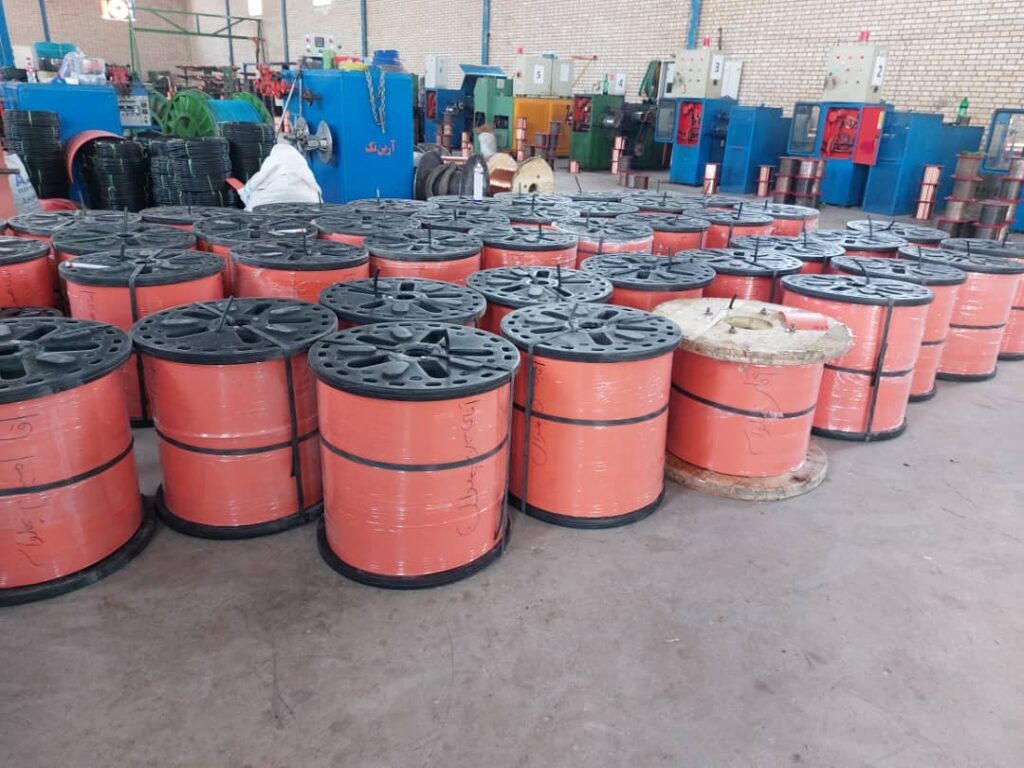
According to the classification of the national standard GB50950-2013, optical cable production line equipment can be generally divided into five major categories. Hongkai provides the following complete set of core equipment:
Optical Fiber Coloring and Rewinding Machine: fiber coloring and color sequence control, also featuring fiber tension screening function.
Optical Fiber Secondary Coating Production Line (Loose Tube Line): Used for PBT loose tube extrusion. Precise temperature control and high-speed extrusion ensure uniform tube wall thickness and fiber excess length control.
SZ Stranding Machine (Cabling Production Line): Used for stranding loose tubes around a central strength member to form the cable core. The equipment includes various models such as steel wire armoring stranding lines and cage-type multicore indoor soft optical cable production lines, central tube optical cables,Optical Cable Sheathing Extrusion Line: Includes alongitudinal tape armoring unit and a PE/LSZH sheathing extruder to complete armoring and sheath forming.
Tight-Buffered Fiber Production Line and Ribbon Line: Suitable for the production of special optical cables such as indoor optical cables, drop cables, and butterfly drop cables.
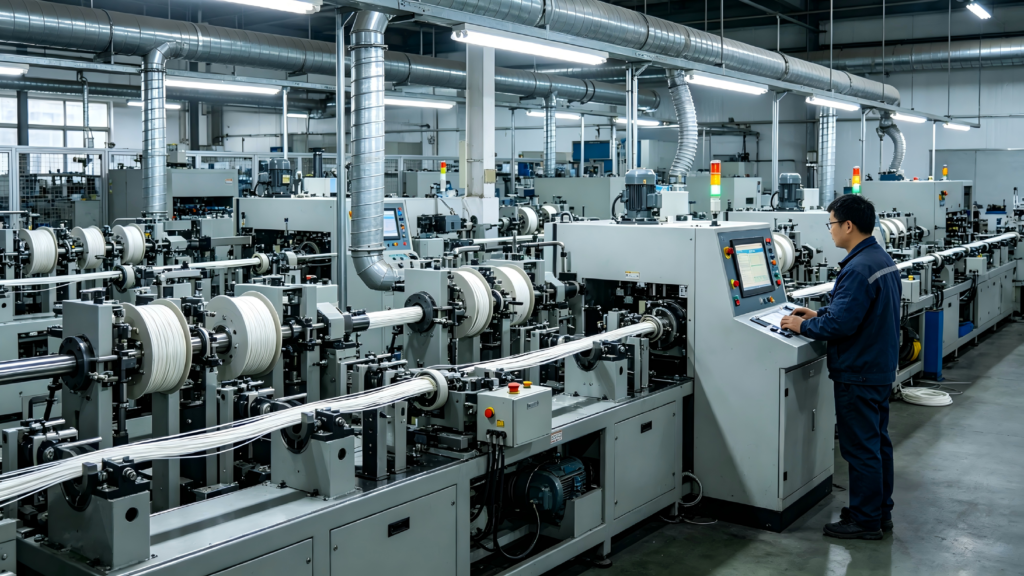
4. Network Cable Equipment Series: Covering Cat5e, Cat6 and Cat7 Cables
In addition to optical cable equipment, Hongkai also provides comprehensive network cable equipment solutions, covering Cat5e, Cat6, Cat6A and Cat7 data cables. Although network cables (LAN cables) differ from optical cables in terms of transmission medium, share many similarities in their production equipment systems – extrusion, stranding, sheathing, and other core technologies have significant overlaps. Leveraging the precision manufacturing experience accumulated in the optical cable equipment field, Hongkai offers the following core equipment:
High-Speed Tandem Insulation Line: Suitable for high-speed tandem production of drawing – annealing – insulation extrusion for high-quality digital communication cables and various LAN cables (Cat5/Cat5e, Cat6/Cat6e, Cat7). Maximum line speed can reach 800–1200 m/min.
Twisting Machine and Single Twist Cabling Machine: Used for twisting core wires to eliminate signal crosstalk and control twist pitch accuracy, ensuring high-frequency transmission performance of network cables.
Cabling – Sheathing – Coiling Integrated Tandem Production Line: Specifically designed for short-process integrated production of cabling, sheathing extrusion, and coiling packaging for high-quality 4-pair network data cables. It features high production efficiency and low energy consumption, making it an ideal choice for producing Cat5E, Cat6, and Cat7 UTP/FTP cables.
Vertical Injection Molding Machine and Cutting & Coiling Equipment: Used for injection molding of network cable connectors and finished cable cutting & coiling packaging, achieving a complete closed-loop process from core wire to finished product.
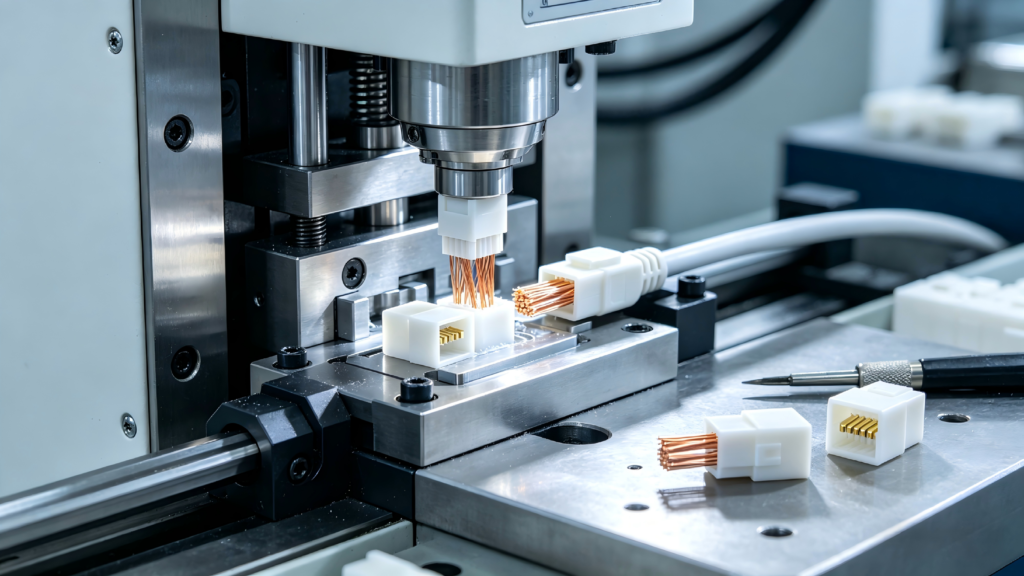
5. About Hongkai
Hongkai is a professional manufacturerspecializing in R&D, manufacturing and global salesof optical cable equipment. Our main products cover optical cable production lines (complete sets of equipment including fiber coloring, secondary coating, stranding, sheathing, etc.) and network cable equipment (production lines for Cat5e, Cat6 network cables). We are committed to providing customers with one-stop solutions from planning and design to equipment delivery. With years of extensive experience serving the cable and wire industry, our equipment has been exported to many countries and regions including North America, Southeast Asia, the Middle East, Russia, and Europe, serving numerous optical cable and network cable manufacturers .
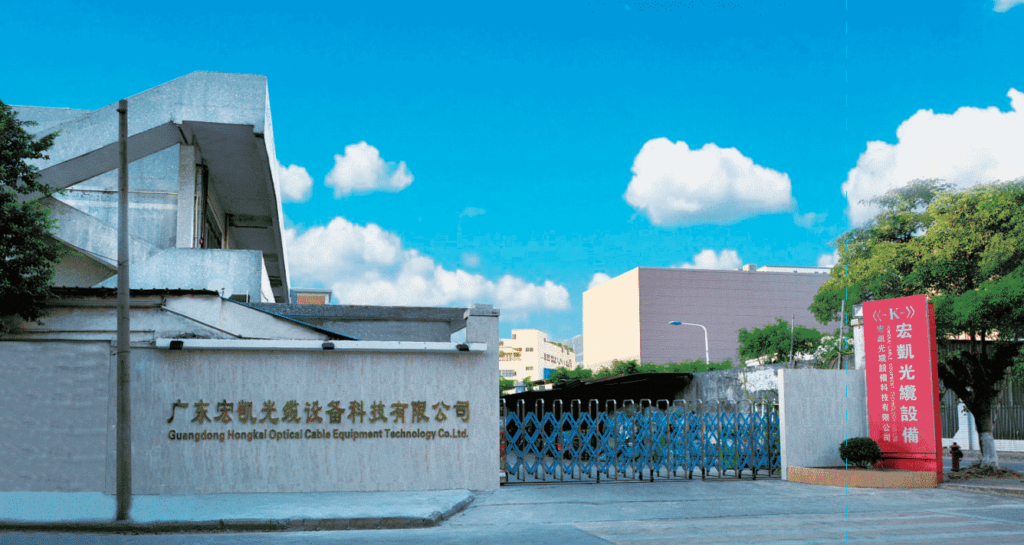
Contact Us for a Customized Equipment Solution
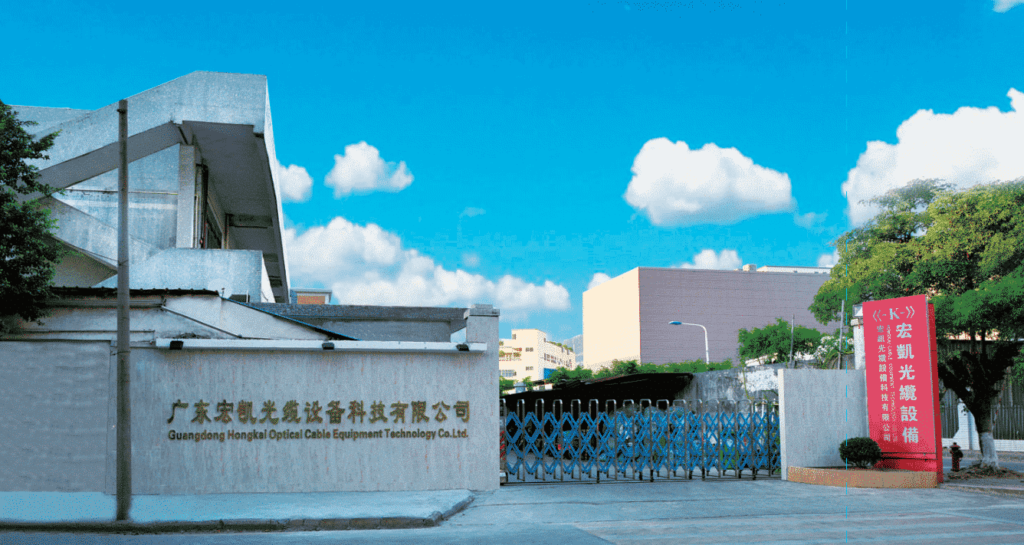
To learn more about optical cable production lines, secondary coating lines, SZ stranding machines, sheathing lines, or complete sets of Cat5e/Cat6 network cable equipment, please visit the official website of Guangdong Hongkai Optical Cable Equipment Technology Co., Teo. or contact our sales team. We look forward to working with partners worldwide, to create a new future of intelligent manufacturing for optical communications and network cables!