In recent years, AI-driven data center investment has rapidly overtaken traditional telecom demand to become the strongest growth engine. The price of G.652.D optical fiber increased significantly during 2025–2026 due to strong demand from AI infrastructure and data center construction. In this demand-side industrial earthquake, optical cable equipment manufacturers are facing an unavoidable question: as downstream customers’ product portfolios change, can the equipment keep up?
1.A Fundamental Shift in Market Drivers: From “Carrier Centralized Procurement” to “AI Data Centers”
Over the past decade, demand for optical cable equipment was primarily driven by telecom carriers’ centralized procurement projects – high-volume, standardized, layer-stranded loose tube cables were the absolute mainstay. But this landscape is being upended.
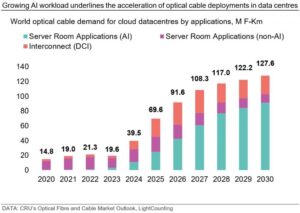
The 2026 industry trend report released by CRU (Commodity Research Unit) clearly points out that data center construction in 2025 has completely reshaped market demand. The rapid expansion of training clusters requires high-density fiber connections inside server rooms, and the increasingly interconnected hyperscale data center campuses are fueling a new wave of DCI (Data Center Interconnect) construction. The expansion of AI infrastructure directly translates into strong demand for high-fiber-count ribbon cables – which can integrate thousands of optical fibers to maximize bandwidth and space efficiency.
The data confirms the intensity of this trend: Global demand for data center fiber and cable products grew rapidly in 2025, driven by AI training clusters and hyperscale data center expansion. and is Industry analysts expect continued growth in data center fiber demand over the coming years. A single AI computing cluster with tens of thousands of GPU cards consumes five to ten times more interconnect fiber than a traditional data center. Meanwhile, the deployment of fiber-carrying drones in specific complex electromagnetic environments has achieved large-scale adoption creating an entirely new fiber product category.
What does this mean for optical cable equipment? The stranding process of traditional layer-stranded loose tube cables is being supplemented or even partially replaced by new products such as high-fiber-count ribbon cables, bend-insensitive fibers (G.657.A2), hollow-core fibers, and more. Equipment manufacturers that still cling to a “one-size-fits-all” approach will fall behind in the new round of competition.
2.Downstream Demand Changes Force Equipment Upgrades: Three Irreversible Trends
Trend 1: High-Fiber-Count Cables Demand Higher Stranding Equipment Precision
Stranding high-fiber-count ribbon cables demands far greater stranding pitch accuracy and tension control than traditional cables. Conventional layer-stranded cables typically have 6 to 12 tubes, with Traditional cables generally have relatively relaxed pitch consistency requirements compared with high-fiber-count ribbon cable structures. high-fiber-count cables often have 24 tubes or more – any tension deviation in a single tube can scrap the entire cable.
The industry is moving toward fully differential stranding + independent servo active pay-off. For example, Hongkai’s SZ stranding line, through independent closed-loop tension control for each spool, has achieved simultaneous stranding of 12 tubes with stable stranding pitch consistency under continuous production conditions. at customer sites. However, as the number of tubes further increases, the requirements for control system real-time performance and mechanical rigidity will only become more stringent.
Trend 2: Specialty Fibers Like G.657.A2 Pose New Requirements for Sheathing Processes
Over the past year, The market price of bend-insensitive fiber has increased significantly in recent years due to rising demand.The sheathing process for this fiber differs significantly from traditional G.652.D – the smaller bending radius requires more precise sheath concentricity and more uniform wall thickness; otherwise, bending loss will increase sharply.
Hongkai’s sheathing line has achieved an average concentricity of 98.6% and wall thickness tolerance ≤0.04 mm (against a nominal 1.8 mm) over 8 hours of continuous production in actual operation. However, industry leaders have already set their targets at concentricity ≥99% and wall thickness tolerance ≤0.03 mm. Equipment manufacturers need to continuously iterate on laser diameter measurement, ultrasonic thickness measurement, and closed-loop control algorithms.
Trend 3: Smart Manufacturing Has Become a “Hard Requirement” for Equipment Purchases
In 2023, Hengtong Fiber was named the Leading manufacturers such as Hengtong and YOFC have accelerated smart factory development. in early 2025, Hengtong Optoelectronics was selected as a national outstanding-level smart factory; around the same time, Yangtze Optical Fiber and Cable (YOFC) was included in the first batch of 15 leading-level smart factories for its “integrated intelligent factory for the entire rod-fiber-cable industrial chain oriented toward extreme processes.” The benchmarks set by industry leaders are already in place.
For small- and medium-sized optical cable manufacturers, whether equipment can interface with MES systems, enable traceability of process parameters, and support remote diagnostics is rapidly changing from a “nice-to-have” to a “must-have.” Hongkai equipment comes standard with a unified PLC platform, supporting OPC UA and SQL database interfaces to help customers achieve automated production data collection and traceability. But this is only the starting point – the next competitive frontier lies in AI-assisted process optimization and predictive maintenance.
3. Evolution Directions of Equipment Technology: What Innovations Are Emerging?
3.1 Stranding-and-Sheathing Integration: Reducing 15 Operators and 50% Floor Space
In 2025, a noteworthy technological breakthrough emerged in the industry – the integrated stranding-and-sheathing machine. This equipment combines the two processes of stranding and sheathing into one integrated production line, significantly reducing labor requirements. and reducing production footprint. Its core innovation, the “cable core spider-web pay-off system,” increases the cable core threading speed during sheathing from improving cable core threading efficiency.
This direction indicates that the trends of equipment integration, footprint minimization, and labor reduction are accelerating. For overseas markets with tight floor space or rapidly rising labor costs (e.g., the Middle East, Southeast Asia), the integrated machine solution holds significant appeal.
3.2 Tool-Free Die Alignment for Sheathing: Tool-Free Die Alignment: Simplifying Sheathing Setup and Improving Concentricity Control
Traditional sheathing dies are like “building blocks” – after installation, they require manual eccentricity adjustment, taking at least 30 minutes. The new tool-free dies adopt an integrated design that eliminates errors caused by manual installation,helping improve sheath concentricity and production consistency.
Although this technology is still in the in-house R&D phase of leading enterprises, the underlying logic – reducing manual intervention and improving product consistency – has become a general principle in equipment design. Manufacturers like Hongkai are incorporating similar “one-click adjustment” concepts into the design of their sheathing lines.
3.3 Digital Twins and AI-Driven Process Optimization
In Hengtong Fiber’s smart factory, every process is simulated online by the system using AI, enabling autonomous optimization of design parameters and processing parameters. Sensors collect real-time data from 6 core processes, 8 auxiliary processes, and nearly 400 pieces of equipment, gathering over collecting large volumes of real-time production data.
For optical cable equipment, this means that future machines will not only be “executors” but also “learners” – by continuously accumulating production data, they will automatically optimize tension settings, pitch parameters, and temperature profiles. Hongkai has already pre-installed data acquisition interfaces and recipe management functions in its equipment, reserving technical headroom for this evolution.
4.Hongkai’s Response: Addressing Industry Changes with Pragmatic Technology
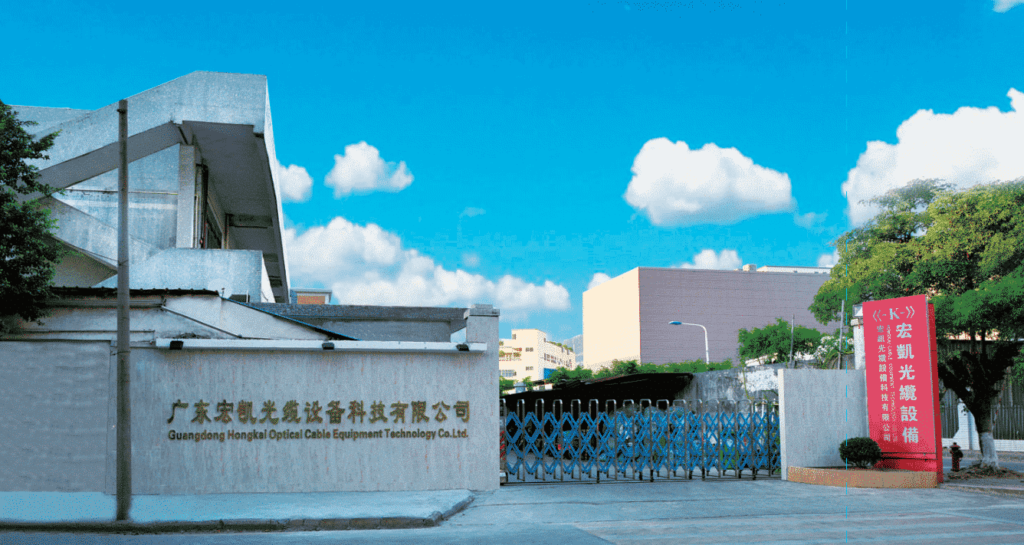
Guangdong Hongkai Optical Cable Equipment Technology Co., Ltd., established in 2015 (with its predecessor dating back to 2005), possesses with more than 20 years of experience in optical cable equipment manufacturing. Facing structural changes in the industry, Hongkai’s strategy is not to blindly pursue “high-end and flashy” features, but to benchmark against industry leaders in key performance indicators while maintaining cost-effectiveness.
In terms of precision: Hongkai’s stable tension control, consistent stranding pitch, and average sheath concentricity above 98%. – these figures already cover the process requirements for current mainstream high-fiber-count cables and G.657.A2 sheathing.
In terms of intelligence: Hongkai equipment comes standard with Siemens/Mitsubishi PLC platforms, supporting recipe storage and rapid product changeover.automatic production data logging (CSV export), and OPC UA/SQL interfaces for MES integration. For customers taking their first step toward smart manufacturing, this solution enables basic data-driven management without additional development.
In terms of overseas adaptability: Hongkai equipment has been exported to more than 15 countries and regions, including the Middle East, Southeast Asia, South Asia, Africa, and Europe. Hongkai offers customized configuration options for different voltage standards and certification requirements (CE/UL/EAC).
5.Final Thoughts: The “New Capability Checklist” for Equipment Manufacturers
Looking back over the past five years, the competitive evaluation dimensions for optical cable equipment manufacturers have undergone profound changes:
| Evaluation Dimension | Five Years Ago | Now |
| Core Metrics | Capacity, Price | Precision, Flexibility, Intelligence |
| Customer Focus | Does the equipment work? | Can the equipment support data-driven process optimization? |
| Competitive Advantage | Low cost | Data enablement + rapid response |
| Market Access | Basic electrical safety | CE/UL + MES interface + remote O&M |
For optical cable manufacturers, it is advisable to ask three questions when purchasing equipment:
Can your equipment produce G.657.A2 optical cable andachieve concentricity above 98% under normal production conditions.
Can your equipment interface with my MES system and automatically record process parameters for each reel of cable? (To test intelligence capability)
Do you have successful delivery cases in overseas markets? Are the equipment certification documents complete? (To test global readiness)
Guangdong Hongkai Optical Cable Equipment Technology Co., Ltd. can provide, upon customer request, factory inspection reports, CE technical files, and a list of overseas delivery cases. For detailed technical specifications of specific models or to arrange a factory visit, please feel free to contact the Hongkai technical team.