In the past, when overseas optical cable manufacturers purchased equipment, they asked: “What is the production capacity? What’s the price? What is the delivery time?”
Now, more and more overseas customers are starting to ask new questions during inquiries: “Can equipment data be uploaded to our MES system?” “Can parameters such as tension fluctuation and pitch deviation be automatically recorded?” “Can equipment faults be diagnosed remotely?”
These changes are not accidental. The competitive logic of the global optical cable industry is being redefined, and the data capability of equipment is gradually becoming a critical differentiator in overseas purchasing decisions.
1.Industry Leaders Are Redefining What “Good Equipment” Means
In 2026, leading companies in the optical cable manufacturing sector are accelerating their smart manufacturing transformations, and their achievements have attracted widespread attention in overseas markets.
YOFC (Yangtze Optical Fiber and Cable) was selected as one of the first batch of “leading-level smart factories” by the Ministry of Industry and Information Technology for its “integrated intelligent factory for the entire rod-fiber-cable industrial chain oriented toward extreme processes.” Its core businesses – optical fiber preforms, optical fibers, and optical cables – have ranked first globally for ten consecutive years, with core manufacturing equipment independently developed and controlled.
FiberHome Technologies achieved 100% data collection coverage on its optical cable production lines, increasing overall production efficiency by 20% and reaching a product quality level beyond 5σ, meeting top international manufacturing standards.
Zhongtian Technology’s Smart Plant No. 1 independently developed an AI-based fiber allocation system that reduced the proportion of materials with over-30-day inventory from 7.14% to 1%, and the proportion of colored fiber in inventory from 53.9% to 4.57%. Its industry-first AI-based character defect inspection system improved detection accuracy from 80% to over 97%. The number of frontline operators was reduced from 234 to 85, while annual production capacity increased from 8 million fiber-kilometers to 12 million fiber-kilometers.
After Sichuan Lefei Optoelectronics implemented its 5G fully connected digital factory for smart cable manufacturing, production efficiency increased by 43.8%, production costs decreased by 20.3%, and product delivery efficiency improved by 27%. Equipment management shifted from “breakdown repair” to “predictive maintenance.”
Digital twin technology has been deployed across multiple cable manufacturers, improving Overall Equipment Effectiveness (OEE) by 15%–20% and reducing unplanned downtime by 30%.
These achievements are being noticed by overseas customers. When your competitors – whether Corning in North America, Prysmian in Europe, or emerging cable plants in Southeast Asia – are starting to manage their production lines with data, if your equipment is still “silent,” the gap will only widen.
2.What Does It Really Mean for Equipment to “Speak”?
For optical cable manufacturers, the data capability of equipment delivers tangible value in four dimensions:
First, quality traceability. If a batch of cables exceeds attenuation limits, under the traditional model there is no way to verify the pitch settings or tension records on the stranding line at that time. But data-enabled equipment automatically records process parameters for every meter of cable produced – from pay-off tension to stranding pitch, from sheath temperature to take-up speed – all fully traceable. When overseas customers demand quality traceability, you can present data, not just verbal assurances.
Second, measurable efficiency. Without data, management can only rely on “gut feeling” to assess line efficiency. With data, OEE, scrap rate, changeover time, and shift output are all quantified. Managers can see the real-time status of each line from the office, and decisions shift from being “experience-based” to “data-driven.”
Third, predictable maintenance. The biggest fear with equipment failure is “sudden stoppage.” By collecting real-time operating parameters (current, vibration, temperature, tension fluctuation trends), the system can predict potential faults and issue warnings before problems occur. Equipment management evolves from “fix after breakdown” to “prevent in advance,” significantly reducing unplanned downtime.
Fourth, a foundation for going global. In an increasing number of overseas tender documents, equipment data interface capability and MES integration are becoming technical evaluation criteria. Whether equipment can “speak” is directly linked to bid qualification.
III. Real Concerns of Overseas Customers
Over the past three years, Hongkai has served customers in more than 15 countries and regions. We have found that overseas cable manufacturers’ main concerns regarding equipment data capability fall into three categories:
Concern 1: “Equipment comes from different suppliers with inconsistent data formats – we can’t integrate them.” This is the most common issue. If the stranding line uses Brand A’s PLC, the sheathing line uses Brand B’s PLC, and auxiliary equipment has no PLC at all, the data from the entire line is fragmented. The solution is to require that all equipment be developed on the same PLC platform to ensure unified communication protocols.
Concern 2: “What’s the use of collecting equipment data? We’re a small factory, we don’t need it.” Many small and medium-sized overseas cable plants believe that data-driven management is exclusive to large enterprises. In fact, even for a single line, data capability delivers immediate improvements in changeover efficiency, quality traceability, and fault diagnosis – one-click recipe recall reduces changeover time, automatic parameter recording reduces quality disputes, and remote diagnostics reduce engineer dispatch costs.
Concern 3: “The data is stored on a local server – what if it crashes?” This is a legitimate concern about data security. In practice, equipment data can simultaneously support local storage (USB export, local server) and cloud backup, with local storage as the primary option, giving customers full control over their data.
3.New Evaluation Dimensions for Equipment Procurement
If you are evaluating optical cable equipment procurement options, we recommend adding the following four data-related dimensions to your assessment, beyond traditional parameters:
| Dimension | Key Questions |
| 1. Is the PLC platform unified? | Does the entire line use the same PLC brand? Does it support mainstream industrial Ethernet protocols such as PROFINET and MODBUS TCP/IP? This is the foundation for equipment interoperability. |
| 2. Can production data be automatically recorded and exported? | Does the equipment have built-in data logging? Can key parameters – tension, pitch, temperature, speed – be exported by batch (e.g., CSV format)? Can process parameters for any time period be traced? |
| 3. Can it interface with MES or management systems? | Does the equipment reserve OPC UA or SQL database interfaces? How long and how much does integration development take? |
| 4. Does it support remote diagnostics? | When a fault occurs, can the supplier remotely view operational status and diagnose the cause? Does this require additional hardware and authorization? |
4.Data Capability of Hongkai Equipment
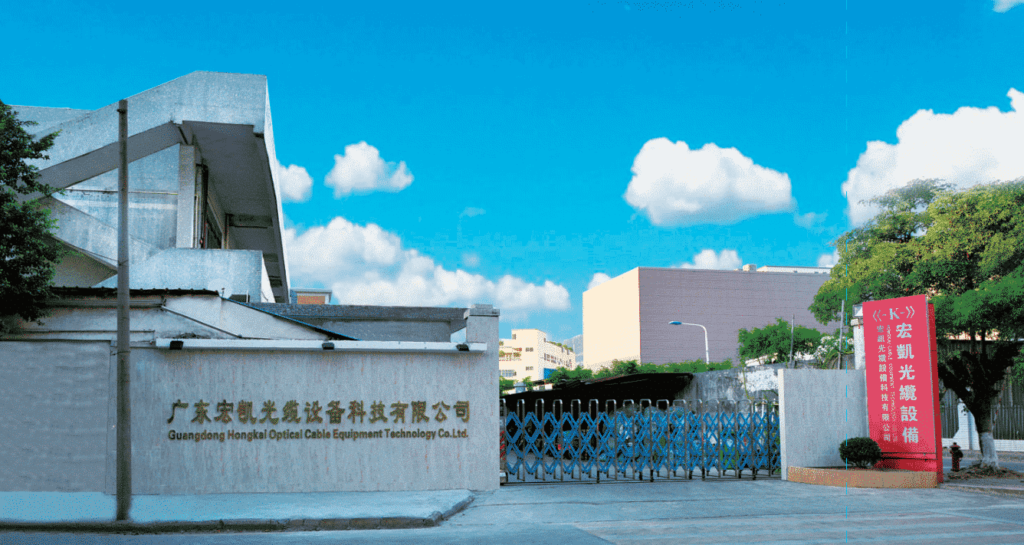
Guangdong Hongkai Optical Cable Equipment Technology Co., Ltd. specializes in the R&D and manufacturing of optical cable production equipment – including SZ stranding lines, outdoor cable sheathing lines, butterfly drop cable lines, and plastic tube production lines. In terms of data capability, Hongkai equipment offers the following features:
| Feature | Description |
| Unified PLC platform (standard) | All Hongkai equipment uses Siemens or Mitsubishi PLC, supporting PROFINET and MODBUS TCP/IP protocols. Customers can achieve centralized monitoring and parameter distribution across all processes – stranding, binding, sheathing, traction, take-up – through a single industrial PC. |
| Automatic production data logging (standard) | Equipment automatically records process parameters (pay-off tension, stranding pitch, sheath concentricity, line speed, etc.), production duration, and alarm logs for each batch. Data can be exported to CSV format via USB, or configured for automatic uploading as needed. |
| Recipe storage and one-click recall (standard) | The touchscreen includes built-in recipe storage, capable of saving complete process parameters for at least 20 different products. During changeover, select the recipe and load with one click, reducing changeover time to less than 1.5 hours. |
| Data interface reservation (optional) | Equipment reserves OPC UA server or SQL database interfaces. Integration with MES or enterprise management systems can be customized to enable automatic data collection and uploading, with a development cycle of 1-3 weeks. |
| Remote diagnostics support (optional) | A remote access module (subject to customer authorization) can be configured, allowing engineers to remotely monitor equipment status and diagnose alarm causes, helping overseas customers resolve faults quickly. |
Equipment precision guarantees: Beyond data capability, Hongkai equipment maintains solid mechanical precision – pay-off tension fluctuation ≤ ±0.4 N, stranding pitch deviation ≤ ±0.08 mm, average sheath concentricity of 98.6%, and wall thickness tolerance ≤ 0.04 mm.
Hongkai equipment has been exported to more than 15 countries and regions across the Middle East, Southeast Asia, South Asia, Africa, and Europe, with cumulative deliveries exceeding 160 sets. We provide bilingual operation manuals, electrical schematics, and CE technical documentation as part of our standard support package.
5.Final Thoughts
Whether equipment can “speak” is becoming a new yardstick for overseas cable manufacturers in evaluating suppliers. This is not a distant technological concept – it is a reality already unfolding. Smart factories of industry leaders have proven the efficiency gains brought by data capability, and overseas customers are beginning to require data interfaces in their tender documents.
If your equipment is still running “silent,” it’s time to make it speak.
Guangdong Hongkai Optical Cable Equipment Technology Co., Ltd. can provide, upon customer request, equipment data interface solutions, factory inspection reports, and overseas delivery case references. For detailed equipment specifications or to evaluate data-upgrade options, please feel free to contact the Hongkai technical team.