A recent report by CCTV Finance showed that overseas orders for optical cable companies are growing steadily, with delivery deadlines generally requiring “no more than half a month.” Orders from multiple countries have already been booked through 2027. From January to May 2026, China’s optical cable exports grew by double digits year‑on‑year. Annual investment in newly built computing centers overseas is estimated to reach trillions of yuan.
Orders are coming in, but delivery lead times have been squeezed to the limit. For optical cable manufacturers, this means a race against time to ramp up production capacity. The question is – can your stranding and sheathing lines keep up?
I. Three “Production Line Challenges” Behind the Order Surge
Challenge 1: Slow equipment delivery misses the order window
Overseas orders require delivery within half a month, but when cable manufacturers expand production, optical cable equipment such as stranding lines and sheathing lines typically take 45 to 60 days from order to shipment. Add sea freight, plus installation and commissioning after the equipment arrives at port – the entire cycle from decision to production could stretch to 3‑4 months.
In a market where optical cable prices continue to rise and orders are fully booked, a one‑month delay in production means losing orders worth millions in output value.
Challenge 2: Frequent specification changes and long changeover times
Current optical cable orders feature a “multi‑variety, small‑batch” pattern – layer‑stranded loose tube cables, butterfly drop cables, high‑fiber‑count ribbon cables – sometimes two or three specifications need to be switched in a single day. If changeover takes 4‑5 hours, a significant amount of effective production time is wasted on adjustments, directly reducing annual effective output.
Challenge 3: Higher precision requirements for sheathing, and equipment falls short
AI data centers demand much higher bending performance and structural consistency from optical cables than traditional telecom cables. Stranding pitch deviation must be controlled within ±0.1 mm, and sheath concentricity must reach above 98%. If equipment precision is insufficient, the cable produced will fail customer acceptance – the orders are there, but you simply cannot make them.
II. Four “Efficiency Levers” for Optical Cable Manufacturers
In the context of surging orders and compressed delivery times, cable manufacturers can maximize line output through the following four levers:
Lever 1: Delivery speed of stranding lines and sheathing lines
The manufacturer’s standardized production capacity directly determines equipment arrival time. Choosing a supplier that pre‑fabricates key components in batches and maintains inventory of common electrical parts can compress the entire line delivery cycle from 60 days to within 45 days.
Lever 2: Changeover efficiency for stranding and sheathing
Does the equipment have recipe storage and one‑click recall? Can specification changes be completed within 30 minutes? Changeover efficiency directly determines the actual annual output of a line under multi‑variety order conditions.
Lever 3: Stranding precision and sheath concentricity
Can the equipment control pay‑off tension fluctuation within ±0.5 N? Can stranding pitch deviation be kept within ±0.1 mm? Can sheath concentricity stably reach above 98%? These metrics determine whether the line can handle high‑requirement optical cable orders.
Lever 4: Line stability and fault response
In a period of full order books, any unplanned stop of the stranding line or sheathing line means real financial loss. Can the equipment support remote diagnostics? Can spare parts be delivered quickly? These capabilities determine the duration of unplanned downtime.
III. How Hongkai Helps Optical Cable Manufacturers Seize This Window
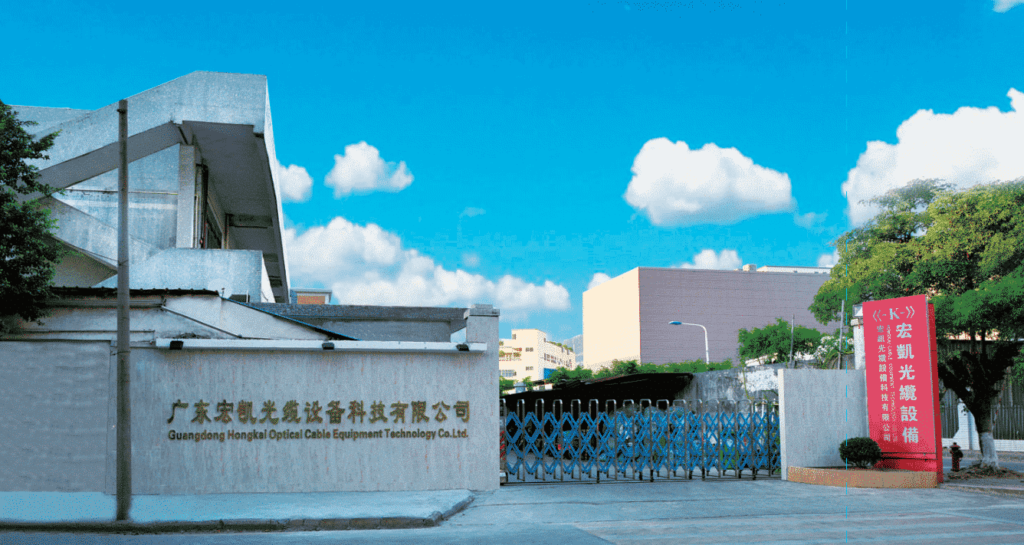
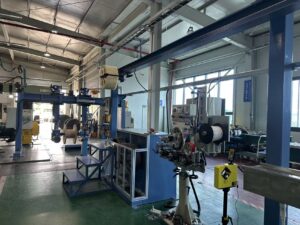
Guangdong Hongkai Optical Cable Equipment Technology Co., Ltd., established in 2015 (with origins dating back to 2005), specializes in optical cable manufacturing equipment – SZ stranding lines, outdoor cable sheathing lines, butterfly drop cable lines, and plastic tube production lines.
In response to the current industry situation of surging overseas orders and compressed delivery lead times, Hongkai assists cable manufacturers in rapid commissioning and efficient production across four dimensions:
Dimension 1: Accelerated delivery – complete line shipment in 45‑60 days
Hongkai adopts standardized design and batch pre‑fabrication for key components (differential gearboxes, dancers, pay‑off stands, etc.), and keeps frequency converters and PLCs in stock. The entire line is shipped within a standard cycle of 45‑60 days from contract signing, with no less than 2 hours of no‑load and load testing performed in‑house. Each shipment includes a Factory Inspection Report with measured data on tension fluctuation, pitch deviation, concentricity, and more.
Dimension 2: Rapid commissioning – 12‑18 days on‑site overseas
Hongkai equipment has been exported to more than 15 countries and regions across the Middle East, Southeast Asia, South Asia, Africa, and Europe, with cumulative deliveries exceeding 160 sets. We provide bilingual operation manuals, electrical schematics, and CE technical documentation; remote video support (response within 2 working hours); on‑site engineer dispatch for installation and commissioning (12‑18 days from arrival to trial production); and a standard wear‑parts kit shipped with the equipment, with DHL express delivery of spare parts in 3‑5 working days.
Dimension 3: Precision control – the hard metric for high‑requirement orders
Measured performance of Hongkai equipment:
| Equipment | Parameter | Performance |
|---|---|---|
| SZ stranding line | Pay‑off tension fluctuation | ≤ ±0.4 N (at 20 m/min) |
| SZ stranding line | Stranding pitch deviation | ≤ ±0.08 mm |
| Sheathing line | Average concentricity (8 hrs continuous) | 98.6% |
| Sheathing line | Wall thickness tolerance | ≤0.04 mm (nominal 1.8 mm) |
| Changeover time | Recipe one‑click recall | ≤1.5 hours |
These figures mean that Hongkai equipment can stably produce layer‑stranded loose tube cables, butterfly drop cables, high‑fiber‑count ribbon cables, and other products, helping customers take on demanding orders.
Dimension 4: Stable operation – predictive maintenance and rapid response
Hongkai equipment comes standard with Siemens/Mitsubishi PLC platforms, supporting automatic production data logging and system interface integration. A remote access module (subject to customer authorization) is optional, allowing engineers to remotely monitor equipment status and diagnose alarm causes. Key mechanical components are designed with high wear resistance; major electrical components are from international brands with global warranties and local availability.
IV. Final Thoughts: A “New Equipment Selection Formula” for Cable Manufacturers
In a market environment where overseas orders are surging and delivery times are compressed to half a month, the logic of equipment selection has changed:
Equipment Value = Delivery Speed × Commissioning Efficiency × Production Precision × Operational Stability
The price difference at purchase is fixed, but the efficiency gap created by equipment compounds every year. Choosing a stranding line or sheathing line that ships fast, commissions quickly, offers high precision, and runs stably means that within the same order window, you can produce more qualified cable and create greater value.
Guangdong Hongkai Optical Cable Equipment Technology Co., Ltd. can provide, upon customer request, factory inspection reports for optical cable equipment, overseas delivery case references, and full‑plant planning proposals. For detailed equipment specifications or to evaluate rapid‑commissioning solutions for your production line, please feel free to contact the Hongkai technical team.