In June 2026, Zhongtian Technology released a 17,280‑core ultra‑high‑density optical cable with an outer diameter of only 45 mm, integrating 17,280 optical fibers – setting a new global record for fiber count in a single cable. This cable offers 60 times the transmission capacity of traditional 288‑core cables, while reducing duct space occupancy by 92% for the same capacity.
A month earlier, at Sichuan Lefei Optoelectronics’ 5G fully connected digital factory for smart cable manufacturing, optical cable was being produced at a speed of 2.5 meters per second. The vast workshop had fewer than ten workers, who could control the entire line using tablets. Production efficiency increased by 43.8%, and production costs decreased by 20.3%.
Even earlier, in January 2026, AWS began deploying hollow‑core fiber to connect 10 data centers. Hollow‑core fiber allows light to travel through air, reducing latency by 33% compared to traditional fiber, but the bottleneck of mass production remains unbroken.
These three events point in the same direction: optical cable manufacturing is entering the “deep waters” – higher density, higher efficiency, and newer technologies. And optical cable equipment is the most fundamental support in this transformation.
I. The Lesson from 17,280‑Core Cable: How Far Can Stranding Equipment Go?
Zhongtian Technology’s 17,280‑core cable relies on a domestically leading 10,000‑fiber integrated production line. Thousands of optical fibers integrated into a single cable means the number of tubes jumps from the traditional 6‑12 to dozens or even hundreds. Any tension deviation in a single tube can scrap the entire cable.
What does this mean for optical cable stranding equipment?
First, tension control precision must reach a new level. For traditional layer‑stranded cables, controlling pay‑off tension fluctuation within ±0.5 N is sufficient. But in high‑fiber‑count cables, even a small tension deviation in any single tube is magnified – with 12 tubes, it might only be a 0.1 mm pitch deviation; with 24 tubes, it could become 0.3 mm.
Second, stranding pitch consistency must be tighter. In stranding 17,280 fibers, a pitch deviation exceeding ±0.1 mm can cause uneven fiber stress, leading to microbending loss during bending – and data center customers have extremely low tolerance for loss.
Third, changeover frequency is higher. Orders for high‑fiber‑count cables are often small‑batch, multi‑specification – a customer might need 17,280 cores today, 3,456 cores tomorrow, and 864 cores the day after. If changeover takes 4‑5 hours, a significant portion of line time is wasted on adjustments.
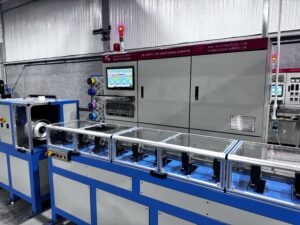
Hongkai’s SZ stranding line has achieved pay‑off tension fluctuation ≤ ±0.4 N and stranding pitch deviation ≤ ±0.08 mm, currently covering the demand for simultaneous stranding of 12 tubes. But as the industry moves toward even higher fiber counts, the precision and tube capacity of stranding equipment must continue to upgrade.
II. The Lesson from 5G Fully Connected Factories: Equipment Is Moving from “Stand‑alone” to “Networked”
The Sichuan Lefei Optoelectronics case is not an isolated example. FiberHome’s optical cable digital smart factory has achieved 100% data collection coverage on production lines, increasing overall production efficiency by 20%. Zhongtian Technology’s cable plant, through its AI‑based fiber allocation system, reduced the proportion of materials with over‑30‑day inventory from 7.14% to 1%, and cut frontline operators from 234 to 85.
Behind these changes is the shift of optical cable equipment from “stand‑alone automation” to “intelligent production lines.”
In the past: Stranding lines and sheathing lines operated independently, requiring separate patrols and separate record‑keeping. Changeover relied on senior operators’ memory of parameters, and quality traceability relied on paper records.
Now: All equipment is connected via a 5G private network. PLC, sensor, and frequency converter data are collected in milliseconds, and the entire line status is visible on a central control screen. Equipment management has shifted from “breakdown repair” to “predictive maintenance” – 5G gateways collect real‑time operating parameters, leveraging fault knowledge graphs for remote diagnostics and life prediction.
For optical cable manufacturers, this means the data capability of equipment is rapidly moving from “nice‑to‑have” to “must‑have.” Equipment without data interfaces or the ability to interface with management systems will gradually be phased out of mainstream supply chains.
Hongkai equipment comes standard with Siemens/Mitsubishi PLC platforms, supporting automatic production data logging and OPC UA/SQL interfaces for MES integration – this is the first step from “stand‑alone” to “networked.”
III. The Lesson from Hollow‑Core Fiber: Next‑Generation Cables Are Driving Equipment Iteration
AWS’s deployment of hollow‑core fiber to connect data centers is one of the most iconic events in the optical communications industry in 2026. Compared to traditional solid fiber, hollow‑core fiber can reduce latency by 33%, but mass production still faces enormous challenges.
What does hollow‑core fiber mean for optical cable equipment?
The structure of hollow‑core fiber is fundamentally different from traditional fiber – it is not a solid glass strand, but a larger glass tube containing multiple hollow glass tubes nested inside. This microstructure makes hollow‑core fiber more fragile than traditional fiber, imposing completely different requirements on tension control during stranding and sheathing processes.
Research has explicitly pointed out the need to develop stranding technologies suitable for hollow‑core fiber, employing low‑stress sheaths and buffer structures to avoid microbending damage to the fibers. In terms of splicing, existing standard splicers cannot meet the requirements; specialized splicers are needed.
Although hollow‑core fiber is still in its early deployment stage (AWS is only using it within metropolitan areas), the technological direction is clear – future optical cable equipment must be capable of handling new fiber types that are more delicate and more precise than traditional fibers.
For optical cable equipment manufacturers, this means they cannot focus only on today’s G.652.D and G.657.A2 – they must also reserve technical headroom for tomorrow’s hollow‑core and multi‑core fibers.
IV. Three New “Equipment Questions” for Optical Cable Manufacturers
Taking the trends above together, optical cable manufacturers in 2026 face three new equipment questions:
Question 1: Can stranding equipment support production of even higher fiber counts?
The 17,280‑core cable is already in mass production, and more high‑fiber‑count products are on the way. Can your stranding line support simultaneous stranding of more tubes? Can pay‑off tension fluctuation be controlled within tighter ranges? Can stranding pitch deviation be stabilized within ±0.1 mm?
Question 2: Can the equipment “go online”?
5G fully connected factories are moving from “showcase” to “standard.” Can your equipment automatically record process parameters for each batch? Can it interface with an MES system? Does it support remote diagnostics? If the answer is no, you may be losing the opportunity to enter mainstream supply chains.
Question 3: Can the equipment adapt to next‑generation fibers?
Hollow‑core and multi‑core fibers are moving from the lab to commercial use. Can your stranding and sheathing lines handle new fiber types that are more delicate than traditional ones? Is there room for future upgrades?
V. Hongkai Optical Cable Equipment: Ready for the “Deep Waters”
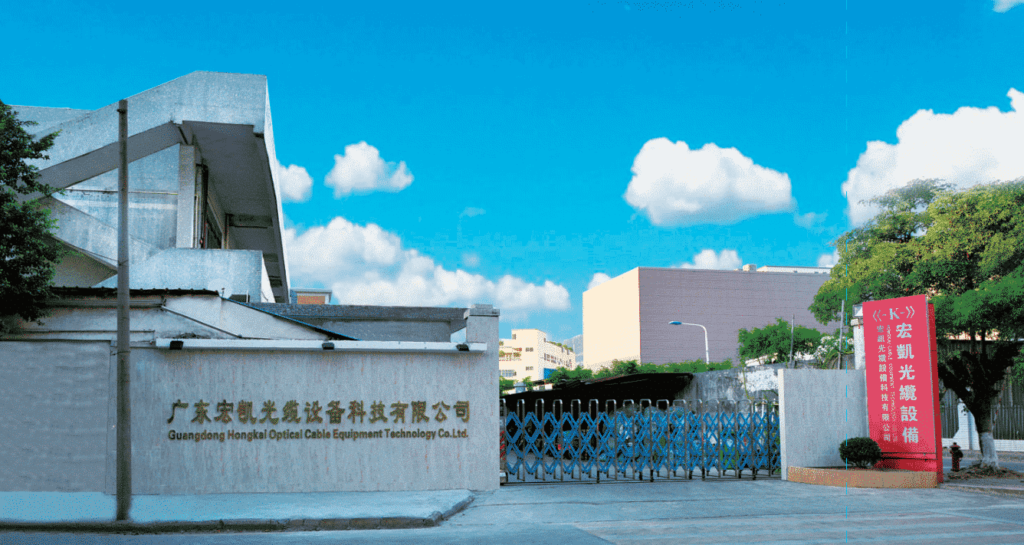
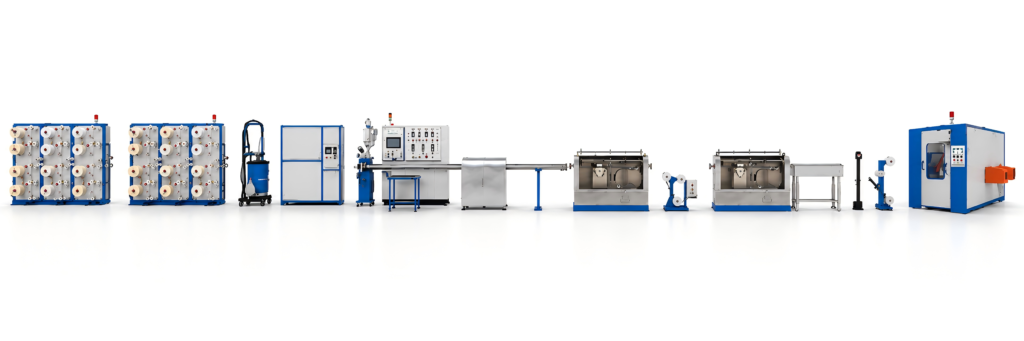
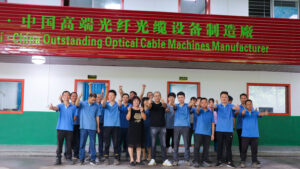
Guangdong Hongkai Optical Cable Equipment Technology Co., Ltd., established in 2015 (with origins dating back to 2005), specializes in optical cable manufacturing equipment – SZ stranding lines, outdoor cable sheathing lines, butterfly drop cable lines, and plastic tube production lines. The equipment has been exported to more than 15 countries and regions across the Middle East, Southeast Asia, South Asia, Africa, and Europe, with cumulative deliveries exceeding 160 sets.
In response to the new challenges of the “deep waters,” Hongkai continues to advance in the following dimensions:
Stranding precision: Hongkai’s SZ stranding line has achieved pay‑off tension fluctuation ≤ ±0.4 N (at 20 m/min line speed) and stranding pitch deviation ≤ ±0.08 mm, supporting simultaneous stranding of 12 tubes – covering current mainstream high‑fiber‑count cable requirements.
Sheathing precision: The sheathing line is equipped with a high‑precision laser diameter gauge (accuracy 0.2 μm, scanning speed 200 mm/s), achieving an average concentricity of 98.6% over 8 hours of continuous production, and wall thickness tolerance ≤0.04 mm (nominal 1.8 mm).
Data capability: Equipment comes standard with Siemens/Mitsubishi PLC platforms, supporting recipe storage (≥20 groups), automatic production data logging (CSV export), and OPC UA/SQL interfaces for MES integration – ready for the “networked factory.”
Changeover efficiency: One‑click recipe loading reduces changeover time to less than 1.5 hours, adapting to multi‑variety, small‑batch order structures.
Overseas delivery: Bilingual operation manuals, electrical schematics, and CE technical documentation are provided; remote video support (response within 2 working hours); on‑site engineer dispatch for installation and commissioning (12‑18 days from arrival to trial production).
VI. Final Thoughts
The optical cable manufacturing industry is entering the “deep waters” – the 17,280‑core cable has pushed density limits, 5G fully connected factories have redefined efficiency ceilings, and hollow‑core fiber has opened new technological horizons. These are not distant forecasts – they are happening now.
For optical cable manufacturers, the logic of equipment selection needs to evolve in parallel. Don’t just ask “what can this equipment produce today” – ask “will this equipment still keep up with industry changes tomorrow?”
Guangdong Hongkai Optical Cable Equipment Technology Co., Ltd. can provide, upon customer request, factory inspection reports for optical cable equipment, overseas delivery case references, and full‑plant planning proposals. For detailed equipment specifications or to evaluate line‑upgrade solutions, please feel free to contact the Hongkai technical team.