Many owners who have purchased fiber optic cable equipment often wonder: what is the annual maintenance cost for a fiber optic cable production line?
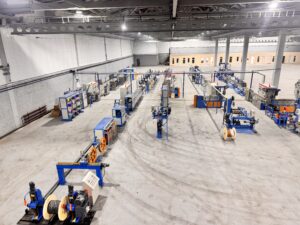
For an SZ stranding machine, changing the oil in the differential gearbox costs a couple thousand RMB. Several bearings need replacement – an SKF bearing can run several hundred RMB each. The screw of an extruder on the sheathing line needs re‑grinding after extended use – that’s a few thousand RMB. Cleaning or replacing the lens of a laser diameter gauge – another few hundred.
Individually, none of these seem like much. But add them up over a year? Tens of thousands of RMB is quite normal. And if something major goes wrong – like teeth shearing off in the differential gearbox, replacing that assembly costs tens of thousands; an extruder screw breaks – a new one is also tens of thousands.
When the market is booming, equipment runs 24/7. The more it runs, the more likely problems emerge. If maintenance lags, minor issues snowball into major breakdowns, and major breakdowns mean production stoppages. How much does one day of downtime cost? You do the math.
You don’t realize the true cost of maintenance until you sit down and calculate it.
1. The Most Common Failure Points on Fiber Optic Cable Equipment
Stranding Lines: Differential Gearboxes and Bearings Are the “Trouble Zones”
The heart of an SZ stranding machine is the differential gearbox – a cluster of gears meshing and rotating, one turn forward, one turn backward, tens of thousands of cycles per day. Gear wear is inevitable; the key is the rate of wear.
With proper lubrication, a differential gearbox can last 7–8 years without issue. But many factories don’t change the oil on schedule – the manual says every six months, but in reality they go a year or more without a change. Dirty oil accelerates gear wear, and after a few years the increased backlash throws off the pitch accuracy. Replacing a set of differential gears starts at tens of thousands of RMB.
Dancer arm bearings are also wear‑prone. A seized bearing causes unstable tension, which causes pitch deviation, which yields defective cable. A single bearing isn’t expensive, but the scrap it causes can cost you tens of thousands.
Sheathing Lines: Screws and Heater Bands Are the Biggest Cost Drivers
On the extruder of a sheathing line, the screw operates under high temperature and high pressure – wear is inevitable. When the screw wears, plasticizing efficiency drops, leading to rough sheath surfaces and uneven wall thickness. Re‑grinding a screw costs a few thousand RMB; replacing it with a new one costs tens of thousands.
Heater bands are also consumables. If a heater band burns out, the temperature won’t reach setpoint, and the entire line must stop. Waiting for a replacement part and installing it can take hours. If it happens during the night shift and you can’t get a new part until morning, you lose the whole night’s production.
Binder/Yarn Applicators and Taping Machines: Constant Minor Issues
The ceramic guide wheels on a binder machine are constantly rubbed by yarn, which over time creates grooves. Deep grooves can cut the yarn, causing breaks. Each break stops the line; if you get eight or ten breaks a day, efficiency plummets.
Brake pads and belts on taping machines are also consumables. They aren’t expensive, but without them the machine simply won’t run.
2. How Much Difference Does Good vs. Poor Maintenance Make?
Difference 1: Equipment Lifespan – Twice as Long
Take the same stranding machine – one factory maintains it properly and it still holds accuracy after ten years; another neglects maintenance and it rattles everywhere after five. What’s the difference? Lubrication. Equipment that gets timely oil and grease changes wears its gears and bearings much more slowly. Unmaintained equipment grinds metal against metal, and the lifespan is easily cut in half.
Difference 2: Scrap Rate – Several Percentage Points
When equipment accuracy degrades, the produced cable shows larger pitch deviations and lower concentricity. Some output can still be used, but some must be scrapped. For a line with an annual output of 3,000 km, a 2% difference in scrap rate – at today’s fiber price of around RMB 83 per fiber‑km – means hundreds of thousands of RMB per year.
Difference 3: Downtime – Night and Day
Planned maintenance takes half a day. Unplanned downtime, waiting for parts and repairs, can take three to five days or more. Some fiber optic cable plants have found that by monitoring equipment power in real time and intelligently controlling energy consumption, energy per unit of output can be reduced by over 20%. With digital twin technology applied to the cable manufacturing shop, overall equipment effectiveness (OEE) can improve by 15%–20%, and unplanned downtime can be cut by 30%. In a busy year with full order books, every day saved from downtime is extra profit.
3. What Does Fiber Optic Cable Equipment Maintenance Actually Involve?
Daily Must‑Dos (5 minutes – don’t skip them)
-
Check the tension curve on the touchscreen for any abnormal fluctuations.
-
Listen for any unusual noises from the running equipment.
-
Touch the motor and bearing areas to check for abnormal temperatures.
-
Clean the laser diameter gauge lens (dust will give inaccurate readings).
-
Test that the yarn breakage sensor is functioning.
Weekly Must‑Dos (30 minutes – schedule it)
-
Apply grease to dancer arm bearings.
-
Check the tension of all belts.
-
Clean the electrical cabinet cooling fans (clogged dust screens raise internal temperature).
-
Inspect the measuring wheel for wear.
Monthly Must‑Dos (half a day – non‑negotiable)
-
Calibrate tension sensors (hang a standard weight and verify the reading).
-
Calibrate the length counter (measure an actual length and compare with the display).
-
Check the oil level and quality in the differential gearbox.
-
Check that all heating zones on the sheathing line maintain stable temperatures.
Semi‑Annual Must‑Dos (1–2 days, schedule during low‑order periods)
-
Change the oil in the differential gearbox.
-
Inspect gear wear.
-
Re‑grind or replace the extruder screw (depending on wear condition).
-
Perform a comprehensive electrical system inspection.
As one data point shows: with 5G digital transformation, overall equipment utilization can rise from 90.7% to 96.0%. Much of that improvement comes from solid, consistent maintenance practices.
4. Which Spare Parts Should You Keep? Don’t Wait Until Something Breaks to Buy
A common problem in many cable factories: they only buy spare parts after a machine breaks down. If the part isn’t available locally and you have to wait for the supplier to ship it, you lose three to five days.
We recommend keeping the following items on hand – they don’t cost much, but they can save you in an emergency.
Spare Parts Kit for Stranding Lines
-
Dancer arm bearings (SKF/NSK, 2 sets)
-
Various belts (2 of each type)
-
Yarn breakage switches (2)
-
Proximity switches (2)
-
Differential gearbox lubricating oil (sufficient quantity)
Spare Parts Kit for Sheathing Lines
-
Heater bands (1 spare for each heating zone)
-
Thermocouples (2)
-
Laser diameter gauge lens (1 spare)
-
Extruder screw (ideally keep one spare; if not, at least have a re‑grinding schedule in place)
With these spares, you can handle minor issues yourself. No waiting for supplier shipments, no losing three to five days of production.
5. When Maintenance Falls Behind, Small Problems Become Big Ones
Case 1: No Bearing Grease – Tension Drifts Daily
A customer called saying their stranding line had unstable tension – they’d been adjusting it for days with no success. A remote video call revealed that the dancer arm couldn’t swing freely. When opened, the bearings were packed with dried‑up grease. Cleaning, replacing the bearings, and re‑greasing took one hour. They had wasted three days and scrapped an entire cable core.
Case 2: No Gearbox Oil Change – Gears Destroyed
Another customer hadn’t changed the differential gearbox oil in three years. The metal debris from worn gears circulated in the oil and destroyed both bearings and gears. Replacing the entire differential assembly cost tens of thousands of RMB and shut down production for a week.
Case 3: Lens Not Cleaned – Sheath Entirely Off‑Spec
An operator on a sheathing line didn’t notice dust on the laser diameter gauge lens, so the readings were consistently too high. The automatic control system kept adjusting the extruder speed, throwing the wall thickness completely off. An entire reel of sheathed cable failed inspection. Scrapping that cable cost tens of thousands. Cleaning the lens? Thirty seconds.
6. Hongkai’s Maintenance‑Friendly Design Features
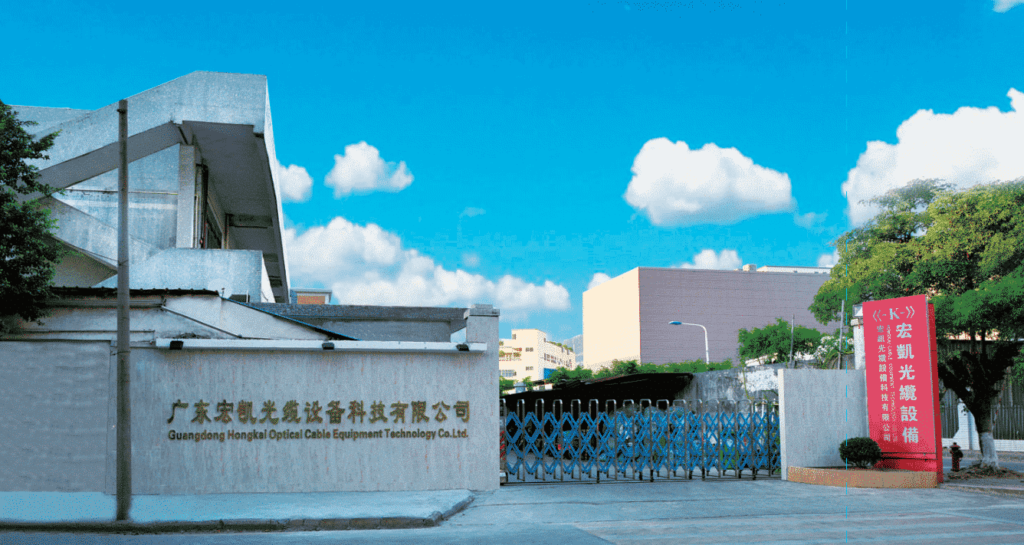
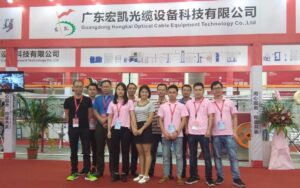
Guangdong Hongkai Optical Cable Equipment Technology Co., Ltd. began manufacturing wire and cable equipment in 2005 and was formally incorporated in 2015. Our main products include SZ stranding and cabling lines, fiber optic cable sheathing extrusion lines, and butterfly‑shaped drop cable production lines.
Hongkai equipment incorporates several practical design features for easier maintenance:
-
Bearings from SKF/NSK – a bit pricier, but they last 7–8 years without frequent replacement.
-
Gears with high‑frequency hardening and precision grinding – more wear‑resistant, extending gearbox life.
-
Major electrical components from Siemens/Mitsubishi/Schneider – global warranty coverage, and you can source replacement parts locally.
-
Each machine comes with a wear‑parts kit – belts, bearings, sensors, fuses, shipped with the equipment.
-
PLC program backup on a USB drive – if parameters get corrupted, restore in 15 minutes without waiting for an engineer.
Our equipment has been exported to more than 15 countries and regions, with over 160 sets currently running on production lines worldwide.
If you are evaluating fiber optic cable equipment, or if you already have equipment and are unsure how to maintain it properly, feel free to contact the Hongkai technical team. We can provide a detailed maintenance checklist and practical guidance.