Cable manufacturers – when you’re selecting equipment, the questions you ask most often are: How much does it cost? What’s the accuracy? How long is the delivery lead time?
Rarely does anyone ask: Has this equipment been designed with the real-world conditions of the production floor in mind?
Between equipment design and shop-floor reality, there’s often a thin veil of separation. Pierce through it, and you get equipment that runs smoothly, requires less attention, and delivers results quickly. Leave it unaddressed, and the machine develops minor issues daily – operators curse under their breath, and the boss gets a headache.
Today, let’s talk about a few “clever design touches” in fiber optic cable equipment – and how they solve actual production problems.
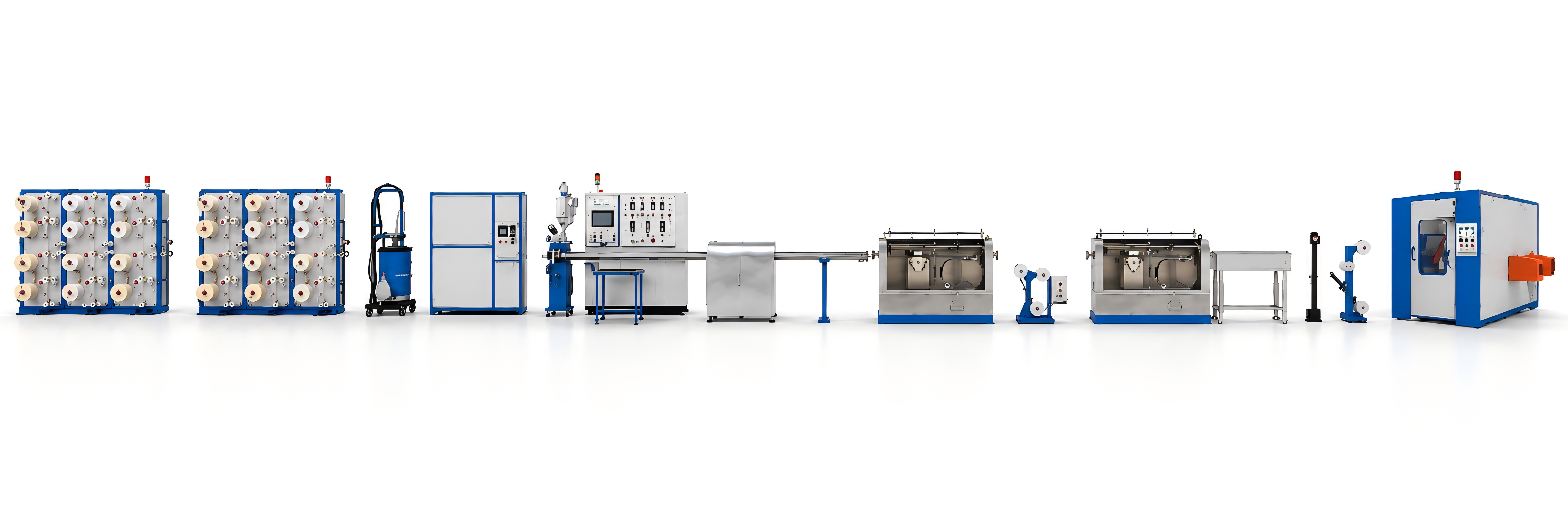
1. Stranding Machine Design: Want Stable Tension? Look at the Dancer
The core of a stranding machine is tension control. Whether the pay-off tension of the buffer tubes is stable directly determines whether the stranding pitch is accurate. Unstable tension means pitch deviation; pitch deviation means defective cable.
But tension is invisible and intangible – how does an operator know whether it’s stable? Look at the dancer.
The dancer is a swing-arm mechanism on the stranding machine. The buffer tube, coming off the pay-off reel, passes over the dancer before entering the stranding unit. When tension is high, the arm presses down; when tension is low, the arm rises. The angle change of the arm is converted into an electrical signal fed back to the PLC, which automatically adjusts the pay-off motor speed.
What does good design look like?
The dancer arm bearings are from SKF or NSK – high precision, low resistance. At the slightest movement of the arm, the sensor picks it up, the signal goes to the PLC, and adjustment is completed within 20 milliseconds.
What does poor design look like?
The bearings are off-brand, and they start to bind after a while. A stuck arm means inaccurate signals. Inaccurate signals mean the PLC makes wrong adjustments. Wrong adjustments mean tension drifts. Tension drift means pitch deviation. The operator spends all day twisting knobs and tweaking parameters – and still ends up with a pile of scrap.
One detail determines whether a stranding machine is a pleasure or a pain to use.
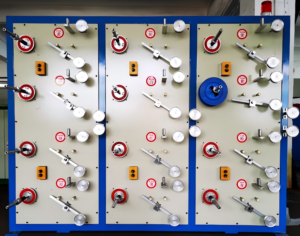
2. Sheathing Line Design: Want Good Concentricity? Look at the Die
The core of a sheathing line is concentricity. If the sheath is thicker on one side and thinner on the other, the thick side wastes material and the thin side compromises protection.
Traditional sheathing dies are “modular” – the core and the sleeve are installed separately, and after assembly, you have to manually adjust for eccentricity. An experienced master technician might take 30 minutes; a novice might not get it right in an hour.
Some manufacturers have already introduced integrated sheathing dies – the entire die is a single unit, requiring no assembly and no eccentricity adjustment – just mount it and run.
What does good design look like?
The die is one piece; concentricity is guaranteed during machining. The operator mounts the die and starts production – no adjustment, no trial run. During changeover, pull the old die off and mount the new one – minutes, not hours.
What does poor design look like?
The die is split – core and sleeve installed separately. After mounting, you have to adjust eccentricity – loosen four screws, reposition, tighten, trial-run, inspect wall thickness, adjust again. Back and forth several times – half an hour gone. Repeat for every changeover. Three changeovers a day? That’s an hour and a half wasted.
One detail determines whether a sheathing line saves you time or wastes it.

3. Process Design: How to Determine Pitch? It Depends on the Cable’s Application
Stranding pitch is the “skeleton parameter” of a fiber optic cable – it’s the distance the cable advances during one full rotation of the stranding unit.
Larger pitch – the cable is more flexible with better bending performance, but tensile strength is slightly lower.
Smaller pitch – the cable is stiffer with higher tensile strength, but bending performance is somewhat compromised.
Different cable applications demand different pitches:
| Application | Pitch Requirement |
| Indoor cable | Larger (more flexible) |
| Outdoor cable | Smaller (higher tensile strength) |
| Data center cable | Moderate (good bending performance) |
| Submarine cable | Very small (extremely high tensile strength required) |
Good design allows the operator to input the desired pitch directly on the touchscreen. The PLC automatically matches stranding speed and haul-off speed – no gear changes, no speed-ratio calculations.
One detail determines whether the equipment can handle diverse product orders.
4. Material Design: What Sheath Material to Use? It Depends on Where the Cable Goes
There are several types of sheath materials, each with different requirements for the equipment:
| Material | Application | Characteristics |
| PE (Polyethylene) | Outdoor cable | Good weather resistance, but requires high extrusion temperature |
| PVC (Polyvinyl Chloride) | Indoor cable | Inexpensive, easy to process, but not low-temperature resistant |
| LSZH (Low Smoke Zero Halogen) | Data centers and equipment rooms | No toxic smoke when burning, but demands more from the screw |
What does good design look like?
The screw and barrel design is compatible with multiple materials – set the temperature higher for PE, lower for LSZH. Switch materials without changing the screw.
What does poor design look like?
The equipment is optimized for only one material – runs PE fine, but fails with LSZH: poor plasticization, rough sheath surface, uneven wall thickness. You want to bid on high-margin data center orders, but your equipment can’t handle them.
One detail determines what tier of orders your equipment can take.
5. Smart Design: How to Use Data? It Depends on What Management Needs
Today’s cable workshops are different from before. At Sichuan Lefei Optoelectronics’ 5G fully connected factory, all-process equipment – coloring, stranding, sheathing – achieves millisecond-level data acquisition.
What does good design look like?
Equipment comes with data interfaces. Production data is automatically collected and uploaded. Managers can see the status of every machine from their office – production volume for the day, scrap rate, any anomalies.
What does poor design look like?
The equipment is “mute” – data can’t be uploaded. Managers rely on verbal reports from operators. By the time a problem is discovered, it’s already too late.
One detail determines whether the equipment can keep pace with the modern factory floor.
6. About Hongkai
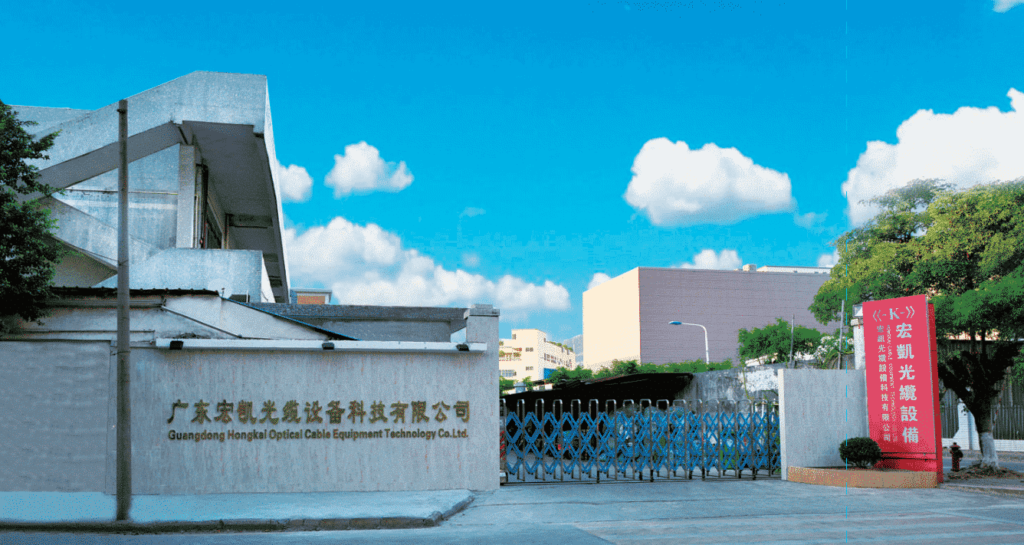
Guangdong Hongkai Optical Cable Equipment Technology Co., Ltd. began manufacturing wire and cable equipment in 2005 and was formally incorporated in 2015. Our main products include SZ stranding and cabling lines, fiber optic cable sheathing extrusion lines, and butterfly-shaped drop cable production lines.
Hongkai equipment is designed with real production-floor problems in mind:
Dancer arm bearings from SKF/NSK – sensitive tension feedback, measured fluctuation ≤ ±0.4 N
Sheathing lines equipped with laser diameter gauges – measured concentricity ≥ 98.6%
Recipe storage with one-touch loading – changeover time within 1.5 hours
Standard Siemens/Mitsubishi PLC – supports data acquisition and MES integration
Our equipment has been exported to more than 15 countries and regions, with over 160 sets currently running on production lines worldwide.
If you are evaluating fiber optic cable equipment and want to know whether the design truly solves the real-world problems of production, feel free to contact the Hongkai technical team.