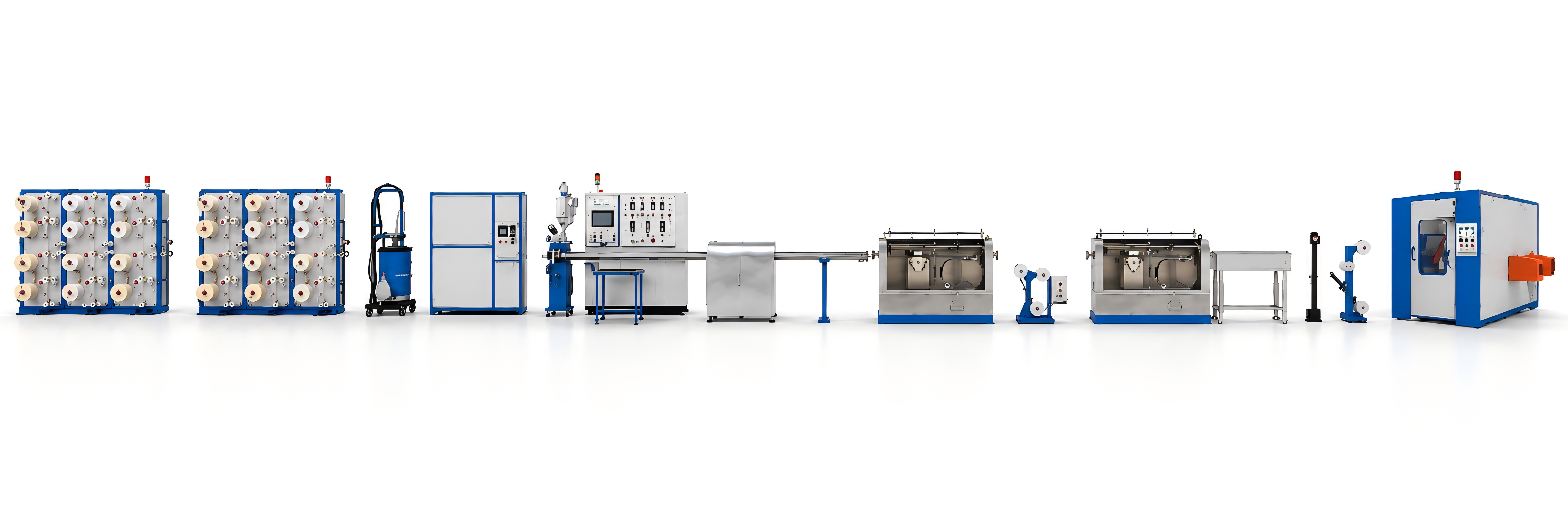
An SZ stranding and cabling machine plus a fiber optic cable sheathing extrusion line – an investment of several hundred thousand to over one million RMB.
When this money goes out, how long before it comes back?
Today, let’s run the numbers – realistically and in detail.
1. Investment: How Much Does a Set of Equipment Cost?
The price of fiber optic cable equipment varies significantly based on configuration, accuracy, and brand. Below is a rough reference range (RMB, new equipment):
| Equipment | Price Range | Notes |
|---|---|---|
| SZ stranding and cabling machine | RMB 350,000 – 800,000 | Depends on tube count and control system configuration |
| Fiber optic cable sheathing extrusion line | RMB 300,000 – 700,000 | Depends on extruder size, gauge configuration, and automation level |
A “stranding machine + sheathing line” combination typically costs between RMB 650,000 and 1.5 million. Taking a mid-range estimate: approximately RMB 1.2 million.
What does this RMB 1.2 million buy? One stranding machine, one sheathing line, installation and commissioning, operator training, and a complete wear‑parts kit.
2. Output: How Much Can This Equipment Earn in a Year?
Fiber optic cable prices have risen, and so has the hourly output value of the production line. Let’s use conservative figures:
| Parameter | Value |
|---|---|
| Line speed | 90 m/min (average for stranding and sheathing; actual can be faster) |
| Annual operating hours | 300 days × 16 hours = 4,800 hours |
| Annual output | 90 m/min × 60 min × 4,800 h = 2,592,000 m = 2,592 km |
Using G.652.D bare fiber at RMB 83.4 per fiber‑km as a reference – but note this is the bare fiber price, not the finished cable price. Depending on the product structure, standard optical cable prices range from RMB 1,000–3,000 per km, with premium products commanding higher prices. (These 2026 prices are conservative; actual may be higher.)
-
Annual output value: 2,592 km × RMB 1,800/km = RMB 4.67 million
Of course, output value is not profit. Raw materials (fiber, sheath materials, strength members), labor, electricity, and factory depreciation all need to be deducted. But one thing is certain: the equipment investment itself is a relatively small percentage of the output value.
3. Key Variables: Equipment Accuracy and Efficiency Directly Determine Payback Speed
You can have the same RMB 1 million equipment – one factory makes a fortune, another barely breaks even. What’s the difference? A few critical data points:
Variable 1: Scrap Rate
Unstable tension on the stranding machine causes pitch deviation, driving up the scrap rate. Insufficient concentricity on the sheathing line creates uneven wall thickness, also raising the scrap rate.
For a line producing 2,592 km per year, a 1% difference in scrap rate means 26 km of lost production annually. At RMB 1,800/km, that’s RMB 46,800 per year. Over three years, that’s RMB 140,000 – nearly the cost of an entire machine.
Hongkai’s stranding machine measures pay‑off tension fluctuation ≤ ±0.4 N and pitch deviation ≤ ±0.08 mm; the sheathing line achieves concentricity ≥ 98.6% and wall thickness tolerance ≤ 0.04 mm. These figures mean scrap rates can be kept very low.
Variable 2: Downtime
Equipment running 24/7 will eventually have issues. How quickly you can fix them directly determines the loss.
-
Spare parts arrive in 3 days vs. 3 weeks – the difference is 18 days of lost capacity.
-
18 days × 16 hours × 90 m/min × 60 min = 1,552,000 m = 155 km of cable, valued at approximately RMB 280,000.
Hongkai provides a wear‑parts kit with every machine, and spare parts can be delivered via DHL within 3 days.
4. Payback Period: As Fast as One Year, Conservatively Two to Three
Let’s run the full calculation:
| Item | Amount |
|---|---|
| Investment | RMB 1.2 million (stranding + sheathing) |
| Annual output value | RMB 4.67 million (2,592 km × RMB 1,800/km) |
| Annual profit (net margin) | ~RMB 700,000 (typically 10%–20% depending on product mix and market conditions; 2026 margins are generally favorable) |
| Payback period | RMB 1.2M ÷ RMB 0.7M ≈ 1.71 years (about 1 year and 8 months) |
Of course, this is the ideal scenario. In practice, you need to account for equipment installation and commissioning time, market fluctuations, raw material availability, and other factors. But even factoring these in, under the 2026 market environment, the payback period for a set of cable equipment typically falls between 1 and 2 years.
5. Real Case Study: Validating the Investment Value
Case Analysis: A Korean Cable Company Invests in Stranding and Sheathing Lines to Upgrade Production Capacity
In the fiber optic cable industry, equipment investment is not just about buying a machine – it’s about establishing a stable, efficient production capability.
In 2025, a Korean cable manufacturer, seeking to expand its optical cable production scope and improve delivery capabilities, selected Hongkai’s equipment solution after extensive comparison.
Total project investment: approximately RMB 1.2 million, including:
-
SZ stranding and cabling machine
-
Fiber optic cable sheathing extrusion line
-
Equipment shipping and installation guidance
-
On‑site commissioning service by engineers
-
Operator technical training
-
A complete set of commonly used wear parts
-
One‑year equipment warranty
From project delivery onward, the Hongkai engineering team planned the installation based on the customer’s actual factory layout and dispatched technical engineers to the Korean facility to complete installation, commissioning, and operator training.
During the commissioning phase, the engineers not only helped the customer configure equipment parameters but also provided training on the following, tailored to different cable structure production requirements:
-
Daily equipment operation procedures
-
Production parameter adjustment methods
-
Changeover operations for different cable specifications
-
Troubleshooting common issues
-
Equipment maintenance requirements
Through on‑site training, the customer’s technical staff became capable of independently operating the equipment and performing basic maintenance, significantly reducing technical risks during subsequent production.
Additionally, to ensure production stability after commissioning, the project included a complete inventory of commonly used wear parts. For non‑human‑induced damage during normal operation, Hongkai provided free replacement parts within the warranty period – helping the customer minimize downtime and maximize equipment utilization.
Based on the customer’s product plan, this line is primarily used for manufacturing standard telecommunications optical cables. After official production launch, the investment not only enhanced the customer’s in‑house production capacity but also reduced outsourced processing costs and improved order response speed.
From an investment perspective, what the customer acquired was not just equipment, but a complete production solution encompassing equipment supply, installation and commissioning, technical training, and after‑sales support.
For companies planning to enter the optical cable manufacturing industry, equipment selection should focus not only on purchase price but also on:
-
Long‑term operational stability
-
Product quality control capability
-
Changeover efficiency
-
After‑sales service response speed
All of these factors directly affect the equipment investment payback cycle.
6. How to Select Equipment for Faster Payback?
To recover your equipment investment in the shortest possible time, focus on these three principles:
Principle 1: Look at accuracy data, not just price
What’s the stranding machine’s tension fluctuation? What’s the sheathing line’s concentricity? Request the factory test report. Higher‑precision equipment may cost more upfront, but it delivers lower scrap rates and the ability to take on higher‑margin orders – meaning faster payback overall.
Principle 2: Look at changeover efficiency, not just capacity
High capacity means nothing if changeover is slow. Does the equipment have recipe storage? How long does changeover take? Fast‑changeover equipment can produce hundreds of extra kilometers of cable per year.
Principle 3: Look at after‑sales service, not just delivery time
How quickly can equipment be repaired when it breaks down? How fast can spare parts arrive? Is remote support available? Equipment with strong service support means one less day of downtime – and one more day of profit.
7. About Hongkai
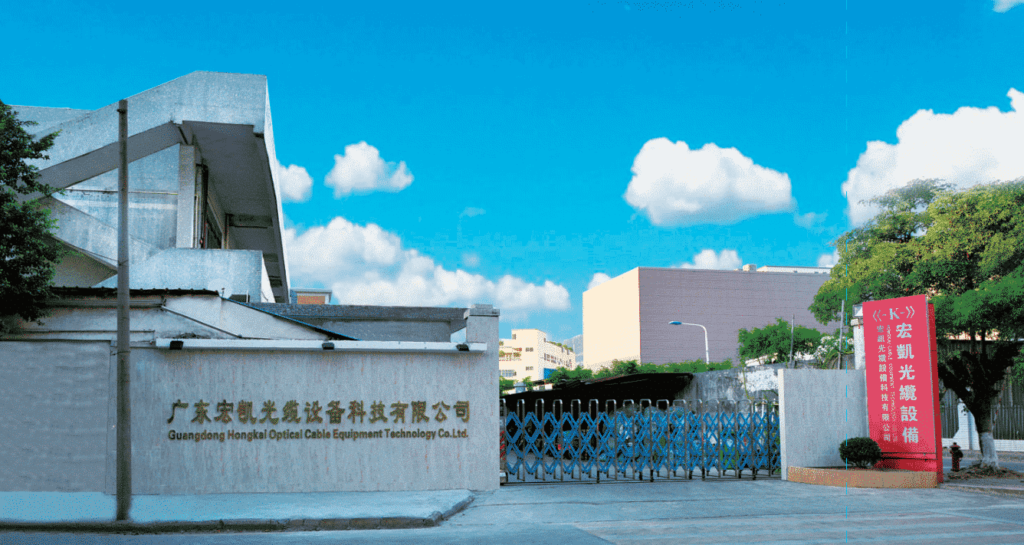
Guangdong Hongkai Optical Cable Equipment Technology Co., Ltd. began manufacturing wire and cable equipment in 2005 and was formally incorporated in 2015. Our main products include SZ stranding and cabling lines, fiber optic cable sheathing extrusion lines, and butterfly‑shaped drop cable production lines.
Hongkai equipment measured data:
| Parameter | Measured Value |
|---|---|
| Stranding pay‑off tension fluctuation | ≤ ±0.4 N |
| Stranding pitch deviation | ≤ ±0.08 mm |
| Sheathing concentricity | ≥ 98.6% |
| Wall thickness tolerance | ≤ 0.04 mm |
| Changeover time | ≤ 1.5 hours (one‑touch recipe loading) |
Our equipment has been exported to more than 15 countries and regions, with over 160 sets currently running on production lines worldwide.
If you’re calculating the ROI of equipment investment, or comparing payback periods across different equipment solutions, feel free to contact the Hongkai technical team. We can run a more detailed analysis based on your actual production capacity and product mix.