Faced with the many fiber optic cable equipment suppliers on the market, how do you choose? By price? By brand? By delivery time? Today, let’s put together a practical chart and break down the key selection criteria for fiber optic cable equipment, one by one.
1. Before Selecting Equipment, First Clarify What Products You Want to Make
Different optical cable products have different equipment requirements. Before looking for optical cable manufacturing equipment, answer three questions first:
Question 1: What type of optical cable do you produce?
| Product Type | Equipment Requirement |
|---|---|
| Loose tube outdoor cable | Standard – medium accuracy requirements |
| FTTH butterfly drop cable | Dedicated FTTH drop cable production line |
| High-fiber-count ribbon cable | Extremely high stranding accuracy required |
| Armored cable | Armored optical cable manufacturing equipment |
| Data center cable | Extremely high sheath concentricity required |
Question 2: What is your target production capacity?
| Annual Output | Recommended Configuration |
|---|---|
| Several hundred km | Entry-level configuration |
| Several thousand km | Medium-to-high speed production line |
| 10,000+ km | High-speed, highly automated equipment |
Question 3: Does the equipment need to be exported?
If exporting overseas, the equipment supplier must have international delivery experience, bilingual technical documentation, and certification capabilities such as CE.
Once these three questions are clear, you can look at the specific selection criteria.
2. SZ Stranding and Cabling Machine Selection: Watch Three Data Points
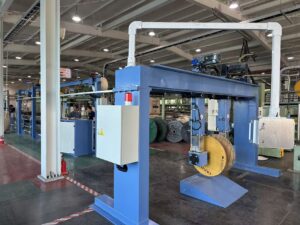
The SZ stranding and cabling line is the core equipment in optical cable production. When selecting a stranding machine, focus on these three data points:
| Selection Criterion | Industry Standard | Why It Matters | How to Verify |
|---|---|---|---|
| Pay-off tension fluctuation | ≤ ±0.5 N | Unstable tension → pitch deviation → defective cable | View real-time tension curve on touchscreen |
| Stranding pitch deviation | ≤ ±0.1 mm | Pitch is the cable’s “skeleton parameter” | Measure a stranded core section |
| Maximum tube count | 12 reels (standard) | More tubes = higher fiber count capability | Check equipment configuration |
Hongkai SZ stranding machine measured data: pay-off tension fluctuation ≤ ±0.4 N, pitch deviation ≤ ±0.08 mm, supporting simultaneous stranding of up to 12 tubes.
If you have higher accuracy requirements, you can opt for a high-precision SZ stranding line – these typically feature a fully differential structure with PLC stepless setting, offering higher accuracy and faster changeover.
3. Fiber Optic Cable Sheathing Line Selection: Concentricity Is the Key
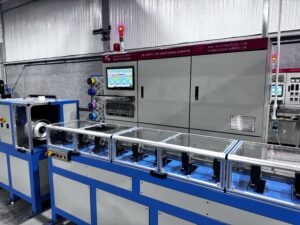
The sheathing extrusion line is the final process in optical cable production. If the sheathing is not done right, everything before it is wasted. When selecting a sheathing line, look at these five indicators:
| Selection Criterion | Industry Standard | Why It Matters | How to Verify |
|---|---|---|---|
| Concentricity | ≥ 98% | Eccentric sheath → uneven wall thickness → inadequate protection | Cut cross-section and view under microscope |
| Wall thickness tolerance | ≤ 0.05 mm (at 1.8 mm nominal) | Uneven thickness → material waste or insufficient protection | Measure at multiple points |
| Material compatibility | PE, PVC, LSZH | Different materials for different applications | Ask about screw configuration |
| Laser diameter gauge | Must have | Real-time outer diameter monitoring, automatic adjustment on deviation | Check equipment spec list |
| Changeover time | ≤ 2 hours | Slow changeover → wasted capacity | On-site trial |
Hongkai sheathing line measured data: concentricity ≥ 98.6%, wall thickness tolerance ≤ 0.04 mm, compatible with PE, PVC, LSZH, changeover time under 1.5 hours.
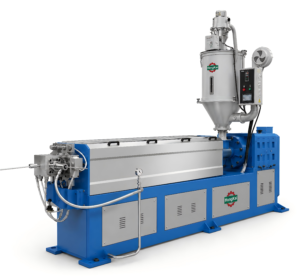
4. FTTH Drop Cable Production Line Selection: The Die Is the Core
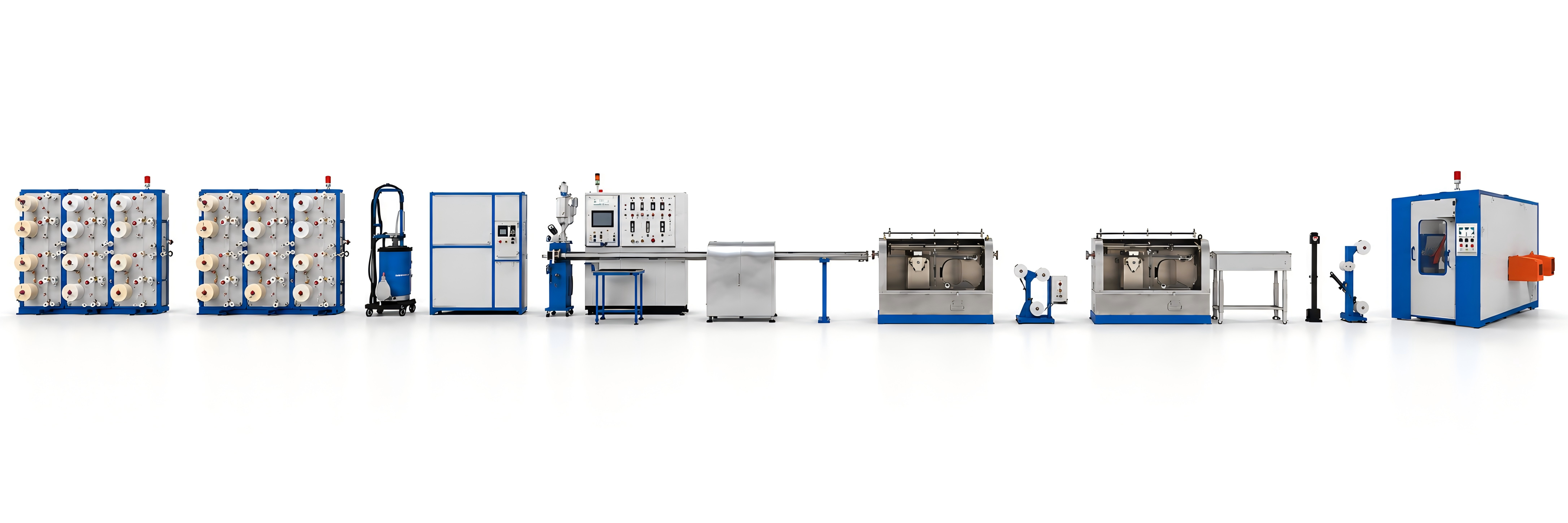
If you primarily produce butterfly-shaped drop cables for fiber-to-the-home applications, you need an FTTH drop cable production line, rather than the conventional stranding + sheathing combination.
The core of an FTTH drop cable production line is the extrusion die – extruding the sheath into a flat butterfly shape with fibers in the center and strength members on both sides. Key selection points:
| Selection Criterion | What to Look For |
|---|---|
| Fiber count capacity | Single-core and dual-core are most common; can it handle multi-core? |
| Extrusion speed | Higher speed = higher capacity |
| Die precision | Is the butterfly cross-section dimension stable? |
| Strength member pay-off | Can steel wire and FRP be paid off simultaneously? |
| Automation level | Automatic reel change? Can it connect to MES? |
5. The “Five Must-Ask Questions” for Equipment Selection
No matter what equipment you’re selecting, ask these five questions to gauge whether the supplier is reliable:
Question 1: Can we see the factory test report?
Good equipment manufacturers provide a test report with every machine, recording actual measured data – tension fluctuation, pitch deviation, concentricity. Those willing to show you have data they’re proud of. Those who won’t – you can draw your own conclusions.
Question 2: What brands are the key components?
Are bearings SKF or off-brand? Are electrical components Siemens/Mitsubishi or generic? What material is the screw made of and what heat treatment does it undergo? These directly determine how many years the equipment will last and how stable it will be.
Hongkai uses SKF/NSK bearings, Siemens/Mitsubishi/Schneider electrical components, and 38CrMoAlA screws with nitriding treatment.
Question 3: How long does a changeover take?
Today’s order mix is diverse – data centers want high fiber counts, overseas markets want G.657, telecoms want loose-tube cables. Changeover time directly determines annual effective output. Does the equipment have recipe storage? Is changeover one-touch or manual parameter entry?
Question 4: Can the equipment connect to MES?
Workshops are moving from “people watching machines” to “data managing machines.” Does the equipment have data interfaces? Can it automatically record production data? Can it connect to MES systems? Equipment without data capability may eventually be phased out.
Hongkai equipment comes standard with Siemens/Mitsubishi PLC, supporting data acquisition and MES integration.
Question 5: Can you send personnel for overseas installation?
If your equipment is for export, or if you have factories overseas, can the supplier send personnel for on-site installation and commissioning? Are bilingual operation manuals available? Can spare parts be shipped quickly? These capabilities determine how soon after arrival the equipment can go into production.
Hongkai equipment has been exported to more than 15 countries and regions, with bilingual manuals, remote support, and engineer on-site service available.
6. Common Selection Mistakes: Don’t Step into These Four Traps
Mistake 1: Looking only at price, not configuration
The same “stranding machine” can have a price difference of double. The cheap one uses off-brand bearings, off-brand electrical components, and ordinary steel. The expensive one uses SKF bearings, Siemens PLC, and alloy steel screws. You save tens of thousands upfront, but the machine breaks down constantly – and you end up paying more in the long run.
Mistake 2: Looking only at capacity, not accuracy
High capacity means nothing if the cable produced fails quality standards. G.657.A2 cable prices have increased tenfold – but this cable requires extremely high sheath concentricity. Without sufficient accuracy, you can’t take high-margin orders.
Mistake 3: Looking only at new equipment, not used
If budget is limited, used fiber optic cable equipment is an option. But always inspect and test used equipment in person – bring an experienced technician along. Photos alone won’t reveal problems that only show up during actual operation.
Mistake 4: Looking only at equipment, not service
Equipment will eventually break down. How quickly can it be repaired? How fast can spare parts arrive? Is remote support available? These factors affect production even more than the equipment price. Selecting equipment also means selecting the service capability of the optical cable making machine manufacturer.
7. About Hongkai
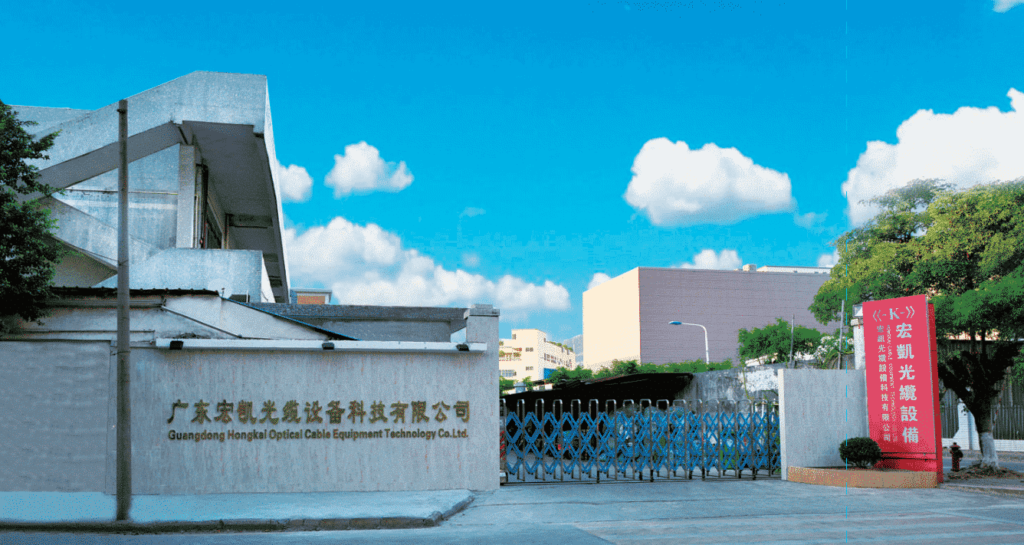
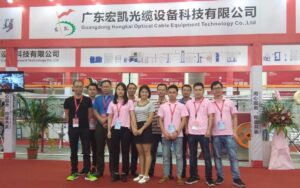
Guangdong Hongkai Optical Cable Equipment Technology Co., Ltd. began manufacturing wire and cable equipment in 2005 and was formally incorporated in 2015. Our main products include SZ stranding and cabling lines, fiber optic cable sheathing extrusion lines, and FTTH drop cable production lines.
Hongkai does not manufacture coloring machines or secondary coating lines – we focus on what we do best: the stranding and sheathing processes, which are the critical steps that determine the cable’s mechanical properties and temperature performance.
Hongkai equipment measured data:
| Parameter | Measured Value |
|---|---|
| Stranding pay-off tension fluctuation | ≤ ±0.4 N |
| Stranding pitch deviation | ≤ ±0.08 mm |
| Sheathing concentricity | ≥ 98.6% |
| Wall thickness tolerance | ≤ 0.04 mm |
| Changeover time | ≤ 1.5 hours (one-touch recipe loading) |
Our equipment has been exported to more than 15 countries and regions, with over 160 sets currently running on production lines worldwide. Every machine comes with a factory test report, a PLC program backup on USB, bilingual operation manuals (Chinese/English), and a wear-parts kit.
If you are setting up a fiber optic cable production line, or need a custom optical cable production line, feel free to contact the Hongkai technical team.