Over the past decade, the production process for loose-tube cables has remained relatively fixed – coloring, secondary coating, stranding, binder yarn application, sheathing – step by step. But in the last couple of years, cable manufacturers have started asking themselves: can we skip some of these intermediate steps? Can we make lines run faster, take up less floor space, and produce less scrap?
So, new processes are emerging – no-binder-yarn cables, combined stranding-and-sheathing integrated machines, UV-LED curing. New processes mean that cable equipment manufacturers must evolve too.
-300x300.jpeg)
1. No-Binder-Yarn Cables Are Coming – What Does That Mean for Stranding Machines?
In May 2026, Yangtze Optical Fiber and Cable (YOFC) filed a patent for a “no-binder-yarn loose-tube optical cable.” The patent states it plainly: the cable core has no binder yarn, resulting in higher roundness, smaller diameters, and lower costs.
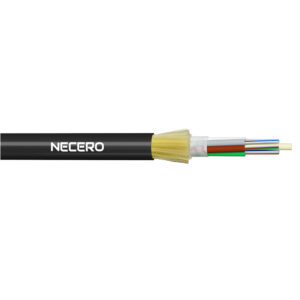
What is binder yarn? During stranding, after the loose tubes are twisted together, yarn is used to bind them – otherwise, the core would fall apart. This process is called binder-yarn application and has been a standard step in stranding. But binder yarn has its problems – it adds thickness, increasing cable outer diameter; and yarn splices can create bulges, affecting roundness.
Now, someone wants to eliminate this step entirely.
What does this mean for cable stranding equipment?
On traditional stranding machines, the tubes are secured by binder yarn after stranding. With no-binder-yarn processes, the stranded core goes directly into sheathing, relying on the shrink force of the sheath to “hoop” the core together. This demands significantly higher stranding accuracy – if pitch deviation is even slightly off, the core won’t be round, and the sheath won’t adhere properly.
Under no-binder-yarn conditions, an SZ stranding and cabling line must control pay-off tension fluctuation within ±0.5 N and stranding pitch deviation within ±0.1 mm. If you’re still running older equipment with tension fluctuation of ±1 N and pitch deviation of ±0.3 mm, the core simply won’t meet no-binder-yarn cable requirements.
Hongkai’s SZ stranding machine measures pay-off tension fluctuation ≤ ±0.4 N and pitch deviation ≤ ±0.08 mm. The differential gears undergo high-frequency hardening and precision grinding, with SKF or NSK bearings. With that level of precision, no-binder-yarn cable production is well within reach.
2. Stranding-Sheathing Integrated Machine: Eliminating the Handling of Heavy Reels
On traditional cable production lines, stranding and sheathing are separate processes – tubes are stranded into a core, wound onto reels, moved to the sheathing line, re-payed off, and sheathed. This adds an extra step of winding, handling, and re-pay-off.
Inefficient – and prone to damage.
A patented integrated stranding-sheathing production device eliminates the need for intermediate winding and pay-off between stranding and sheathing. The stranded core goes directly into sheathing without reeling and unreeling steps.
What does this mean for equipment integration?
Integrated machines are changing how cable factories approach equipment procurement. Previously, it was “buy a stranding machine, then buy a sheathing line.” Now it’s “one production line handles everything from stranding to sheathing.” Equipment integration, floor-space efficiency, and labor efficiency are becoming new competitive dimensions.
Hongkai does not manufacture integrated machines, but our equipment is designed with process continuity in mind – all machines are built on a unified PLC platform (Siemens/Mitsubishi), and the stranding machine and sheathing line can communicate via industrial Ethernet for speed matching and data exchange. If customers want to retrofit their own stranding-sheathing integration, Hongkai’s equipment provides open interfaces.
3. Sheathing Extrusion Is Changing: UV-LED Curing Is Here
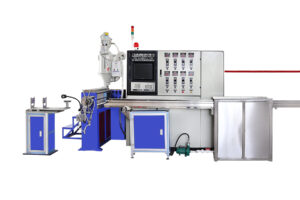
Traditional sheathing extrusion relies on heater bands to melt plastic, extrude it over the cable core, and then cool it naturally or in a water trough. The quality of temperature and cooling control directly determines sheath concentricity and wall thickness uniformity.
New technology is being introduced to sheathing lines – UV-LED line light source curing systems. With high penetration, uniform light spots, and stable output, this technology is becoming key equipment for high-speed extrusion lines to improve sheath quality. Compared to traditional heating methods, UV-LED curing is faster, consumes less energy, and offers more precise temperature control.
What does this mean for sheathing equipment?
The core components of sheathing lines are shifting from “extruder + heater bands” to “extruder + UV curing system.” Equipment manufacturers must achieve precise control in both extrusion and curing to ensure sheath concentricity and wall thickness uniformity.
Hongkai’s sheathing line is equipped with a high-precision laser diameter gauge (accuracy 0.2 μm), using a PID algorithm to dynamically adjust extruder screw speed. Over 8 hours of continuous production, concentricity averages 98.6%, with wall thickness tolerance ≤ 0.04 mm. Whether the sheathing line uses traditional heating or UV curing, the diameter gauge and closed-loop control remain the key to ensuring concentricity.
4. Braiding Machines Are Expanding: Demand for Specialty Cables Is Rising
In May 2026, Amd Optics added 260 PET braiding machines to enhance its specialty cable manufacturing capabilities. After commissioning, braiding precision and production efficiency directly improved, with product consistency and stability achieving dual upgrades.
Braided sheaths are a common process for specialty cables – braiding a layer of PET or aramid fiber over the cable to increase tensile strength and abrasion resistance. Demand for specialty cables in data centers, cloud computing, and other sectors is growing rapidly.
What does this mean for cable equipment?
Cable manufacturing is moving from “general-purpose” to “specialty.” Data centers need high-fiber-count cables and bend-insensitive cables. The power industry needs ADSS and OPGW cables. Offshore engineering needs submarine cables. Each specialty cable type has different equipment requirements.
Hongkai does not manufacture braiding machines, but our SZ stranding and sheathing lines are compatible with multiple specialty cable production needs. Aramid yarn pay-off stands are suitable for ADSS cables; steel tape armoring equipment is suitable for armored cables; FTTH drop cable production lines are suitable for butterfly drop cables.
5. The “New Capability Checklist” for Cable Equipment Manufacturers
Cable manufacturing processes are changing, and so are the capability requirements for cable equipment manufacturers. In the past, being able to build a stranding machine was enough – not anymore.
Capability 1: Higher precision. No-binder-yarn cables demand stranding accuracy far beyond traditional products. Tension fluctuation must be controlled within ±0.5 N, and pitch deviation within ±0.1 mm. Hongkai’s SZ stranding machine measures pay-off tension fluctuation ≤ ±0.4 N and pitch deviation ≤ ±0.08 mm.
Capability 2: More open systems. Whether it’s integrated stranding-sheathing machines or MES system integration, equipment must have open data interfaces. Hongkai equipment comes standard with Siemens/Mitsubishi PLC platforms, supporting data acquisition and MES integration.
Capability 3: More flexible production lines. Cable orders are “multi-variety, small-batch” – equipment must support rapid changeover. Hongkai equipment features built-in recipe storage – process parameters for 20 different products are stored in the touchscreen. Changeover is one-touch loading, completed in 1.5 hours.
Capability 4: Better service. For equipment exported overseas, the supplier must be able to send personnel for installation and commissioning, provide remote support, and ship spare parts quickly. Hongkai equipment has been exported to more than 15 countries and regions, with over 160 sets currently running on production lines worldwide.
6. About Hongkai
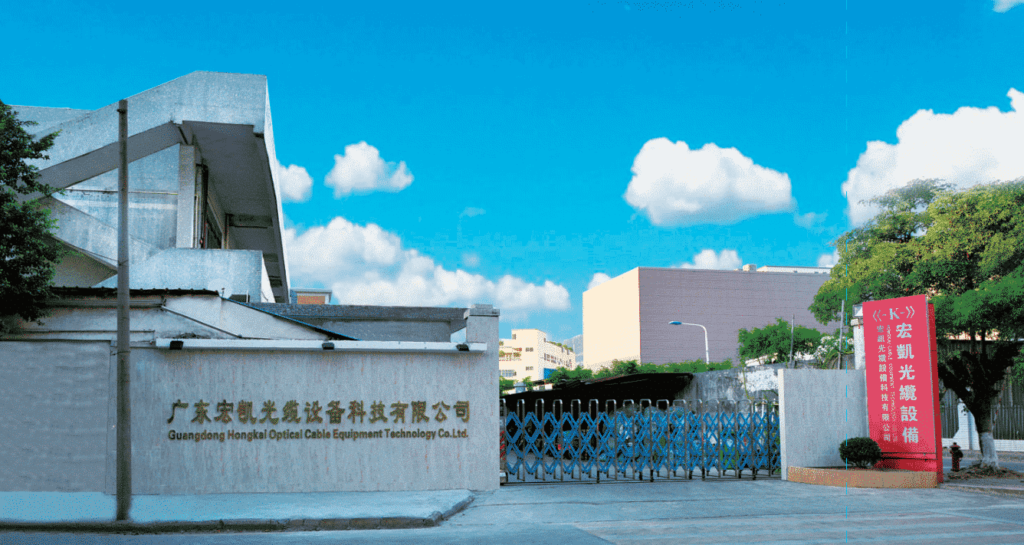
Guangdong Hongkai Optical Cable Equipment Technology Co., Ltd. began manufacturing wire and cable equipment in 2005 and was formally incorporated in 2015. Our main products include SZ stranding and cabling lines, fiber optic cable sheathing extrusion lines, and FTTH drop cable production lines.
Hongkai does not manufacture coloring machines or secondary coating lines – we focus on what we do best: the stranding and sheathing processes – the two critical steps that determine cable mechanical properties and temperature performance.
Hongkai equipment measured data:
| Parameter | Measured Value |
|---|---|
| Stranding pay-off tension fluctuation | ≤ ±0.4 N |
| Stranding pitch deviation | ≤ ±0.08 mm |
| Sheathing concentricity (8-hour continuous production) | ≥ 98.6% |
| Wall thickness tolerance | ≤ 0.04 mm |
| Changeover time | ≤ 1.5 hours (one-touch recipe loading) |
Our equipment has been exported to more than 15 countries and regions, with over 160 sets currently running on production lines worldwide. Every machine comes with a factory test report, a PLC program backup on USB, bilingual operation manuals (Chinese/English), and a wear-parts kit