In January 2026, Matt Rehder, Vice President of Core Networking at AWS, announced that AWS had successfully deployed hollow-core fiber to connect its 10 core data centers, marking the official commercial-scale adoption of hollow-core fiber. That same month, Yangtze Optical Fiber and Cable (YOFC) officially launched its hollow-core fiber brand HollowBand at MWC 2026, achieving a world-record low attenuation of 0.04 dB/km.
During the same period, cable fiber count records are being continuously broken. In June 2026, ZTT released a 17,280‑fiber ultra‑high‑density optical cable with an outer diameter of just 45 mm – a 60‑fold increase in transmission capacity over traditional 288‑fiber cables, reducing duct space occupancy by 92% at equivalent capacity.
Optical cables are changing – becoming more sophisticated, more delicate, and placing higher demands on manufacturing equipment. Next‑generation cables are here, and the equipment that makes them must evolve too.

1. Hollow‑Core Fiber: The Structure Has Changed – and So Must the Stranding Process
Traditional optical fiber is a solid glass filament. Hollow‑core fiber, by contrast, consists of a larger glass tube containing multiple hollow glass capillaries, with light traveling through air.
AWS spent over a year testing hollow‑core fiber and believes it is ready for large‑scale deployment. But as Matt Rehder candidly admitted: “The real challenge is manufacturability. This fiber is extremely difficult to manufacture, especially in sufficient lengths. Yields are currently very low, and manufacturing costs remain very high.”
Global effective production capacity for hollow‑core fiber currently meets less than 30% of market demand. An AWS executive even stated: “We’ll take as much hollow‑core fiber as we can get. The real bottleneck is that we can’t make enough of it.”
What does this mean for cable stranding equipment?
Hollow‑core fiber has a much more complex structure than traditional solid‑core fiber. In May 2026, Hengtong Optoelectronics obtained a patent related to hollow‑core fiber optic cables – featuring an outer sheath, aluminum tape, a fiber core layer, and a central strength member, with the core layer consisting of at least one hollow‑core fiber element and solid‑core fibers arranged in a ring array.
This structure imposes higher demands on tension control during the stranding process. Hollow‑core fiber is more delicate than traditional fiber – with hollow glass capillaries nested inside a larger glass tube, any excessive tension can cause microstructural deformation or damage. Cable manufacturers need to develop stranding technologies suitable for hollow‑core fiber, employing low‑stress sheathing and buffer structures to avoid microbend stress damage under concentrated forces.
Some cable manufacturers are developing comprehensive hollow‑core cable installation systems covering duct, aerial, direct‑burial, and rail transit applications – with standardized laying procedures, closed‑loop control of cable temperature, humidity, and internal air pressure, and high‑precision splicing operation specifications. These new requirements ultimately come down to stranding and sheathing equipment – higher tension control precision, more refined sheathing processes, and closed‑loop management of temperature and pressure.
2. The 17,280‑Fiber Cable: More Fibers Mean Higher Stranding Accuracy Requirements
ZTT’s 17,280‑fiber cable relies on a domestic leading 10,000‑fiber integrated production line. Integrating 17,280 fibers into a single cable means the tube count jumps from the traditional 6–12 to dozens or even over a hundred.
Fiber density reaches 5.80 fibers/mm². At equivalent capacity, duct space occupancy is reduced by 92%.
But the challenges of high density are equally significant. With thousands of fibers integrated into a single cable, pay‑off tension deviation on any single tube can be magnified – with 12 tubes, pitch deviation might be 0.1 mm; with 24 tubes, it might become 0.3 mm; with over a hundred tubes, what then?
What does this mean for cable stranding equipment?
First, tension control accuracy must go to the next level. For traditional loose‑tube cables, controlling pay‑off tension fluctuation within ±0.5 N is sufficient. But in high‑fiber‑count cables, even slight tension deviation on any single tube is magnified. Industry standards require tension control accuracy of ±0.5 N – Hongkai’s SZ stranding machine measures ±0.4 N.
Second, pitch consistency requirements are more stringent. For stranding 17,280 fibers, pitch deviation exceeding ±0.1 mm can cause uneven fiber stress, leading to microbend loss during bending. Data center customers have extremely low tolerance for loss.
Third, pay‑off rack capacity must be larger. Traditional stranding machines typically come with 12 pay‑off positions. A 17,280‑fiber cable requires dozens or even over a hundred positions for simultaneous pay‑off. No matter how good the stranding machine, it can’t handle it without enough pay‑off positions.
Fourth, changeover frequency is higher. Orders for high‑fiber‑count cables are often small‑batch, multi‑specification – the customer might need 17,280‑fiber today and 3,456‑fiber tomorrow. If changeover takes 4–5 hours, the line spends most of its time stopped for adjustments.
3. Multicore Fiber: Three‑Band Parallel Transmission – Sheathing Processes Face New Challenges
In June 2026, China Mobile, in partnership with Hengtong Optoelectronics, commissioned the world’s first S+C+L three‑band ultra‑low‑loss multicore fiber cable line in Qingdao, Shandong. The cable uses a four‑core fiber structure, integrating four independent signal channels within a standard 125 μm cladding, delivering over five times the capacity of traditional single‑core fiber.
Multicore fiber has a fundamentally different structure from traditional single‑core fiber – four fiber cores squeezed into a single cladding. This structure places higher demands on the sheathing process: inadequate sheath concentricity causes uneven stress across the four cores; uneven sheath wall thickness leads to performance variations between different cores.
Meanwhile, data centers are driving continued growth in demand for high‑spec, high‑value‑added products like G.657.A1/A2. CRU reports indicate that G.657.A2 cables, primarily used for high‑density cabling in data centers, are among the biggest beneficiaries of the AI data center demand explosion.
4. Three New Requirements for Cable Equipment Manufacturers
Requirement 1: Higher stranding accuracy
Whether hollow‑core fiber, 17,280‑fiber cables, or multicore fiber – all demand stranding accuracy an order of magnitude higher than traditional products. Pay‑off tension fluctuation must be controlled within ±0.5 N, and stranding pitch deviation within ±0.1 mm. Hongkai’s SZ stranding machine measures pay‑off tension fluctuation ≤ ±0.4 N and pitch deviation ≤ ±0.08 mm – these figures were sufficient in the era of traditional cables, but in the next‑generation cable era, they are merely the “passing line.”
Requirement 2: More refined sheathing processes
Hollow‑core fiber requires low‑stress sheathing and buffer structures; 17,280‑fiber cables require higher sheath concentricity (≥ 98%); multicore fiber requires more uniform wall thickness distribution. Hongkai’s sheathing line measures concentricity ≥ 98.6% and wall thickness tolerance ≤ 0.04 mm – approaching the performance boundaries required by next‑generation cables.
Requirement 3: Equipment must accommodate multiple new fiber types
The cable production line of the future might run traditional G.652.D today, G.657.A2 tomorrow, hollow‑core fiber the day after, and multicore fiber the day after that. A stranding machine or sheathing line that can only handle one fiber type will be unable to adapt to rapidly changing market demands. Equipment “flexibility” and “compatibility” are becoming core competitive advantages.
5. Final Thoughts
In 2026, the global fiber optic cable industry is undergoing a comprehensive upgrade – from “materials” to “structure.” Hollow‑core fiber is moving from the laboratory to commercial deployment; the 17,280‑fiber cable has pushed the density limit; multicore fiber has opened a new dimension in transmission capacity.
Cables are changing, and the equipment that makes them must change too. Higher stranding accuracy, more refined sheathing processes, and greater equipment flexibility – these three directions are defining the technical standards for next‑generation cable equipment.
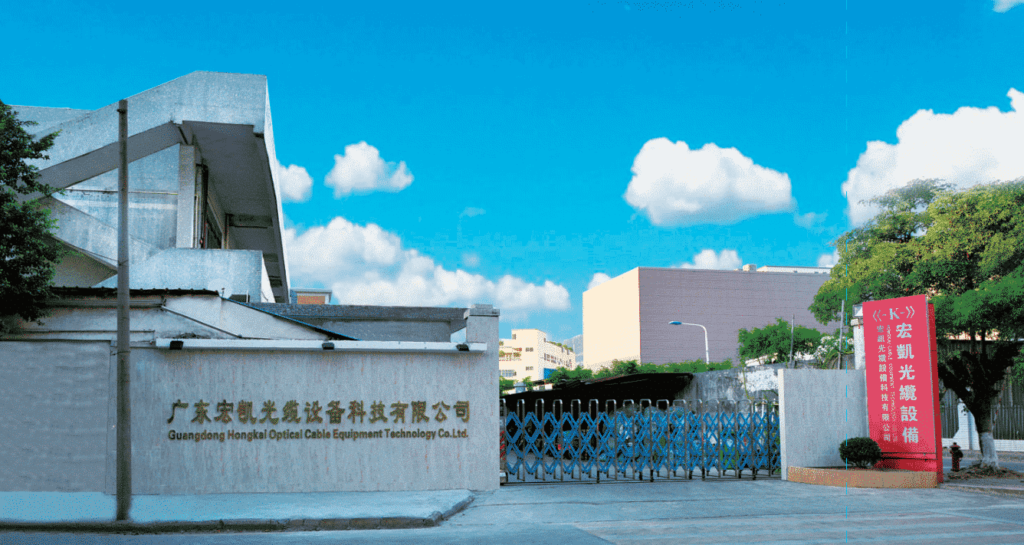
Guangdong Hongkai Optical Cable Equipment Technology Co., Ltd. began manufacturing wire and cable equipment in 2005 and was formally incorporated in 2015. Our main products include SZ stranding and cabling lines, fiber optic cable sheathing extrusion lines, and FTTH drop cable production lines. Our equipment has been exported to more than 15 countries and regions, with over 160 sets currently running on production lines worldwide. Every machine comes with a factory test report, a PLC program backup on USB, bilingual operation manuals (Chinese/English), and a wear‑parts kit.