There’s a saying in the fiber optic cable industry: “Even a 0.1°C temperature deviation or a 0.01 mm dimensional error can affect the ultimate transmission speed and stability of the fiber.”
Anyone in the cable business knows the weight of that statement. But few stop to consider that the equipment used to make those cables has precision requirements no less demanding than the cables themselves.
An SZ stranding and cabling line must control the tooth surface roughness of differential gears to within 0.8 μm. A fiber optic cable sheathing line must achieve laser diameter gauge accuracy of 0.2 μm. A tension control system must keep fluctuation within ±0.5%.
These numbers are the “precision code” of cable equipment.
1. Differential Gears: 0.8 μm Roughness, Eight Years of Service Life
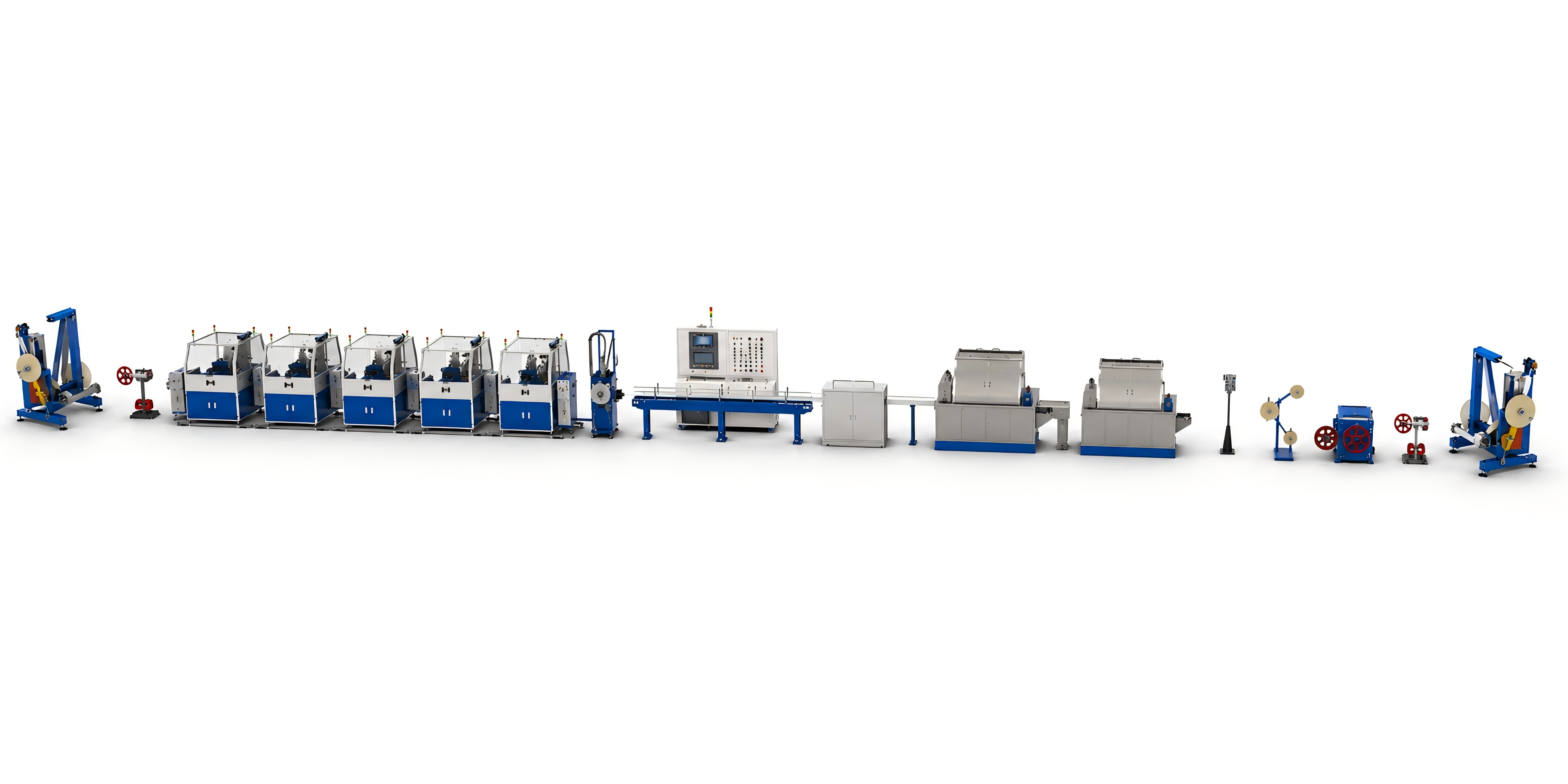
The core of an SZ stranding and cabling line is the differential gearbox – a cluster of meshing gears rotating forward and backward, tens of thousands of cycles per day. The precision of these gears directly determines whether the stranding pitch stays accurate and how many years the equipment will last.
Ordinary gears have tooth surface roughness above 1.6 μm, resulting in high friction, high noise, and high heat during meshing – wear begins within two to three years. Hongkai’s differential gears undergo precision grinding, achieving surface roughness below 0.8 μm – smooth gears mean less friction, smoother transmission, and a set that lasts eight to nine years.
Tooth surface hardness is equally critical. Ordinary gears have hardness of only HRC 20–30. Hongkai’s gears are high‑frequency hardened to HRC 50–55. Harder means less wear. Only by passing both hardness and finish requirements can gears maintain accuracy under high‑intensity continuous production.
Industry standards are also pushing this requirement higher. The Code for Construction and Quality Acceptance of Production Equipment Installation Engineering in Optical Fiber Cable Factories (GB 50950‑2013) has clear provisions for the mechanical precision of cable equipment – the machining accuracy of the differential gearbox, as the core transmission component of the stranding machine, directly determines whether the equipment passes acceptance.
2. Tension Control: From ±5% to ±0.5%
During stranding, pay‑off tension of the loose tubes must be precisely controlled. If tension is too high, the tubes are stretched, consuming the fiber excess length inside; if tension is too low, the tubes arch during stranding, causing uneven pitch.
Traditional stranding equipment uses open‑loop tension control – set a value and forget it, with no visibility into whether the actual tension has drifted. Industry data shows that tension fluctuation on traditional equipment typically ranges from ±1% to ±3%, easily causing broken strands and loose stranding, reducing product yield by 10% to 20%.
As cable products move toward higher speeds, larger capacities, smaller diameters, and lighter weight, tension control accuracy requirements during stranding have tightened from ±5% to within ±2%. Hongkai’s SZ stranding machine uses independent servo motors for active pay‑off with real‑time closed‑loop tension sensor control, stabilizing tension fluctuation within ±0.4 N – equivalent to ±0.5%.
Digital twin technology is pushing precision even further. Through 5G gateways collecting real‑time operating parameters and leveraging fault knowledge databases for remote diagnostics and life prediction, the system can provide early warning if stranding tension deviation exceeds 5%.
3. Sheath Concentricity: From Manual Adjustment to Micron‑Level Closed‑Loop Control
What does a fiber optic cable sheathing extrusion line fear most? Eccentricity – sheath wall thickness being thicker on one side and thinner on the other. The thick side wastes material; the thin side compromises protection. Industry standards require sheath concentricity ≥ 98%, with deviation exceeding 0.05 mm potentially causing microbend loss.
Traditional sheathing relies on operators manually adjusting the die – loosening screws, repositioning, tightening, trial running, inspecting wall thickness, adjusting again. An experienced master technician might take 30 minutes; a novice might not get it right in an hour.
Some manufacturers have developed integrated sheathing dies that avoid errors from manual assembly, controlling eccentricity of the finished cable cross‑section within 0.2 mm. But 0.2 mm is no longer sufficient today.
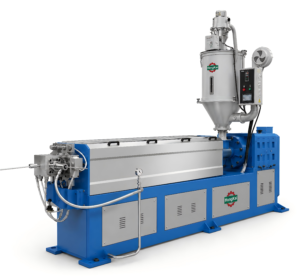
Hongkai’s sheathing line is equipped with a high‑precision laser diameter gauge with 0.2 μm accuracy – one‑thousandth of 0.2 mm. If the sheath outer diameter deviates by just 0.01 mm, the gauge detects it. Data is uploaded to the PLC every 0.1 seconds, and the PLC uses a PID algorithm to dynamically adjust extruder speed to bring the diameter back. Over 8 hours of continuous production, concentricity averages 98.6%, with wall thickness tolerance ≤ 0.04 mm.
The laser diameter gauge and extrusion control system form a closed‑loop feedback – once micron‑level deviation occurs, the system adjusts automatically. Ultrasonic probes monitor sheath wall thickness in real time, while the diameter gauge measures outer diameter – combining wall thickness and outer diameter data yields sheath concentricity.
4. Datafication: Making Precision “Visible”
Precision is only half the story – it must also be “visible” to the customer.
Every Hongkai machine comes with a factory test report that lists the actual measured data from load testing under real production conditions – pay‑off tension fluctuation, stranding pitch deviation, sheath concentricity. These figures are not arbitrary – they are actually measured by sensors and instruments under simulated production conditions.
Customers can replicate the measurements upon receipt. If the numbers match, the equipment’s precision is proven.
FiberHome, through lean manufacturing, has already achieved cable manufacturing processes with tube wall thickness control accuracy of ±0.05 mm, enabling the development of large‑core, small‑diameter, fully dry cables with up to 1,728 fibers and an outer diameter below 30 mm. Behind that 0.05 mm wall thickness control lies the precision capability of sheathing equipment.
5. About Hongkai
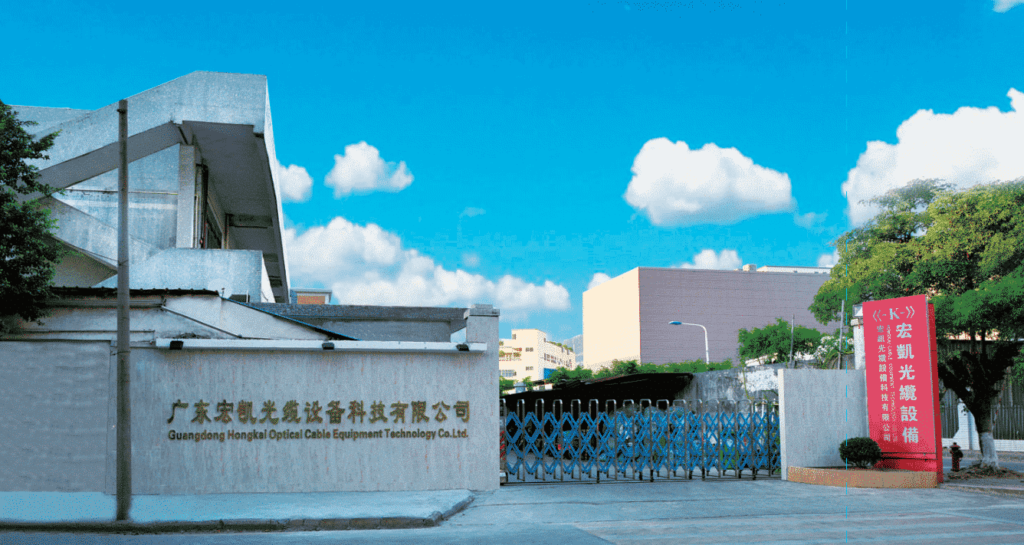
Guangdong Hongkai Optical Cable Equipment Technology Co., Ltd. began manufacturing wire and cable equipment in 2005 and was formally incorporated in 2015. Our main products include SZ stranding and cabling lines, fiber optic cable sheathing extrusion lines, and FTTH drop cable production lines.
Hongkai equipment core precision data:
-
Differential gears: High‑frequency hardening HRC 50–55, precision grinding roughness ≤ 0.8 μm – one set lasts eight to nine years
-
Tension control: Closed‑loop control, fluctuation ≤ ±0.4 N (equivalent to ±0.5%)
-
Sheath concentricity: 8‑hour continuous production average ≥ 98.6%, wall thickness tolerance ≤ 0.04 mm
-
Laser diameter gauge: Accuracy 0.2 μm, closed‑loop feedback automatic adjustment
Every machine comes with a factory test report, a PLC program backup on USB, bilingual operation manuals (Chinese/English), and a wear‑parts kit. Our equipment has been exported to more than 15 countries and regions, with over 160 sets currently running on production lines worldwide.