A cable factory owner in Zhejiang, surnamed Chen, had been in the cable business for over a decade. Starting in the second half of last year, overseas orders suddenly surged – especially high-fiber-count cables for data centers, integrating thousands or even tens of thousands of fibers into a single cable.
Mr. Chen had a stranding machine that was nearly ten years old – a significant investment at the time, and it had served him well. But when running high-fiber-count cables, problems emerged – pitch deviation exceeded tolerances, and the scrap rate jumped from 1% to over 8%.
He contacted the manufacturer, who said the equipment was fine and that it was an operator issue. He then hired a third-party inspection firm, whose report concluded that the equipment’s precision had indeed degraded.
Mr. Chen called me: “Old Liu, can this machine still be fixed?”
I asked: “Have you ever changed the oil in the differential gearbox?”
“Yes – last year.”
“Have you inspected the gears?”
“Never opened it up.”
“Then open it and take a look.”
The “Metal Shavings” in the Differential Gearbox – The Root Cause of Precision Degradation
Mr. Chen had his maintenance crew open the differential gearbox. Inside, they found a layer of fine metal debris at the bottom of the oil sump, and several gears showed obvious pitting and spalling on the tooth surfaces.
With worn gears, the meshing clearance increases – causing vibration during stranding and throwing off the pitch accuracy.
Mr. Chen asked: “How did this happen? I change the oil on schedule.”
“Changing the oil just removes the old oil and adds new,” I said. “But once the gears have started wearing, the metal debris circulates in the oil, accelerating wear. No matter how often you change the oil, already-worn gears won’t grow back.”
He paused for a moment: “So what do I do?”
“Replace the gears. A new set of differential gears will restore 80–90% of the equipment’s precision.”
“How much will that cost?”
“Much less than buying a new machine.”
He thought for a moment: “How long will it last after replacement?”
“With normal use, four to five years – on one condition: follow the maintenance schedule from now on. Don’t wait until they’re worn out again.”
Maintenance vs. Neglect – Equipment Lifespan Can Be Twice as Long
Mr. Chen’s case is not unique.
Many cable factories are willing to spend big on buying equipment but reluctant to invest time in maintenance. The differential gearbox oil should be changed every six months – but some stretch it to a year. Dancer bearings should be greased weekly – but some do it only when they remember. The laser diameter gauge lens should be cleaned daily – but some go a week without wiping it.
Anyone in the cable business knows that uneven stress on fibers during stranding leads to attenuation issues. And that uneven stress is often caused by degraded equipment precision – 90% of which comes from neglected maintenance.
A set of differential gears costs tens of thousands of RMB. A single bearing costs several hundred. An unplanned shutdown can cost tens of thousands in lost output. Regular maintenance costs pennies; skipping maintenance costs fortunes.
Industry data shows that in 2026, the global cable industry is in an upcycle driven by AI data centers – Corning’s optical communications sales grew 32% year‑on‑year, with AI‑related sales nearly doubling. When the market is hot, equipment failure is the last thing you need.
Troubleshooting: Start with These Checks First
Through years of after‑sales service, I’ve found that most equipment faults have simple causes. Mr. Chen’s case was on the severe side – worn gears. But more often than not, the cause is something minor.
Fault 1: Large tension fluctuation, unstable pitch
Start with the dancer arm. Push it by hand – does it spring back freely? If it’s stuck, clean the bearings and apply grease. If the arm moves freely but tension is still unstable, check the tension sensor – is there dust on the surface? Are the signal wires loose? These two steps resolve most tension issues.
Fault 2: Sheath concentricity drifts
Start with the laser diameter gauge lens. Dust or oil film on the lens causes inaccurate readings. Wipe it with an alcohol swab – often, that’s all it takes. If that doesn’t work, calibrate the gauge with a standard reference rod.
Fault 3: Equipment alarm won’t reset
Locate the inverter or drive showing the alarm and check the alarm code on its display. After noting the code, disconnect power to that unit, wait 10 seconds, reapply power, and then press the reset button. This clears the majority of alarms.
Fault 4: Incorrect pitch
Check the encoder coupling. The encoder is mounted on the motor, feeding real‑time speed feedback. If the coupling is loose, the feedback speed doesn’t match the actual speed – and the pitch is off. Simply tighten the set screw and recalibrate the pitch factor.
When Selecting New Equipment, Don’t Just Look at Price
Mr. Chen eventually replaced his old stranding machine with a new one. During selection, he asked me: “There’s a big price range for stranding machines – some are 500,000 RMB, others over 800,000. What’s the difference?”
I told him the difference lies in a few key areas.
Differential gears: Cheap ones use ordinary gears with HRC 20–30 hardness – wear begins in two to three years. Premium ones use high‑frequency hardened gears at HRC 50–55 – a set lasts eight to nine years. Hongkai’s SZ stranding machine gears undergo precision grinding with surface roughness below 0.8 μm – a set lasts eight to nine years.
Bearings: Cheap ones use off‑brand bearings that bind over time. Premium ones use SKF or NSK – one set lasts eight to nine years. Hongkai’s dancer bearings are SKF or NSK – the sensor picks up the slightest arm movement with a 20 ms refresh cycle.
Electrical components: Cheap ones use generic brands – hard to find replacements locally when they fail. Premium ones use Siemens, Mitsubishi, Schneider – globally warranted, with local availability of replacement parts.
Factory test reports: Cheap ones don’t provide measured data. Premium ones include a complete factory test report with every machine – tension fluctuation, pitch deviation, concentricity – all listed.
Mr. Chen’s final comment: “Equipment may look cheap when you buy it – but you only find out how expensive it really is once you start using it.”
About Hongkai
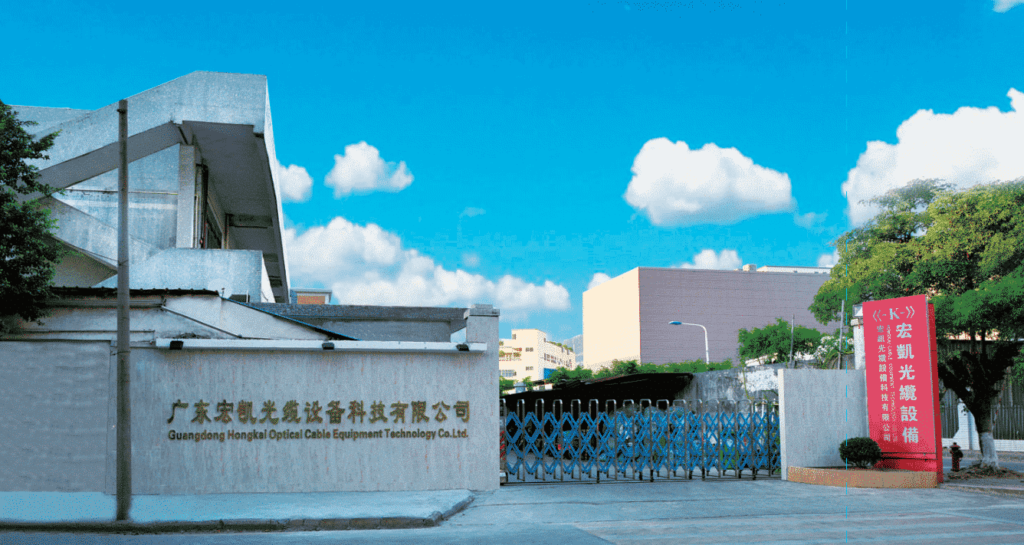
Guangdong Hongkai Optical Cable Equipment Technology Co., Ltd. began manufacturing wire and cable equipment in 2005 and was formally incorporated in 2015. Our main products include SZ stranding and cabling lines, fiber optic cable sheathing extrusion lines, and FTTH drop cable production lines.
Hongkai equipment core data:
-
SZ stranding machine: Pay‑off tension fluctuation ≤ ±0.4 N, stranding pitch deviation ≤ ±0.08 mm, supporting simultaneous stranding of up to 12 tubes
-
Sheathing line: 8‑hour continuous production concentricity average ≥ 98.6%, wall thickness tolerance ≤ 0.04 mm, compatible with PE, PVC, LSZH
-
Changeover time: ≤ 1.5 hours (one‑touch recipe loading, storing process parameters for up to 20 different products)
-
Control system: Siemens/Mitsubishi PLC platform, supporting data acquisition and MES integration
Every machine comes with a factory test report, a PLC program backup on USB, bilingual operation manuals (Chinese/English), and a wear‑parts kit. Our equipment has been exported to more than 15 countries and regions, with over 160 sets currently running on production lines worldwide.
If you’re running a cable production line and encountering equipment issues – or if you’d like to see precision data on new equipment – feel free to contact the Hongkai technical team.