Sheathing extrusion looks simple – pour plastic pellets in, heat and melt, extrude over the cable core, cool and set.
But anyone who has actually run a production line knows it’s far more complicated than that.
Here’s a classic scenario: you’ve been running smoothly with one material for a long time. Then you switch to a new batch of material, and problems start. Surface pitting, porosity, unstable melt output – and issues crop up as soon as you increase speed. The operator adjusts temperatures, changes the screw, replaces the screen pack – and after hours of effort, still can’t fix it.
Where’s the problem? Material and equipment mismatch.
1. Same Type of Material, Different Suppliers – Equipment Reacts Differently
A cable factory had been using one brand of LSZH (low-smoke zero-halogen) sheathing compound and running smoothly. They switched to a new supplier’s material – and the screw started slipping. At higher line speeds, melt output became unstable, and the sheath surface was covered in pitting and porosity.
They adjusted temperatures, tried different screw configurations – nothing worked. Finally, they contacted the material supplier for the recommended temperature profile, adjusted the feed zone temperature settings, and added screw air cooling – just barely managing to get the problem under control.
There are even more extreme cases. Some factories, after switching to a new material, couldn’t even purge the melt after removing the breaker plate – even with the head opened. They tried every temperature combination, even dropping the first zone to 100°C – still nothing. In the end, they had to switch back to the original material.
Same equipment, different materials – drastically different results.
Where’s the root cause?
Different suppliers’ sheathing compounds have different formulations, different melt flow indexes, and different temperature and pressure requirements. LSZH material is particularly temperature-sensitive – if the feed zone temperature is too high, screw thrust is insufficient and the material won’t feed; if it’s too low, plasticization is poor and the extrudate comes out with surface defects.
The screw design, temperature control system, and cooling method on a sheathing line – these are all designed for specific materials. Switch to a different material, and the original process parameters may be completely incompatible.
Some industry practitioners have observed: the feeding characteristics of different sheath materials vary greatly. Equipment that runs PE perfectly can be disappointing when switched to LSZH.
2. Wrong Screw Selection = Poor Sheath Quality
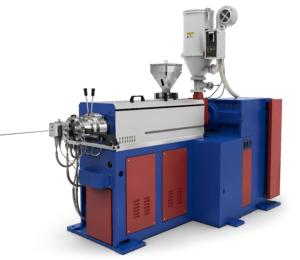
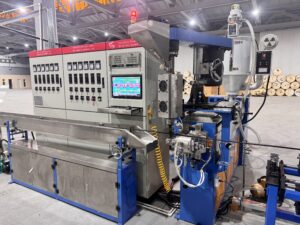
The core of a sheathing line is the extruder screw. The screw’s geometry directly determines whether the material is adequately plasticized and whether the extrudate is uniform.
Different materials require different screw designs. Polyethylene (PE) and low-smoke zero-halogen (LSZH) have completely different feeding characteristics. The screw’s compression ratio, L/D ratio, and feed zone temperature control must all match the material’s properties.
Pipe extrusion generally requires higher head pressure than sheathing extrusion – which subtly undermines the justification for using a long metering section on sheathing screws. In other words, sheathing screw design is different from ordinary extrusion screws – you can’t just use a “universal screw” for all materials.
Many cable factories buying sheathing lines only ask about “capacity” – few ever ask “what materials can this screw handle.”
If the equipment is only optimized for PE, running LSZH will result in poor plasticization, rough surfaces, and uneven wall thickness. When data center orders come – and most data center cables use LSZH sheathing – you discover the equipment simply can’t do the job.
3. When Material Changes, Process Parameters Must Change Too
When switching to a new material, you can’t just run the old parameters and hope for the best.
Different sheath materials require different temperature profiles. One cable factory’s experience: feed zone temperature should not be too high – 120–130°C is sufficient. If the temperature is too high, the material melts in the feed zone and the screw can’t push it forward. If it’s too low, the material feeds but plasticization suffers.
LSZH material has another characteristic: it readily absorbs moisture. If the material has taken on moisture, extrusion will produce bubbles and surface pitting. Some factories experience this problem especially during seasonal transitions – in southern China’s rainy season, high warehouse humidity causes sheathing compounds to absorb moisture, leading to problems during extrusion.
A more complex scenario is dual-layer sheathing. Rodent-resistant and termite-resistant cables require an outer nylon layer over the polyethylene sheath. But these two materials have significantly different cooling shrinkage rates and poor adhesion. During co-extrusion, the nylon and PE layers don’t bond after cooling – gaps between the layers can cause water penetration.
This type of problem can’t be solved by temperature adjustments alone – it requires addressing the equipment configuration: either use a co-extrusion head or add an adhesive layer.
4. When Selecting Equipment, Material Compatibility Must Be a Priority
When buying a sheathing line, don’t just ask about capacity – ask these questions:
First: What materials can this screw handle?
PE, PVC, LSZH – how many materials can the equipment cover? Does changing materials require changing the screw? If a single screw is advertised as “universal” for everything, chances are it won’t do any of them well.
Second: Is the temperature control range sufficient?
Different materials have different processing temperature ranges. LSZH has a much narrower processing window than PE, requiring higher temperature control accuracy. Without sufficient precision, LSZH production will suffer.
Third: Is screw cooling available?
LSZH material requires precise feed zone temperature control. Without screw cooling, many LSZH compounds simply can’t be produced stably.
Fourth: Does the material supplier provide recommended process parameters?
When switching to a new material, always ask the supplier for their recommended temperature profile first – don’t just start guessing. Many problems come from a complete mismatch between the temperature curve and material characteristics.
5. About Hongkai Sheathing Lines
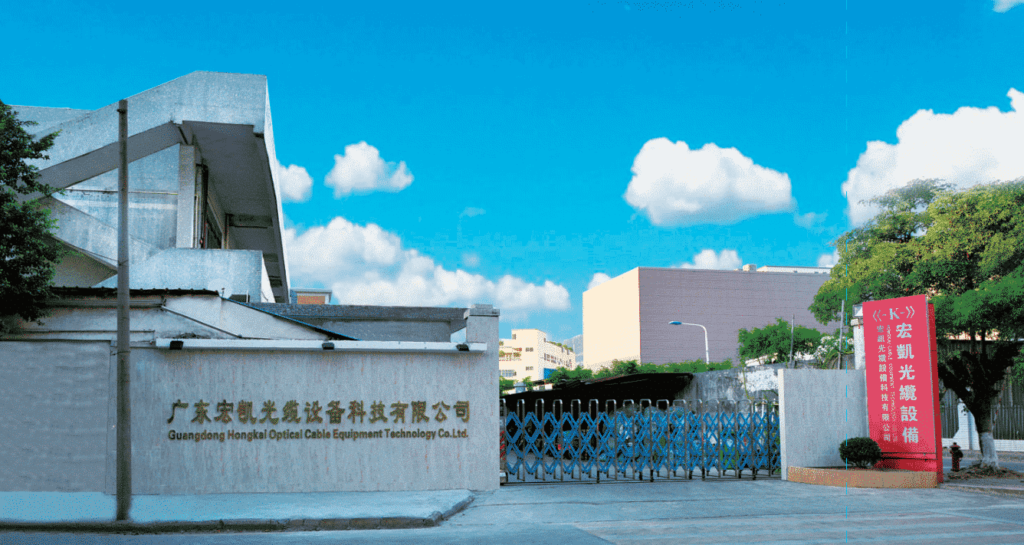
Guangdong Hongkai Optical Cable Equipment Technology Co., Ltd. began manufacturing wire and cable equipment in 2005 and was formally incorporated in 2015. Our main products include SZ stranding and cabling lines, fiber optic cable sheathing extrusion lines, and FTTH drop cable production lines.
Hongkai sheathing lines address material compatibility in several ways:
-
Screw material: 38CrMoAlA alloy steel with nitriding treatment – nitriding depth 0.5–0.7 mm, hardness above HV 900 – wear-resistant and long-lasting
-
Material compatibility: PE, PVC, LSZH, and more – different screw configurations for different materials
-
Temperature control: Imported temperature controllers with high precision, meeting the temperature requirements of various materials
-
Laser diameter gauge: 0.2 μm accuracy, real‑time outer diameter monitoring, automatic speed adjustment via PID closed‑loop control
-
Measured data: 8‑hour continuous production concentricity average ≥ 98.6%, wall thickness tolerance ≤ 0.04 mm
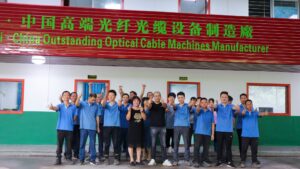
Every machine comes with a factory test report, a PLC program backup on USB, bilingual operation manuals (Chinese/English), and a wear‑parts kit. Our equipment has been exported to more than 15 countries and regions, with over 160 sets currently running on production lines worldwide.