The longer cable equipment runs, the more likely it is to develop issues. But many faults aren’t actually “breakdowns” – they’re just minor problems that went unnoticed.
Below are the most common fault scenarios on SZ stranding and cabling lines and fiber optic cable sheathing lines. None of them are complicated to fix – but if you don’t know what to look for, you could waste hours chasing the wrong cause.
1. Sudden Violent Vibration During Stranding
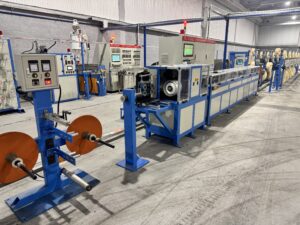
Symptom: During operation, the stranding unit suddenly shakes violently, accompanied by abnormal noise.
When a cable stranding machine suddenly experiences severe vibration during operation, the priority is to cut power to the main motor. This is not an overreaction – vibration usually means a rotating component has developed serious imbalance or excessive clearance.
Start with these checks:
Bearings: Vibration and noise are most often bearing issues. Worn or damaged bearings produce periodic vibration during rotation. Remove the guard, rotate the stranding head by hand, and feel for roughness or play. If bearings are the problem, replace them.
Coupling: If the coupling between the motor and the stranding unit is loose, vibration occurs at high speed. Check whether the set screws on the coupling are tight.
Cage balance: If the stranding head is out of dynamic balance, it will vibrate at high speed. This is less common, but if bearings and couplings check out, inspect the cage itself.
Operating principle: When severe vibration occurs, stop the machine before investigating. Don’t run it while faulty – small problems can become major failures.
2. Large Tension Fluctuation – Pitch Varies Inconsistently
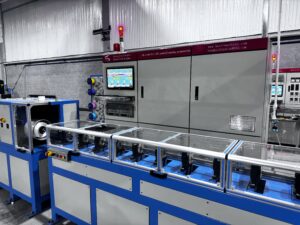
Symptom: The pay-off tension reading on the touchscreen jumps around. The stranding pitch varies from large to small, with inconsistencies along the same reel.
During stranding, pay-off tension fluctuation directly affects pitch stability. Poor tension control is one of the most common early-stage faults on stranding machines.
Start with these checks:
Dancer arm: Push the dancer arm by hand – does it spring back freely? If it sticks, the bearings are dry or damaged. Clean the bearings and apply grease – that usually resolves it.
Tension sensor: Check the sensor surface for dust or oil contamination. Are signal wires loose? Use a multimeter to check whether the output signal is linear. Sensors are precision components – dirt or damage will cause inaccurate readings.
Pay-off reel brake: If the pay-off reel brake is locked or loose, pay-off tension will be abnormal. Check brake pad wear and air line condition.
PID parameters: If all the above are normal, the PLC’s tension PID parameters may have been accidentally changed. Try restoring factory defaults.
Excessive stranding tension can cause microbend loss; insufficient tension results in loose stranding. Address tension instability early – don’t delay.
3. Stranding Pitch Deviation – Won’t Adjust Correctly
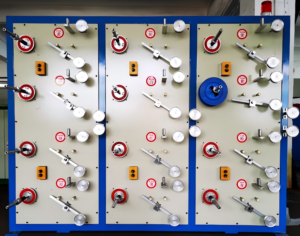
Symptom: The pitch setpoint hasn’t changed, but the measured pitch is significantly off – and adjusting parameters doesn’t fix it.
Start with this check:
Encoder coupling – this is the most easily overlooked and most common cause.
The encoder is mounted on the motor, providing real-time speed feedback to the PLC. If the set screw on the coupling between the encoder and the motor shaft is loose, the feedback speed doesn’t match the actual speed. The PLC thinks the stranding head has completed one revolution, but it’s actually turned only 0.9 revolutions. Since Pitch = Haul-off Speed ÷ Stranding Speed, a smaller denominator results in a larger pitch.
Fix: Stop the machine, open the encoder cover, tighten the coupling set screw, and recalibrate the pitch factor. Run the machine for 100 revolutions, measure the actual cable length, and recalculate using: New Factor = Old Factor × Actual Length ÷ (Pitch Setpoint × 100).
4. Frequent Binder Yarn Breakage – Several Times an Hour
Symptom: Left- or right-hand binder yarn breaks repeatedly, disrupting production.
Start with these checks:
Spool orientation: The most easily overlooked cause – the yarn spool is installed backwards. The yarn should be pulled off from the top of the spool, not the bottom. If installed backwards, the friction angle at the exit increases – and at high speed, the yarn is easily cut.
Ceramic guide wheel: Are there grooves on the guide wheel surface? Over time, yarn friction wears grooves into the ceramic guide wheel. Deep grooves cut the yarn. Replace the guide wheel if grooved.
Binder tension: Is the tension set too high? Typically 2–4 N is sufficient; above 5 N, breakage becomes likely.
Breakage sensor: The breakage sensor must be enabled during normal production. If the sensor isn’t working, the machine keeps running even after a break – resulting in scrap.
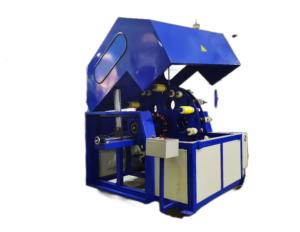
5. Sheathing Line Extruder Temperature Out of Control
Symptom: The extruder temperature reading suddenly spikes – exceeding the process upper limit by over 50°C.
Start with these checks:
Heater bands: A burned-out or shorted heater band causes temperature loss of control. Use a multimeter to check the resistance of the heater bands and determine if they’re damaged.
Thermocouple: If the thermocouple is loose or damaged, the temperature reading will be inaccurate. Check that the thermocouple is securely installed and that signal wires are intact.
Cooling system: Is the extruder cooling system (air or water) working properly? Cooling failure will cause temperatures to rise continuously.
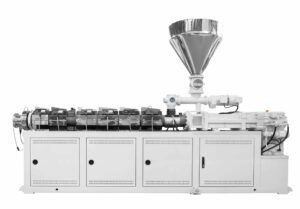
6. Sheathing Line Take-Up Violent Vibration
Symptom: The take-up unit suddenly vibrates violently during operation, accompanied by abnormal noise.
Start with these checks:
Take-up reel: Is the reel mounted straight? A deformed or off-center reel will vibrate during rotation.
Bearings: Worn take-up shaft bearings also produce vibration and noise.
Drive belt: A loose or worn belt can also cause vibration. Check belt tension.
7. Inverter Alarm – Machine Won’t Start
Symptom: An alarm displays on the touchscreen. Pressing the reset button does nothing. The machine won’t start.
Fix:
Locate the inverter or drive showing the alarm and check the alarm code on its display. After noting the code, disconnect power to that unit, wait 10 seconds, reapply power, and then press the reset button. This clears the majority of alarms.
If the power cycle doesn’t work, consult the alarm code for the specific cause – overload, overvoltage, phase loss, encoder disconnection – each code indicates a different course of action.
Three Principles for Troubleshooting
Principle 1: Simple before complex. Start with the most easily overlooked things – is the sensor dirty? Is the coupling loose? Are bearings low on grease? – before suspecting major components like PLCs and inverters.
Principle 2: External before internal. Check external wiring, sensors, and mechanical binding before disassembling internal components. Rushing to tear apart a machine can turn a minor issue into a major one.
Principle 3: Keep factory parameter backups. If parameters are scrambled, restoring factory defaults is much faster than re-entering everything from scratch. Hongkai provides a PLC program backup USB drive with every machine.
About Hongkai
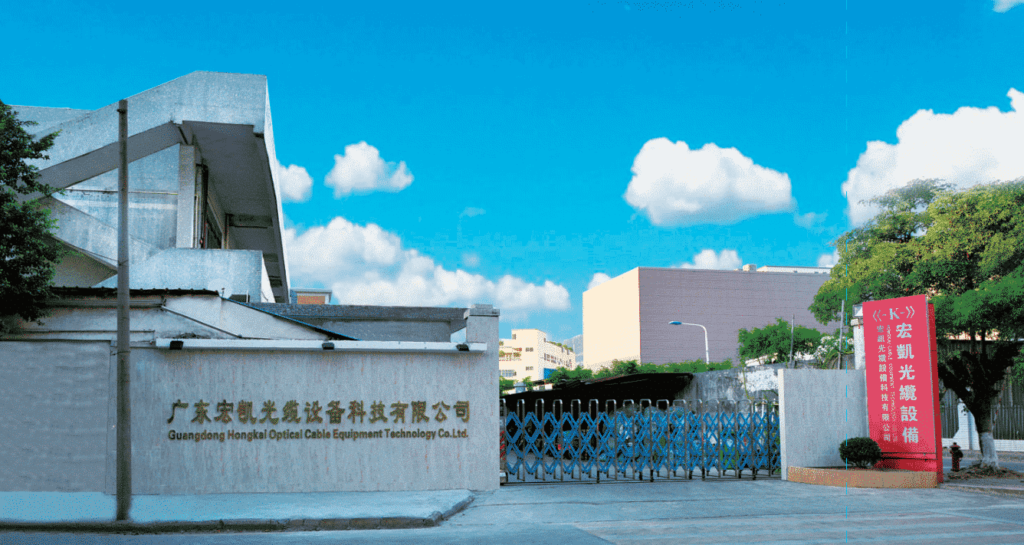
Guangdong Hongkai Optical Cable Equipment Technology Co., Ltd. began manufacturing wire and cable equipment in 2005 and was formally incorporated in 2015. Our main products include SZ stranding and cabling lines, fiber optic cable sheathing extrusion lines, and FTTH drop cable production lines.
Hongkai equipment measured data: SZ stranding machine pay-off tension fluctuation ≤ ±0.4 N, stranding pitch deviation ≤ ±0.08 mm; sheathing line 8-hour continuous production concentricity average ≥ 98.6%, wall thickness tolerance ≤ 0.04 mm. Our equipment has been exported to more than 15 countries and regions, with over 160 sets currently running on production lines worldwide.
Every machine comes with a factory test report, a PLC program backup on USB, bilingual operation manuals (Chinese/English), and a wear-parts kit. If you’re experiencing equipment issues and aren’t sure how to troubleshoot, feel free to contact the Hongkai technical team – we’ll do a remote assessment first and solve what we can, without rushing to replace parts.