Buying equipment seems simple – check the specs, negotiate the price, sign the contract, and wait for delivery. But quite a few people only discover problems after the equipment has arrived.
Here are five things you’d better think through before making a purchase.
1. What Exactly Are You Making?
This is the most fundamental question – and the one most people overlook.
Loose‑tube cables, FTTH drop cables, high‑fiber‑count cables – different products require completely different equipment. Loose‑tube cables need an SZ stranding and cabling line. FTTH drop cables need a dedicated butterfly cable production line. High‑fiber‑count cables require stranding machines with more tube positions.
Some people say “I make cables” when buying equipment – only to discover after delivery that the machine can’t produce what they actually need. An SZ stranding and cabling line is suitable for loose‑tube cables, but it cannot produce FTTH drop cables. Once you buy the wrong equipment, it either sits idle or costs you even more to retrofit.
Recommendation: Before buying equipment, write down your product type, fiber count range, and sheath material clearly – indoor or outdoor, loose‑tube or butterfly, 12‑fiber or 24‑fiber, PE or LSZH. The more specific you are, the more accurate the equipment recommendation will be.
2. What Is the Actual Precision of Your Equipment?
When buying equipment, manufacturers will say “high tension control accuracy” and “low pitch deviation.” But what do “high” and “low” actually mean? Is there any measured data?
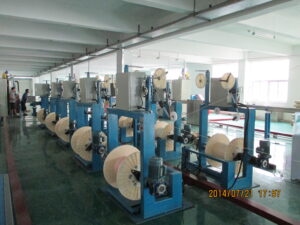
A qualified stranding machine should control pay‑off tension fluctuation within ±0.5 N (at 20 m/min line speed). For G.657 fiber, stranding pitch deviation should be ≤ ±0.1 mm. Sheathing line concentricity should be ≥ 98%.
Hongkai’s SZ stranding machine measures pay‑off tension fluctuation ≤ ±0.4 N and pitch deviation ≤ ±0.08 mm; the sheathing line achieves 8‑hour continuous production concentricity average ≥ 98.6% and wall thickness tolerance ≤ 0.04 mm. Every machine comes with a factory test report – the data is there for you to see.
If a manufacturer claims “high precision” but can’t provide measured data, or if the factory report only says “qualified” without specific numbers – be cautious.
Recommendation: Request the factory test report from the supplier and review the measured data for core indicators – pay‑off tension fluctuation, stranding pitch deviation, sheath concentricity.
3. What Is the Equipment’s Material Compatibility?
The most common pitfall with sheathing lines: when buying, you only ask “can it run PE?” – without asking “can it run LSZH?”
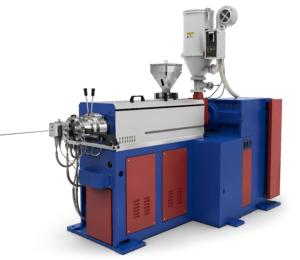
PE (polyethylene) is for outdoor cables, PVC for indoor cables, and LSZH (low‑smoke zero‑halogen) for data center cables. Different materials have different requirements for the extruder screw – PE and LSZH require different screw geometries and temperature profiles.
If the equipment is only optimized for PE, running LSZH will result in poor plasticization, rough sheath surfaces, and uneven wall thickness. When data center orders come – and most data center cables use LSZH sheathing – you discover the equipment simply can’t do the job.
Recommendation: Ask clearly what materials the equipment can handle, whether changing materials requires changing the screw, and whether the temperature control range is sufficient. If you’re running PE now but plan to run LSZH in the future, factor in compatibility when making your purchase decision.
4. Who Handles Installation and Commissioning?
An SZ stranding and cabling line weighs dozens of tons and contains hundreds of components. After delivery, these components need to be assembled, wired, routed, parameterized, and trial‑run – every step requires skilled personnel.
For domestic customers, the supplier typically sends engineers, and the job takes about two weeks. Overseas customers face bigger challenges – in the Middle East, Africa, and Southeast Asia, there aren’t many people familiar with cable equipment installation and commissioning. If the supplier only provides equipment and doesn’t send personnel, the customer may spend two to three months figuring it out on their own.
During this period, labor costs, downtime losses, and trial production scrap can add up to more than the equipment itself.
Hongkai’s approach: send engineers to the site – 12 to 18 days from unpacking to producing the first qualified reel. Before they leave, they train the operators, leaving behind bilingual manuals, electrical schematics, and a complete troubleshooting guide.
Recommendation: Ask clearly whether the supplier provides on‑site installation and commissioning services, how long engineers stay on‑site, and how costs are calculated.
5. How Are Spare Parts and After‑Sales Support Handled?
Equipment running 24/7 will eventually have issues. The worst scenario isn’t equipment failure – it’s failure without spare parts to replace the faulty component.
A sensor fails, a bearing wears out – if you can’t find replacements locally, you wait for the supplier to ship from China. DHL takes three to five days; sea freight takes twenty to twenty‑five days. A week of downtime costs tens of thousands in lost output.
Recommendation: Before signing the contract, ask: what wear parts are included with the equipment? Is there a spare parts list? Can spares be shipped quickly? Is remote technical support available?
One Table to Understand: What to Confirm Before Buying Equipment
| Item to Confirm | Specific Details |
|---|---|
| Product type | Cable type, fiber count, sheath material |
| Equipment precision | Pay‑off tension fluctuation, pitch deviation, concentricity – request the factory test report |
| Material compatibility | Can it handle PE/PVC/LSZH? Does changing material require changing the screw? |
| Installation & commissioning | Does the supplier provide on‑site installation? How long do engineers stay? |
| Spare parts & after‑sales | What wear parts are included? How fast can spares arrive? Is remote support available? |
About Hongkai
Guangdong Hongkai Optical Cable Equipment Technology Co., Ltd. began manufacturing wire and cable equipment in 2005 and was formally incorporated in 2015. Our main products include SZ stranding and cabling lines, fiber optic cable sheathing extrusion lines, and FTTH drop cable production lines.
Hongkai equipment measured data: SZ stranding machine pay‑off tension fluctuation ≤ ±0.4 N, stranding pitch deviation ≤ ±0.08 mm; sheathing line 8‑hour continuous production concentricity average ≥ 98.6%, wall thickness tolerance ≤ 0.04 mm. Every machine comes with a factory test report, a PLC program backup on USB, bilingual operation manuals (Chinese/English), and a wear‑parts kit. Our equipment has been exported to more than 15 countries and regions, with over 160 sets currently running on production lines worldwide.
If you’re planning to build or expand a cable production line and aren’t sure where to start, feel free to contact the Hongkai technical team. First, tell us what products you want to make and your approximate capacity target – then we’ll help you work out a solution.