When buying cable equipment, you look at specifications when signing the contract – and at data after the equipment arrives at your plant.
This means that before an SZ stranding and cabling line leaves the factory, it’s not enough that it’s “assembled and can run.” It must pass through three checkpoints: no-load trial run, load trial run, and performance inspection. Every set of data produced must be recorded and compared item by item against the contract technical documents.
Checkpoint 1: No-Load Trial Run – Can Each Unit “Run on Its Own”?
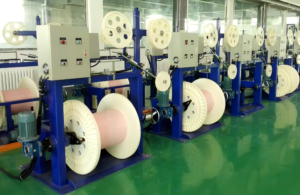
A no-load trial run means running each unit of the equipment individually with power on, without feeding tubes or sheath material. Does the pay-off stand rotate? Does the dancer arm move freely? Does the stranding unit reverse smoothly? Is the take-up traverse even? Every item must be checked.
This checkpoint may look simple, but it is the foundation for all subsequent testing. GB 50950‑2013 clearly specifies that load operation should be conducted after no-load operation is normal. If it can’t run smoothly without load, there’s no point discussing load testing.
When operators inspect equipment at the customer site, they often skip the no-load step and go straight to load data. In fact, the no-load trial run can expose many problems – abnormal bearing noise, loose belts, abnormal sensor signals. If these problems aren’t solved, the data from load testing is not reliable either.
Checkpoint 2: Load Trial Run – Running with Real Tubes and Sheath Material
Once no-load operation is fine, feed actual tubes and sheath material for real production.
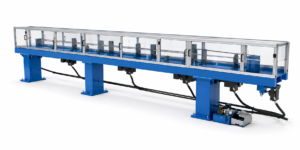
GB 50950‑2013 specifies that load operation should “transition smoothly from startup to maximum working speed or from maximum working speed to shutdown,” and that “production raw materials should be fed after the production equipment has slowed to low speed,” with operating parameters “measured after operation has stabilized.”
Why does it specify “feed raw materials after slowing to low speed”? Because feeding tubes at high speed can cause instantaneous tension shock that may break the optical fibers. Why “measure after operation has stabilized”? Because right after startup, temperature, tension, and speed have not yet reached steady state – the data measured then has no reference value.
Before leaving the factory, every Hongkai machine undergoes no less than 2 hours of load testing under simulated real production conditions. The data collected is recorded in the factory test report – pay-off tension fluctuation, stranding pitch deviation, sheath concentricity – all listed.
Checkpoint 3: Performance Inspection – Let the Data Speak, Item by Item
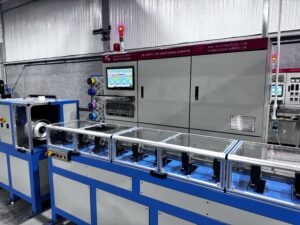
After the load run is complete, performance inspection begins. This is the most “rigorous” part of GB 50950‑2013 – each indicator has a clear test method. Whatever the measurement is, that’s what it is, and it is compared against the contract technical documents.
How to Test a Stranding Line?
Maximum production speed: During load operation, adjust the motor to maximum speed and measure directly with a tachometer with accuracy no less than 1 r/min.
Stranding pitch: Take a section of cable core stranded by the machine and measure the distance of a single helix directly with a steel ruler with accuracy no less than 1 mm. That is the stranding pitch.
SZ reversal angle: Observe the number of revolutions a point on the stranding head rotates in one direction. The product of that number and 2π is the SZ reversal angle.
Take-up tension: During load operation, measure with a dynamic tension meter with accuracy no less than 1 N.
How to Test a Sheathing Line?
Central member pay-off and take-up tension: During load operation, measure with a dynamic tension meter with accuracy no less than 1 N. Maximum production speed is measured with a tachometer.
These test methods are not “just taking a look” – they involve direct instrument measurement and direct reading. The core parameters focused on by third-party testing agencies are also clear: tension control accuracy ±0.5 N, stranding pitch deviation ≤ ±0.1 mm (for G.657 fiber), sheath concentricity ≥ 98%, and attenuation change ≤ 0.03 dB/km after 10 temperature cycles from -40°C to 70°C.
How Does the Customer Re-Verify After Arrival?
After the equipment arrives at the customer’s factory, the customer also needs to perform acceptance. The method is the same as the manufacturer’s pre-delivery testing, with one addition – comparison. Can the data measured by the customer match the data on the manufacturer’s factory test report?
If it matches, it means no deviation occurred during transportation and installation. If it doesn’t match, the extent and location of the difference must be investigated.
Several Practical Re-Verification Methods:
Tension fluctuation: View the real-time tension curve on the touchscreen. Industry standards require dynamic tension fluctuation ≤ ±0.5 N at 20 m/min line speed. When the equipment is running stably, the curve should be a smooth line with small fluctuation. If the curve keeps jumping, check the dancer arm, tension sensor, and pay-off stand brake.
Stranding pitch: Take a section of stranded cable core and measure the distance of a single helix with a steel ruler. Measure three sections and take the average. Compare with the setpoint. Hongkai’s SZ stranding machine measures pitch deviation ≤ ±0.08 mm.
Sheath concentricity: Cut a cross-section of the sheathed cable and examine wall thickness under a microscope. Compare the thinnest and thickest points. Industry standards require concentricity ≥ 98%; deviation exceeding 0.05 mm can cause microbend loss. Hongkai’s sheathing line measures concentricity ≥ 98.6% and wall thickness tolerance ≤ 0.04 mm.
SZ reversal angle: Mark any point on the stranding unit, observe the reversal point, wait for the next reversal point and mark again, then measure the angle with a protractor. Repeat three times and take the average.
An Easily Overlooked Detail: The Factory Test Report
Every machine should come with a factory test report. What’s written on that report determines whether there is a “basis” after the equipment reaches the customer.
A qualified factory test report should include at least:
-
Equipment model and factory serial number
-
Load test operating conditions (line speed, material specifications)
-
Measured pay-off tension fluctuation
-
Measured stranding pitch deviation
-
Measured sheath concentricity
-
Measured maximum production speed
-
Noise, vibration, and temperature rise data for each unit
GB 50950‑2013 requires that the acceptance report “may be completed in accordance with Appendix C, Table C.0.3 of this standard.” After receiving the equipment, the customer can re-measure, fill in the data, and compare it with the manufacturer’s report.
Every Hongkai machine comes with a complete factory test report – pay-off tension fluctuation, stranding pitch deviation, sheath concentricity – all listed. A PLC program backup on USB, bilingual operation manuals (Chinese/English), and a wear-parts kit are shipped with the equipment.
Final Thoughts
The “health check” of cable equipment is not a formality.
The no-load trial run checks whether each unit can operate normally. The load trial run checks how the equipment performs under actual working conditions. Performance inspection uses instruments to measure the actual data for each key indicator. After passing all three checkpoints, the data is recorded and shipped with the equipment – this is the manufacturer’s accountability to the customer, and the basis for the customer’s acceptance.
Whether equipment is good or not is not determined by “high precision” on a quotation sheet – it’s determined by the numbers on the factory test report.
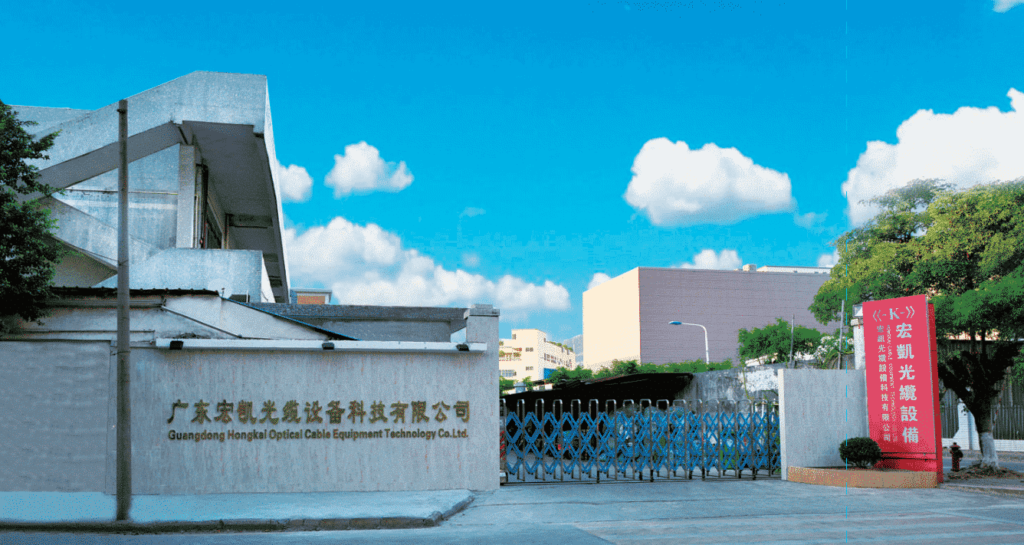
Guangdong Hongkai Optical Cable Equipment Technology Co., Ltd. began manufacturing wire and cable equipment in 2005 and was formally incorporated in 2015. Our main products include SZ stranding and cabling lines, fiber optic cable sheathing extrusion lines, and FTTH drop cable production lines.
Hongkai equipment measured data: SZ stranding machine pay-off tension fluctuation ≤ ±0.4 N, stranding pitch deviation ≤ ±0.08 mm; sheathing line 8-hour continuous production concentricity average ≥ 98.6%, wall thickness tolerance ≤ 0.04 mm. Every machine comes with a factory test report, a PLC program backup on USB, bilingual operation manuals (Chinese/English), and a wear-parts kit. Our equipment has been exported to more than 15 countries and regions, with over 160 sets currently running on production lines worldwide.
If you are inspecting cable equipment or want to see the factory test data for a particular machine, feel free to contact the Hongkai technical team. Look at the data first, then look at the equipment.