Anyone in the cable business knows that during cable manufacturing, even a 0.1°C temperature deviation or a 0.01 mm dimensional error can affect the ultimate transmission speed and stability of the fiber.
But few stop to consider that the equipment used to make those cables is itself a “precision instrument.”
An SZ stranding and cabling line – from a set of blueprints to a machine running day and night on the production floor – passes through countless precision checkpoints. If any checkpoint fails, the consequences on the customer’s line are: unstable tension, drifting pitch, and persistently high scrap rates.
Below, from the perspective of cable equipment manufacturing, we break down how the “invisible” precision of a stranding machine and a sheathing line is actually built.
1. The Differential Gearbox: The “Heart” of the Stranding Machine – Precision Starts with the Gears
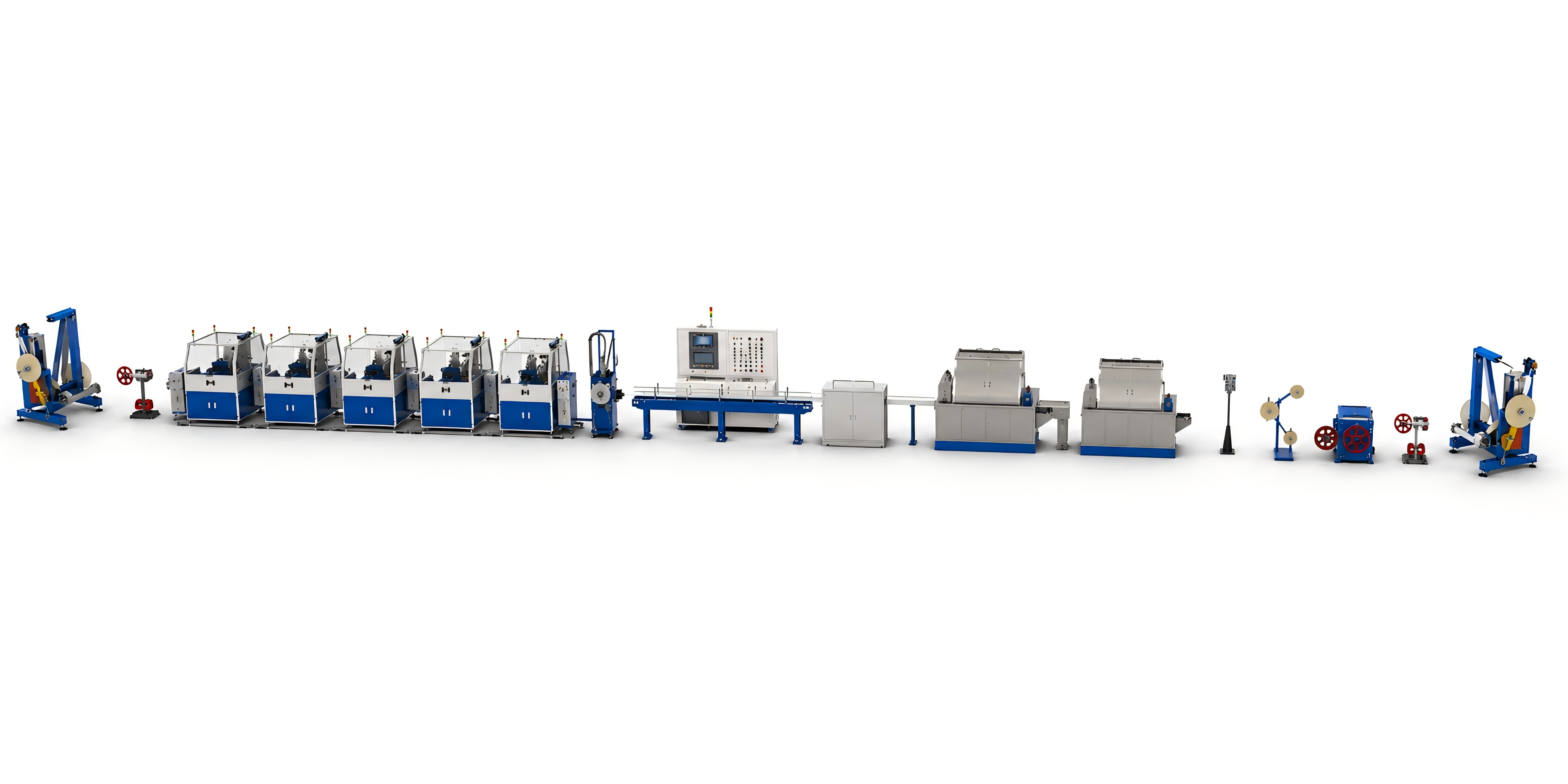
The SZ stranding unit is the core of the loose‑tube cable stranding machine – the heart of the entire production line, directly affecting line speed and cable performance.
The differential gearbox is the “heart” of the stranding machine. A cluster of gears meshing and rotating, one turn forward, one turn backward – tens of thousands of cycles per day. The precision of these gears directly determines whether the stranding pitch stays accurate and how many years the equipment will last.
Traditional stranding units use a single high‑power motor for drive. The stranding cage has a large outer diameter, high rotational inertia, and long reversal delay times, resulting in less than ideal cable bending performance. The fully differential SZ stranding unit, by contrast, uses four servo motors as power sources for segmented drive – the first drives one cage section, the second drives two, the third drives four, and the fourth drives ten. With fewer transmission chains and a reduced cage outer diameter, the stranding speed is higher.
Gear machining is the first checkpoint for precision control.
Ordinary gears begin to wear within two to three years – insufficient surface hardness and finish. Hongkai’s differential gears undergo high‑frequency hardening and precision grinding – hardening achieves tooth surface hardness of HRC 50–55, and grinding brings surface roughness below 0.8 μm. Harder and smoother – the gears are less prone to wear, with one set lasting eight to nine years.
Reversal control relies on encoders. The encoder sends pulse signals to the control system, which calculates the rotation angle of the stranding head. When the angle meets the preset reversal condition, the motor reverses direction. The synchronous pulleys use taper‑lock bushings – compared to keyed connections, they run more smoothly during reversal and do not impose additional tension on the fiber tubes.
2. The Dancer: The “Sensor” of Tension Control – Sensitivity Comes from Bearings
During stranding, pay‑off tension must be precisely controlled. If tension is too high, the tubes are stretched, consuming the fiber excess length inside; if tension is too low, the tubes arch during stranding, causing uneven pitch.
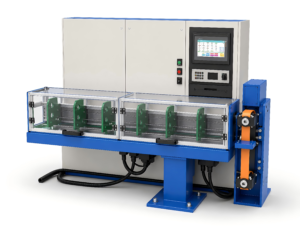
The dancer is the key to tension control. The tube comes off the pay‑off reel, passes over the dancer arm, and then enters the stranding unit. When tension changes, the arm swings up or down – the angle change is converted into an electrical signal fed back to the PLC, which automatically adjusts the pay‑off speed.
The dancer’s bearings determine whether that feedback signal is accurate.
With off‑brand bearings, they bind over time. A stuck arm means inaccurate signals; inaccurate signals mean the PLC makes wrong adjustments; wrong adjustments mean tension drifts; tension drift means pitch deviation.
Hongkai’s dancer bearings are SKF or NSK – high precision, low resistance, long life. One set lasts eight to nine years without replacement. The sensor picks up the slightest arm movement – with a 20 ms refresh cycle.
3. The Laser Diameter Gauge: The “Eye” of the Sheathing Line – 0.2 μm Accuracy
What does a sheathing line fear most? Eccentricity – sheath wall thickness being thicker on one side and thinner on the other. Industry standards require sheath concentricity ≥ 98%, with deviation exceeding 0.05 mm potentially causing microbend loss.
Traditional sheathing relies on operators using their eyes and hands. An experienced master technician can spot deviations, but not always with perfect accuracy.
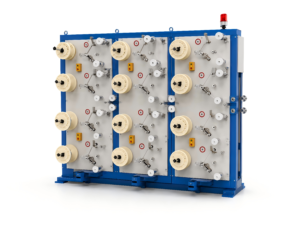
The laser diameter gauge is the key to solving eccentricity. Using laser scanning for non‑contact online measurement, it monitors the sheath outer diameter in real time, sends data to the PLC, and the PLC automatically adjusts extruder speed to bring the diameter back.
The gauge’s accuracy determines how “true” the sheath can be.
Hongkai’s sheathing line is equipped with a high‑precision laser diameter gauge with 0.2 μm accuracy – one two‑hundredth of a human hair’s diameter. If the sheath outer diameter deviates by just 0.01 mm, the gauge detects it. Data is uploaded every 0.1 seconds, and the PLC automatically adjusts extruder speed to bring the diameter back.
Over 8 hours of continuous production, concentricity averages 98.6%, with wall thickness tolerance ≤ 0.04 mm. This isn’t achieved by operator experience – it’s the equipment “watching” itself work.
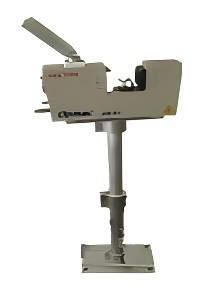
4. The Screw: The “Soul” of the Extruder – Wear Resistance Comes from Nitriding
The core of a sheathing line is the extruder. Plastic pellets are melted at high temperature and pushed through the screw to cover the cable core. The precision and wear resistance of the screw directly determine whether the sheath wall thickness is uniform and the surface is smooth.
Ordinary screws need re‑grinding every two to three years – re‑grinding costs a few thousand RMB, and a new one costs tens of thousands. The key point is: re‑grind before the screw is completely worn out. If you wait until it can no longer extrude, the entire screw is already scrap.
Hongkai’s extruder screw is made of 38CrMoAlA alloy steel and undergoes nitriding – at temperatures exceeding 500°C, nitrogen atoms diffuse into the steel surface, forming an extremely hard nitrided layer 0.5–0.7 mm deep, with hardness above HV 900. With this nitrided layer, the screw maintains its precision for five to six years.
5. Before Factory Release: Load Testing – Let the Data Speak
All components assembled, all wiring connected – but the machine still cannot ship. There’s one final checkpoint: load testing.
The Code for Construction and Quality Acceptance of Production Equipment Installation Engineering in Optical Fiber Cable Factories (GB 50950‑2013) clearly specifies that equipment performance inspection must be conducted after load operation is completed, and an acceptance report must be issued.
Before leaving the factory, every Hongkai machine undergoes no less than 2 hours of load testing – feeding actual tubes and sheath material, simulating real production conditions. The data collected is recorded in the factory test report:
-
Pay‑off tension fluctuation (measured ≤ ±0.4 N)
-
Stranding pitch deviation (measured ≤ ±0.08 mm)
-
Sheath concentricity (measured ≥ 98.6%)
-
Sheath wall thickness tolerance (measured ≤ 0.04 mm)
These figures are not arbitrary – they are actually measured by sensors and instruments during load operation. Customers can replicate the measurements upon receipt – if the numbers match, the equipment’s precision is proven.
Final Thoughts
From blueprints to the production line, a cable machine passes through countless precision checkpoints. The hardness of differential gears, the sensitivity of dancer bearings, the accuracy of the laser diameter gauge, the wear resistance of the extruder screw – each checkpoint determines whether the equipment runs stably and lasts long on the customer’s production line.
China’s fiber optic cable industry has built the world’s most complete closed‑loop industrial ecosystem – accounting for over 50% of global optical fiber preform production capacity, and is the only country that has achieved full self‑sufficiency across the entire chain – from key raw materials to core equipment to end‑user applications. Cable equipment manufacturing is the critical link that connects this closed loop.
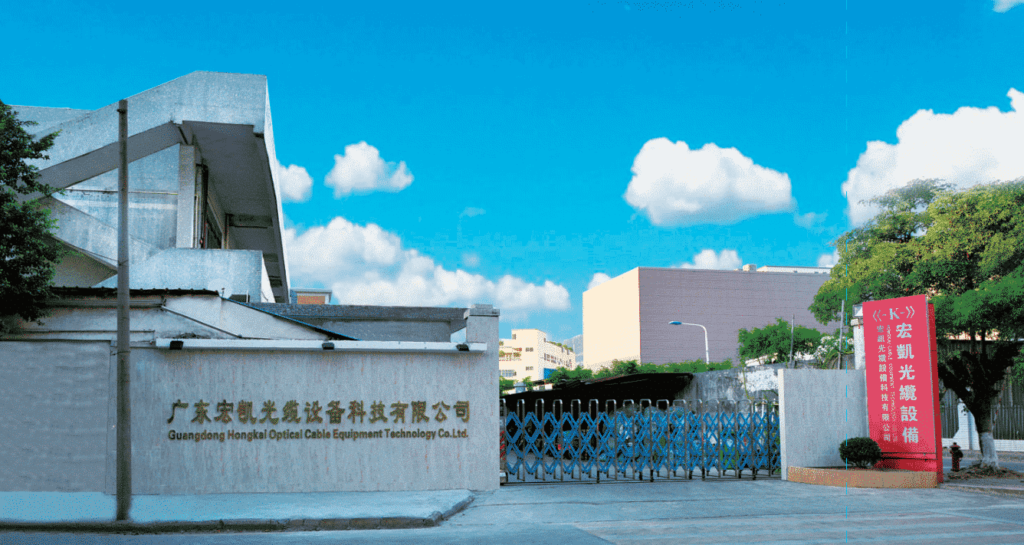
Guangdong Hongkai Optical Cable Equipment Technology Co., Ltd. began manufacturing wire and cable equipment in 2005 and was formally incorporated in 2015. Our main products include SZ stranding and cabling lines, fiber optic cable sheathing extrusion lines, and FTTH drop cable production lines.
Every machine comes with a factory test report – listing pay‑off tension fluctuation, stranding pitch deviation, and sheath concentricity. A PLC program backup on USB, bilingual operation manuals (Chinese/English), and a wear‑parts kit are shipped with every machine. Our equipment has been exported to more than 15 countries and regions, with over 160 sets currently running on production lines worldwide.
If you’re planning to build or expand a cable production line – or if you want to see actual measured data from equipment before it leaves the factory – feel free to contact the Hongkai technical team.