Cable factories are racing to expand capacity – and the equipment manufacturers that supply them are evolving right alongside.
A 2025 study published in the journal Wire & Cable on the design of high‑speed stranding and cabling units pointed out that traditional stranding units in high‑speed cabling processes have shortcomings in speed, durability, accuracy, and digital interconnectivity. By adopting new servo motors, optimizing mechanical structures, improving materials, and enhancing informatization, the research team achieved significant increases in line speed, notable improvements in equipment durability, and effective control of stranding accuracy.
Equipment manufacturing itself is undergoing a technical evolution – from “functional” to “exceptional.”

1. Design Philosophy Is Changing: From “Machine‑Centric” to “System‑Centric” Thinking
Traditional cable equipment design has often been “machine‑centric” – as long as a stranding machine could rotate and strand, it was sufficient. But today’s requirements have changed.
Digital transformation of cable manufacturing workshops is now a clear trend. Digital twin technology builds intelligent production systems with virtual‑physical mapping, enabling real‑time equipment status awareness, dynamic optimization of process parameters, and rapid response to anomalies. A company survey showed that its workshop generates over 200,000 equipment data points daily – but only 30% are effectively utilized. Equipment data capability is rapidly shifting from a “nice‑to‑have” to a “must‑have.”
In FiberHome’s smart factory, artificial intelligence coverage exceeds 80%, supporting the parallel efficient production of hundreds of fiber optic cable products on a routine basis. ZTT’s cable headquarters has independently developed 14 traverse arms and automatic fiber storage frames, along with other technologies and products. Equipment is no longer an isolated “hunk of metal” – it’s a node on an entire digital production line.
The first checkpoint of equipment manufacturing has shifted from “can we make it” to “can we connect it.”
2. Materials Are Changing – and So Must Processing Techniques
The materials used in equipment are also evolving.
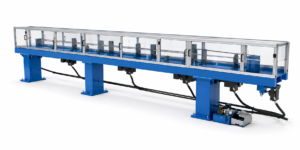
Traditional stranding cage guide plates are mostly made of steel – heavy and prone to wear. Comparative studies have shown that guide plates made of zirconia ceramics offer significantly improved wear resistance and longer equipment life. Timing belts have also been upgraded from standard types to steel‑reinforced types, providing smoother operation during reversal.
The processing techniques for differential gears are also being upgraded. Ordinary gears begin to wear within two to three years. Hongkai’s differential gears undergo high‑frequency hardening and precision grinding – hardening achieves tooth surface hardness of HRC 50–55, and grinding brings surface roughness below 0.8 μm. Harder and smoother – the gears are less prone to wear.
Extruder screw materials are also evolving. Hongkai’s extruder screw is made of 38CrMoAlA alloy steel and undergoes nitriding – with a nitrided layer 0.5–0.7 mm deep and hardness above HV 900. Without this nitrided layer, the screw would wear out after just a few months of extrusion under high temperature and pressure.
Materials upgrades in equipment manufacturing directly determine how many years the equipment will last and how long its precision will remain stable.
3. Precision Is Changing: From “Good Enough” to “Just Slightly Off Won’t Do”
As cable products have changed, so have the precision requirements for equipment.
High‑fiber‑count cables have moved from niche to mainstream. In the past, loose‑tube cables used 6 to 12 tubes – now high‑fiber‑count cables routinely use 24 tubes or more. Pay‑off tension deviation on any single tube can be magnified. Industry standards require pay‑off tension fluctuation during stranding ≤ ±0.5 N and stranding pitch deviation ≤ ±0.1 mm.
Sheathing precision requirements are also increasing. G.657 series bend‑insensitive cables require sheath concentricity ≥ 98% – deviation exceeding 0.05 mm can cause microbend loss.
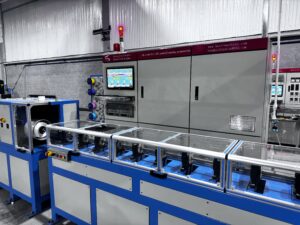
Hongkai’s SZ stranding machine uses independent servo motors for active pay‑off with real‑time closed‑loop tension sensor control – measured pay‑off tension fluctuation ≤ ±0.4 N and stranding pitch deviation ≤ ±0.08 mm. The sheathing line is equipped with a high‑precision laser diameter gauge (accuracy 0.2 μm) – over 8 hours of continuous production, concentricity averages 98.6%, with wall thickness tolerance ≤ 0.04 mm.
In 2026, Yangtze Optical Fiber and Cable (YOFC) obtained a patent for a cable winding device that achieves fully automated, tightly packed cable winding through precise control of winding points and turning points.
Equipment precision is no longer a question of “is it sufficient” – it’s a question of “can you take the orders.”
4. Manufacturing Processes Are Changing: From “Assembly” to “Integrated Molding”
The manufacturing processes for cable equipment itself are also evolving.
Traditional sheathing dies were like “building blocks” – core and sleeve installed separately, requiring manual eccentricity adjustment afterward, taking at least 30 minutes. Yan Huiliang, workshop director at Zhejiang Dongtong Optical Network IoT Technology Co., Ltd., led a team to develop an integrated, adjustment‑free sheathing die – the entire die is a single unit, requiring no assembly and no eccentricity adjustment – just mount it and run, with finished cable cross‑section eccentricity controlled within 0.2 mm.
The stranding‑sheathing integrated machine follows the same logic. Yan Huiliang’s team developed an integrated machine that combines stranding and sheathing into a single process – reducing line staffing by 15 people and freeing up 50% of workshop floor space.
Equipment manufacturing is moving from “assembly of multiple components” to “integrated design.” Fewer components mean fewer failure points; less manual intervention means higher product consistency.
5. Service Models Are Changing: Equipment Export Is Not Just “Pack and Ship”
In 2026, cable equipment exports are becoming the new normal.
FiberHome’s optical fiber and cable production base in Rayong, Thailand, is already in production. ZTT has established specialty optical fiber and cable production bases in Morocco, Poland, Brazil, Indonesia, and multiple other countries. The annual investment scale for new overseas computing centers in 2026 is projected to reach RMB 4.2 trillion.
Every new overseas cable plant means procurement demand for cable equipment.
But equipment export is not the same as domestic sales. When equipment goes overseas, who installs it? What happens if it breaks down? How are spare parts guaranteed? These service capabilities are becoming the core competitive advantages in equipment exports.
Hongkai equipment has been exported to more than 15 countries and regions, with over 160 sets currently running on production lines worldwide. For overseas markets, Hongkai has prepared on several fronts: engineers on‑site for installation and commissioning – 12 to 18 days from installation to trial production; bilingual operation manuals and electrical schematics shipped with the equipment; standard wear‑parts kits shipped with the equipment – DHL delivery within three days; remote video support with two‑hour response during working hours.
Final Thoughts
Cable equipment manufacturing is undergoing a technical evolution – from “functional” to “exceptional.”
-
Design philosophy: from “machine‑centric” to “system‑centric”
-
Materials: from ordinary steel to high‑performance alloys
-
Precision: from “good enough” to “just slightly off won’t do”
-
Manufacturing processes: from “assembly” to “integrated molding”
-
Services: from “sell and forget” to “full lifecycle support”
The cable industry is changing – and the equipment that makes cables must change too.
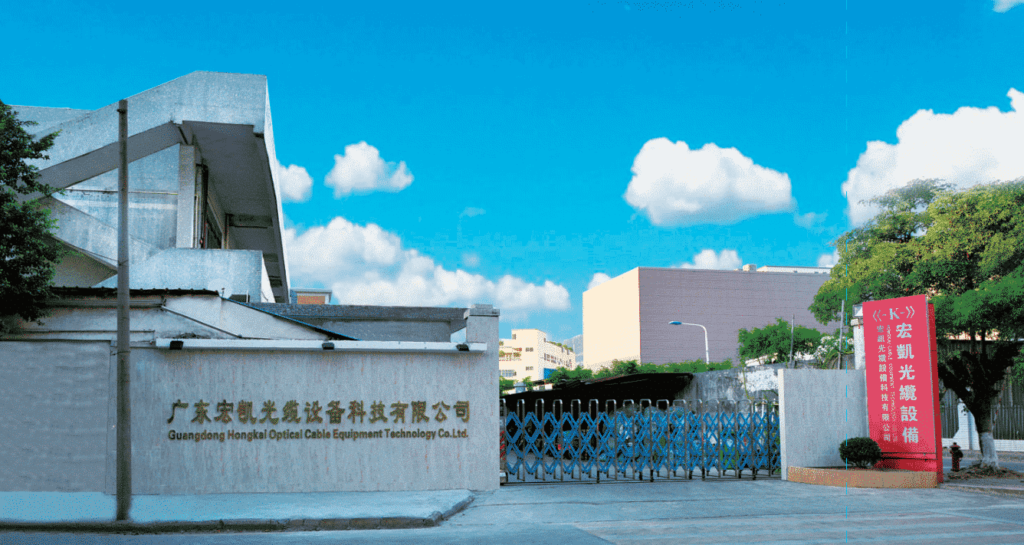
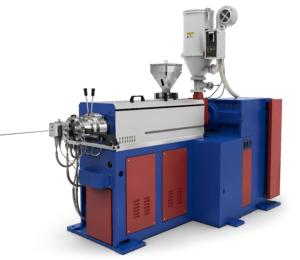
Guangdong Hongkai Optical Cable Equipment Technology Co., Ltd. began manufacturing wire and cable equipment in 2005 and was formally incorporated in 2015. Our main products include SZ stranding and cabling lines, fiber optic cable sheathing extrusion lines, and FTTH drop cable production lines.
In the ongoing technical evolution, Hongkai has focused on several key areas:
-
Precision assurance: SZ stranding machine pay‑off tension fluctuation ≤ ±0.4 N, pitch deviation ≤ ±0.08 mm; sheathing line concentricity ≥ 98.6%, wall thickness tolerance ≤ 0.04 mm
-
Materials upgrade: Differential gears with high‑frequency hardening + precision grinding – hardness HRC 50–55; 38CrMoAlA screws with nitriding treatment
-
Data capability: Siemens/Mitsubishi PLC platforms, supporting data acquisition and MES integration
-
Recipe storage: Stores process parameters for up to 20 different products – one‑touch recipe loading, changeover in 1.5 hours
-
Overseas service: Engineers on‑site for installation and commissioning, bilingual technical documentation, spare parts via DHL within three days
Every machine comes with a factory test report, a PLC program backup on USB, bilingual operation manuals (Chinese/English), and a wear‑parts kit. Our equipment has been exported to more than 15 countries and regions, with over 160 sets currently running on production lines worldwide.