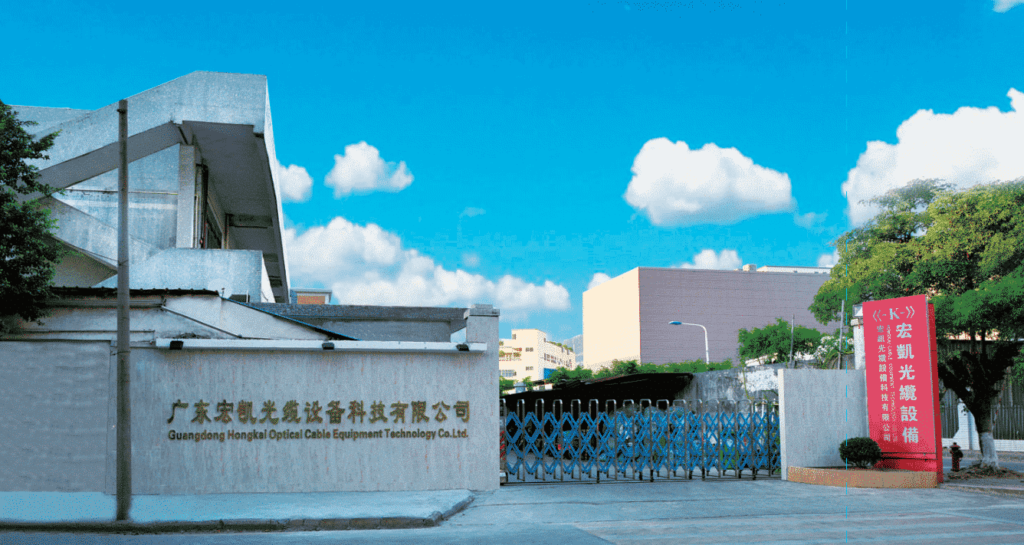
“Orders are fully booked, and optical cable equipment runs 24/7” – this is the norm for optical cable manufacturers.
But behind full-load operation, an easily overlooked issue is emerging: the same model of optical cable stranding machine from the same manufacturer may still maintain stable precision after eight years in one factory, yet experience frequent breakdowns after just three years in another. Where does the gap lie?
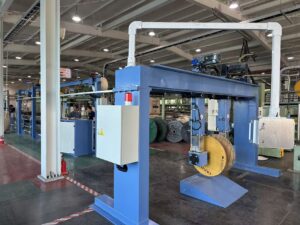
I. The “Wear Curve” of Optical Cable Equipment: Normal Wear vs. Accelerated Aging
All mechanical equipment has a normal service life. A well‑designed optical cable SZ stranding line, under proper operation and regular maintenance, typically has a design life of 8‑10 years for its core components (differential gearbox gears, dancer bearings, traction wheels).
However, in actual production, many machines wear out much faster than designed. Based on service records from Hongkai’s after‑sales team across more than 15 countries and regions, the most common causes of “accelerated aging” in optical cable equipment are concentrated in the following four areas:
Cause 1: The tension system is chronically “sub‑healthy”
The pay‑off tension control accuracy of a stranding line directly determines stranding pitch stability. The tension sensor and dancer arm are the core components of the closed‑loop tension system. If the dancer bearing is not lubricated regularly, the resistance to arm return increases, and the tension sensor output signal may lag or drift. Initially, tension fluctuation might only widen from ±0.4 N to ±0.8 N – which seems “still usable” – but over long‑term operation, the impact load on the differential gearbox gears multiplies, accelerating gear wear by 2‑3 times.
Cause 2: Lubrication management is done “only when remembered”
The differential gearbox is the “heart” of the SZ stranding line. The gears inside mesh continuously at high speed; the lubricating oil not only provides lubrication but also dissipates heat and removes wear particles. If the oil change interval is extended from the recommended 6 months to 12 months or longer, metal debris from gear wear circulates through the oil system, accelerating bearing and gear wear failure. The replacement cost of a differential gearbox can account for 15‑20% of the entire machine’s price.
Cause 3: Electrical components are running “with underlying issues”
Frequency converters, PLCs, sensors, and other electrical components are sensitive to ambient temperature, humidity, and dust. Many overseas cable plants are located in high‑temperature or high‑humidity regions (e.g., the Middle East, Southeast Asia). If the air conditioning or cooling fans in the electrical cabinet are not maintained for a long time, and the internal temperature consistently exceeds 50°C, the lifespan of the converter’s electrolytic capacitors may shrink from the designed 8‑10 years to 3‑4 years. Equipment management is shifting from “breakdown repair” to “predictive maintenance,” with 5G gateways collecting real‑time operating parameters and leveraging fault knowledge graphs for remote diagnostics and life prediction.
Cause 4: Operators “misadjust parameters”
Hongkai’s 2024 overseas service statistics show that 42% of remote support requests are related to operator errors – new employees mis‑adjusting pitch coefficients, incorrectly setting tension values, accidentally disabling breakage switches, and so on. These issues are not difficult to resolve themselves, but if they occur repeatedly, the equipment running under suboptimal parameters for extended periods will also accelerate abnormal wear of mechanical components.
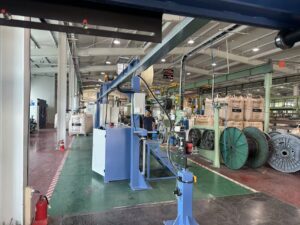
II. Three Key Actions for “Longevity” of Optical Cable Equipment
Based on Hongkai’s service experience across more than 15 countries and regions, the following three actions are most critical for extending equipment lifespan:
Action 1: Establish a “preventive maintenance” calendar, not “fix after breakdown”
Every Hongkai equipment shipment includes a Maintenance Manual that clearly specifies:
-
Daily inspection items (dancer arm flexibility, breakage switch sensitivity, laser gauge lens cleaning)
-
Weekly maintenance items (greasing lubrication points, checking electrical cabinet cooling fans)
-
Monthly maintenance items (tension sensor zero calibration, measuring wheel wear check)
-
Semi‑annual overhaul items (differential gearbox oil change, traction wheel wear measurement)
After the implementation of Sichuan Lefei Optoelectronics’ 5G fully connected digital factory for cable manufacturing, equipment management has shifted from “breakdown repair” to “predictive maintenance,” significantly improving overall equipment effectiveness.
Action 2: Keep a backup of factory “default parameters”
Every Hongkai equipment shipment includes a USB drive containing:
-
Complete PLC program backup
-
Touchscreen recipe files (including factory‑calibrated pitch coefficients, tension PID parameters, etc.)
-
Electrical schematics (with all wire number markings)
When parameters become scrambled due to operator error, personnel can restore factory defaults via the USB drive within 15 minutes, without waiting for remote engineer support.
Action 3: Establish a “wear‑parts” safety stock
Hongkai provides a standard wear‑parts kit with each equipment shipment (8 types: belts, bearings, ceramic guide wheels, proximity switches, fuses, etc.). For overseas customers, it is recommended to additionally stock the following critical spare parts:
-
Frequency converter (1 unit, same model as the equipment)
-
Tension sensor (1‑2 units)
-
Differential gearbox lubricating oil (sufficient quantity)
-
Critical belts and bearings (2 sets each)
The value of a safety stock of spare parts is that when a critical component unexpectedly fails, line downtime is reduced from “waiting 3‑5 days for DHL delivery” to “1‑2 hours for part replacement.”
III. How Hongkai Helps Customers Extend Equipment Lifespan
Guangdong Hongkai Optical Cable Equipment Technology Co., Ltd., established in 2015 (with origins dating back to 2005), specializes in optical cable manufacturing equipment – SZ stranding lines, outdoor cable sheathing lines, butterfly drop cable lines, and plastic tube production lines. In terms of “long‑term equipment operation,” Hongkai provides support across the following three dimensions:
Dimension 1: The “longevity gene” of the equipment itself
Hongkai equipment emphasizes long‑term reliability from the design and manufacturing stages:
-
Differential gearbox gears use high‑frequency hardening (HRC 50‑55) + precision grinding, offering better wear resistance than standard gears
-
Dancer bearings are from international brands such as SKF/NSK, with low‑friction design and a design life of 8‑10 years
-
Major electrical components use Siemens/Mitsubishi PLC, Siemens/Schneider low‑voltage devices, with global warranties and stable quality
-
Sheathing line screw material is 38CrMoAlA, with a nitrided layer depth of 0.5‑0.7 mm and hardness above HV900
Dimension 2: Preventive maintenance “toolkit”
-
Bilingual (Chinese/English) Operation and Maintenance Manual (including daily checklist, weekly maintenance items, monthly maintenance plan)
-
Standard wear‑parts kit (8 types, shipped with the equipment)
-
PLC program and factory parameter backup on USB drive
-
Built‑in fault code quick‑reference table on the touchscreen for operator self‑diagnosis
Dimension 3: Remote diagnostics and rapid response
-
Remote video support (response within 2 working hours) – 89 overseas remote support sessions completed in 2024
-
Spare parts delivered by DHL express in 3‑5 working days
-
On‑site engineer service (12‑18 days for installation/commissioning or fault repair)
IV. Three Recommendations for Optical Cable Manufacturers
In an industry cycle with full order books and equipment running at full capacity, the long‑term stable operation of optical cable equipment is more important than ever. Here are three practical recommendations:
Recommendation 1: Incorporate equipment maintenance into “capacity management”
Don’t wait until equipment breaks down to think about maintenance. Integrate preventive maintenance into production scheduling – schedule maintenance time just like production orders: half a day each month for lubrication and inspection, and two days each year for major overhaul. This may seem to “occupy” production time, but it avoids longer unplanned downtime.
Recommendation 2: Provide “equipment awareness” training for operators
Many equipment faults stem from operators “not knowing.” It is recommended to arrange at least 2 days of systematic training when new equipment is commissioned, covering: equipment working principles, daily inspection items, meanings of common alarm codes, and parameter backup/restoration methods. Hongkai can provide bilingual training materials and remote video training services for customers.
Recommendation 3: Choose an equipment supplier with strong “full‑lifecycle service” capabilities
Equipment procurement is not just buying a machine – it is buying a support system that “keeps the machine running stably for the long term.” Does the supplier provide bilingual maintenance manuals? Does the equipment come with a wear‑parts kit and parameter backup? Is remote diagnostics and rapid spare‑parts shipping supported? These capabilities determine how long the equipment can “keep running” during full‑load production cycles.
V. About Guangdong Hongkai
Guangdong Hongkai Optical Cable Equipment Technology Co., Ltd., established in 2015 (with origins dating back to 2005), is located in Humen Town, Dongguan City, Guangdong Province. The company specializes in optical cable manufacturing equipment – SZ stranding lines, outdoor cable sheathing lines, butterfly drop cable lines, and plastic tube production lines. The equipment has been exported to more than 15 countries and regions across the Middle East, Southeast Asia, South Asia, Africa, and Europe, with cumulative deliveries exceeding 160 sets.
Hongkai equipment measured performance:
-
Pay‑off tension fluctuation ≤ ±0.4 N (at 20 m/min line speed)
-
Stranding pitch deviation ≤ ±0.08 mm
-
Average sheath concentricity over 8 hours continuous production: 98.6%
-
Wall thickness tolerance ≤0.04 mm (nominal 1.8 mm)
-
Changeover time ≤1.5 hours (one‑click recipe recall)
Hongkai provides bilingual operation manuals, electrical schematics, and CE technical documentation; remote video support (response within 2 working hours); on‑site engineer dispatch for installation and commissioning (12‑18 days from arrival to trial production); and a standard wear‑parts kit shipped with the equipment, with spare parts delivered by DHL express in 3‑5 working days.
For detailed equipment specifications, maintenance support plans, or equipment lifespan assessments, please feel free to contact the Hongkai technical team.
-