Many cable factories achieve only about 95% yield in the early stages of production. After equipment optimization and process control, this can be raised to over 99%. From 95% to 99% – it looks like just a 4 percentage point difference, but for a line producing 3,000 km per year, that’s a difference of 120 km of qualified cable annually. At current cable prices, that’s no small amount.
This article outlines five key control points on a fiber optic cable production line to help overseas cable manufacturers “raise” their yield.
1. Tension Control: The “Stability” of the SZ Stranding Line Is the First Checkpoint
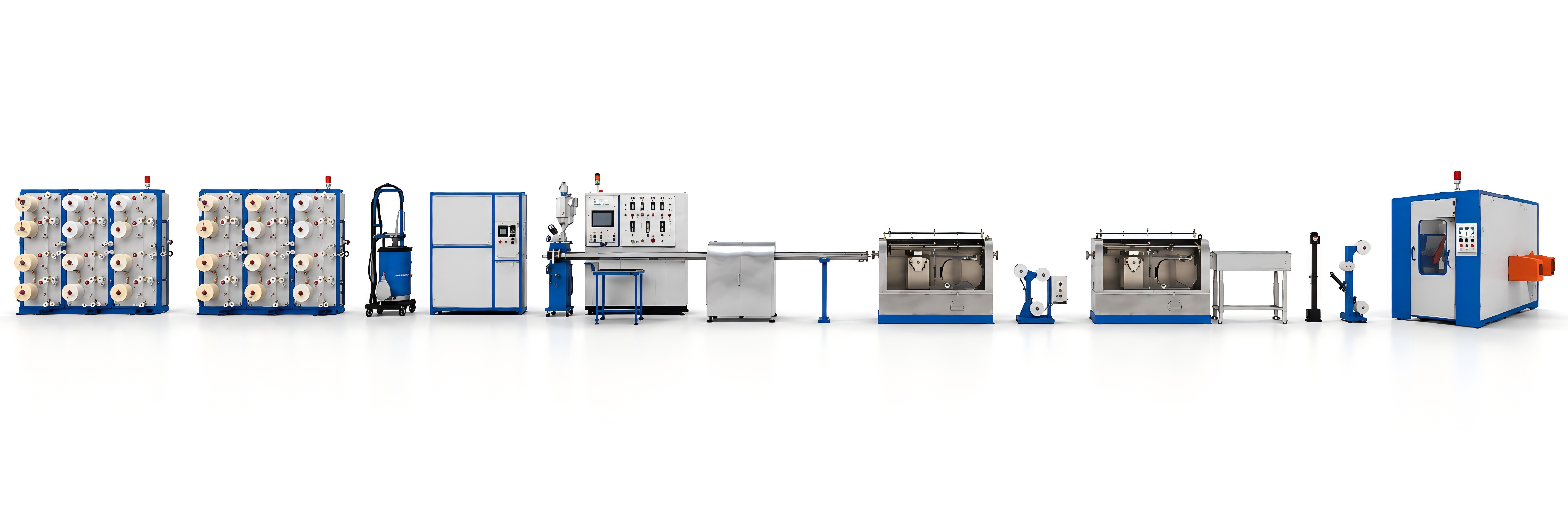
The stranding process is the core of cable production. Pay-off tension fluctuation on the SZ stranding line directly determines the stability of the stranding pitch. If tension is too high, the tubes are stretched, consuming the fiber excess length; if tension is too low, the tubes arch, causing uneven pitch.
Industry standards require pay-off tension fluctuation during stranding ≤ ±0.5 N (at 20 m/min line speed), and stranding pitch deviation ≤ ±0.1 mm. Hongkai’s SZ stranding line uses independent servo motors for active pay-off with real-time closed-loop tension sensor control, with a signal refresh cycle of 20 milliseconds – measured pay-off tension fluctuation ≤ ±0.4 N and stranding pitch deviation ≤ ±0.08 mm.
Front-end equipment is equally important. The fiber coloring machine achieves pay-off tension accuracy of ±0.05 N, the secondary coating line for optical fiber achieves excess length control accuracy of ±0.2‰, and the loose tube line is also designed with high-precision tension control standards.
2. Sheath Concentricity: The “Eye” of the Fiber Optic Cable Sheathing Line Must Be Bright Enough
Sheath eccentricity is the biggest “hidden killer” of cable yield. Wall thickness that is thick on one side and thin on the other wastes material on the thick side and provides insufficient protection on the thin side. G.657 series bend-insensitive cables require sheath concentricity ≥ 98% – below this standard, bending loss sharply amplifies, and the customer rejects the shipment outright.
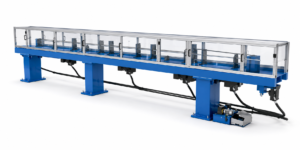
The core of the fiber optic cable sheathing line is the laser diameter gauge and closed-loop control. Hongkai’s sheathing line is equipped with a high-precision laser diameter gauge (accuracy 0.2 μm) – if the sheath outer diameter deviates by just 0.01 mm, it detects it and the PLC automatically adjusts the extruder speed to bring it back. Over 8 hours of continuous production, concentricity averages 98.6%, with wall thickness tolerance ≤ 0.04 mm.
The FTTH optical cable manufacturing machine and indoor optical fiber production line are similarly equipped with inline inspection to ensure stable sheath precision across different products.
3. Changeover Efficiency: Recipe Storage Reduces Human Error
Today’s cable orders are “multi-variety, small-batch” – 12-fiber today, 24-fiber tomorrow, butterfly drop cable the day after. During changeover, operators manually enter over a dozen parameters – one slip and it’s wrong. A parameter error can scrap an entire reel of cable.
Hongkai equipment features built-in recipe storage, capable of saving process parameters for up to 20 different products. During changeover, simply select the corresponding product on the touchscreen and tap “Load” – all parameters are automatically sent to each unit. The entire fiber optic cable making machine series – including the fiber optic coloring line, SZ stranding line, and fiber optic cable sheathing line – supports one-touch recipe loading, compressing changeover time to under 1.5 hours.
Faster changeover with fewer errors naturally improves yield.
4. Inline Inspection and Data Traceability: Giving Every Meter of Cable a “File”
Traditional cable production relies on manual sampling – by the time a problem is discovered, hundreds of meters of defective product may already have been produced. Inline inspection and data traceability on the fiber optic cable production line are shifting from “nice-to-have” to “must-have.”
Hongkai equipment comes standard with Siemens/Mitsubishi PLC platforms, supporting automatic production data recording and MES integration. Process parameters for every batch – tension, pitch, temperature, speed – are all automatically recorded, traceable, and exportable. If a customer needs production data for a specific cable batch, simply retrieve it from the system. The entire optical fiber cable production line is data-connected – managers can see line status from their office.
5. Equipment Stability: Core Component Lifespan Determines Long-Term Yield
Equipment may achieve 95% yield when first commissioned, but after two years, yield may drop to 90% – the problem often lies in core component wear.
For the SZ stranding line differential gears, Hongkai uses high-frequency hardening plus precision grinding – hardness HRC 50–55, tooth surface roughness ≤ 0.8 μm, with one set lasting eight to nine years. The fiber optic cable sheathing line screw is made of 38CrMoAlA alloy steel with nitriding treatment – nitrided layer depth 0.5–0.7 mm, hardness above HV 900. Dancer bearings use SKF or NSK, with low-friction design and a 20-millisecond signal refresh cycle.
When core components last, long-term yield remains stable.
Improving Yield Is Not Just About Equipment
Going from 95% to 99% requires coordination across four areas: equipment precision, process control, personnel operation, and data management. What Hongkai provides is not just equipment, but also:
-
Factory test report: Every machine comes with measured data for pay-off tension fluctuation, stranding pitch deviation, and sheath concentricity
-
On-site installation and commissioning: Engineers on-site – 12 to 18 days from unpacking to producing the first qualified reel
-
Operator training: Three levels of training – operational, maintenance, and data
-
Spare parts support: Standard wear-parts kit shipped with equipment, DHL delivery within three days
-
Remote support: Response within 2 hours during working hours, with optional remote diagnostic module
📩 Get Your Customized Yield Improvement Plan
If you are procuring a fiber optic cable production line for an overseas project, or want to learn how to improve yield through equipment selection and process control, feel free to contact the Hongkai technical team.
Just tell us three things:
-
What type of cable do you want to make? (Loose-tube / FTTH / indoor cable)
-
Where will the factory be built? (This affects voltage system and certification requirements)
-
Approximately what capacity? (How many kilometers per month or per year)
We will provide a preliminary equipment configuration proposal and quotation within 5 working days.
📧 Email: sales2@hkofcmachine.com
🌐 Website: https://hkofcmachine.com/