Looking back, the optical fiber and cable industry has experienced two typical high‑cycle periods: 2009‑2010, driven by 3G license issuance and broadband speed upgrades; and 2015‑2016, driven by large‑scale 4G construction. Both cycles shared the same pattern: domestic carrier centralized procurement with rising volume and prices → manufacturers expand capacity → oversupply → price declines. The industry exhibited a typical “strong cyclicality, weak growth” character. Pricing power remained in the hands of buyers (carriers), and the industry was consistently confined to a cyclical‑commodity analytical framework.
But this cycle is different. Emerging demand from AI data centers and drones is breaking the old cyclical logic. In 2026, the optical fiber industry shows a boom with both volume and prices rising. The current price increase is driven by three major emerging demand sources: first, the large‑scale construction of AI data centers creating interconnection demand; second, the rapid growth of special application scenarios such as fiber‑carrying drones; and third, the continuous expansion of overseas infrastructure markets driving export demand.
The industry is moving from “cyclical” to “growth” – and the equipment selection logic for optical cable manufacturers must shift accordingly.

I. Three Changes Rewriting the Demand Landscape for Optical Cable Equipment
Change 1: Demand drivers shift from a “single market” to “global resonance”
In the past, domestic carrier centralized procurement was the “single engine” for fiber and cable demand. Today, one of the key variables in this cycle is that overseas demand is becoming a core driver, and Chinese optical fiber and cable manufacturers are beginning to expand globally in a systematic way. The North American fiber market is currently experiencing severe supply shortages – AI data center construction is driving an exponential leap in fiber density demand, while U.S. domestic fiber production capacity is highly concentrated in a few manufacturers such as Corning, and capacity expansion is constrained by an 18‑24 month lead time for preform production, making short‑term supply almost rigid.
According to industry statistics, the annual investment scale of overseas newly built computing centers in 2026 is expected to reach RMB 4.2 trillion. Unlike past cycles driven purely by domestic demand from a “single market + single customer type,” this cycle’s fiber price increase comes from global multi‑agent demand resonance. Chinese cable companies are accelerating overseas expansion – every new overseas cable plant represents procurement demand for stranding lines, sheathing lines, and other optical cable equipment.
Change 2: Product mix shifts from “commodity standard products” to “high‑end customization”
The AI era imposes higher requirements on latency, bandwidth, and density for data transmission. In 2025, one of the most notable shifts in fiber type structure is the significant rise in demand for G.657.A2 fiber, as the server room environment increasingly relies on its bend‑insensitive characteristics. One cable company executive revealed that the price of G.657.A2 fiber has risen more than tenfold compared to last year, with orders increasing fourfold year‑on‑year.
This means that optical cable is gradually transforming from a bulk commodity into a critical component in the AI era, and its traditional cyclical logic is changing. In data center application scenarios, the unit of measurement for some specialty fibers shifts from “fiber‑kilometers” to “meters,” resulting in an order‑of‑magnitude increase in unit price. Cable manufacturers need to produce a wider variety of products with higher precision and greater added value – which imposes entirely new requirements on the precision and flexibility of stranding and sheathing equipment.
Change 3: Manufacturing methods shift from “manual operation” to “5G fully connected”
At Sichuan Lefei Optoelectronics’ smart workshop, optical cables are being produced at a speed of 2.5 meters per second. The vast workshop has fewer than ten workers, who can control the entire line using tablets. After the implementation of the 5G fully connected digital factory for smart cable manufacturing, production efficiency increased by 43.8%, and production costs decreased by 20.3%.
This transformation stems from the integration of 5G private networks with distributed all‑fiber industrial control networks, enabling millisecond‑level data collection from PLCs, sensors, and frequency converters across coloring, stranding, sheathing, and other processes – completely breaking down information barriers between equipment and platforms. Equipment management has shifted from “breakdown repair” to “predictive maintenance” – 5G gateways collect real‑time operating parameters, leveraging fault knowledge graphs for remote diagnostics and life prediction.
Optical cable manufacturing is evolving from “people watching equipment” to “data managing equipment.” Equipment without data interfaces or the ability to interface with management systems will gradually be phased out of mainstream supply chains.
II. Three Direct Impacts on Optical Cable Equipment Selection
First, the equipment’s “global readiness” becomes a hard requirement. As overseas cable plants accelerate construction, whether the equipment supplier has overseas delivery experience, provides bilingual technical documentation, and can dispatch engineers for on‑site installation and commissioning – these are becoming critical thresholds in equipment selection.
Second, the equipment’s “precision ceiling” determines order value. High‑end cables such as G.657.A2 demand far tighter stranding pitch deviation and sheath concentricity than traditional products. Insufficient precision means losing high‑margin orders. Industry standard requirements specify: tension control accuracy within ±0.5 N (at 20 m/min line speed), stranding pitch deviation controlled within ±0.1 mm, and sheath concentricity reaching ≥98%.
Third, the equipment’s “data interface” is moving from optional to standard. The proliferation of 5G fully connected factories means equipment must be able to “speak” – automatically record process parameters, interface with MES systems, and support remote diagnostics. Equipment without these capabilities will gradually lose market relevance in the coming years.
III. Hongkai Optical Cable Equipment: Aligning with New Industry Demands Through Three Core Capabilities
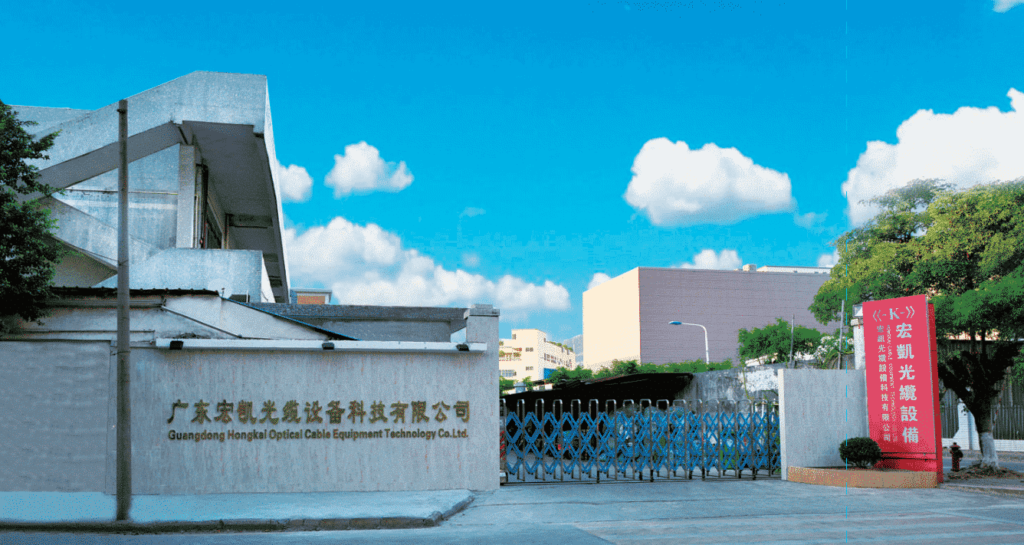
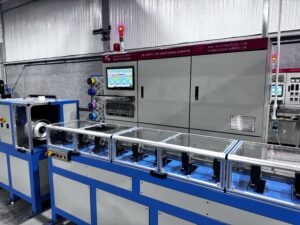
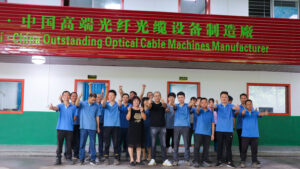
Guangdong Hongkai Optical Cable Equipment Technology Co., Ltd., established in 2015 (with origins dating back to 2005), specializes in optical cable manufacturing equipment – SZ stranding lines, outdoor cable sheathing lines, butterfly drop cable lines, and plastic tube production lines. The equipment has been exported to more than 15 countries and regions across the Middle East, Southeast Asia, South Asia, Africa, and Europe, with cumulative deliveries exceeding 160 sets.
Capability 1: Overseas delivery – from equipment export to production line commissioning
Hongkai provides bilingual operation manuals, electrical schematics, and CE technical documentation; remote video support (response within 2 working hours); on‑site engineer dispatch for installation and commissioning (12‑18 days from arrival to trial production); and a standard wear‑parts kit shipped with the equipment, with spare parts delivered by DHL express in 3‑5 working days. The electrical safety design complies with EN 60204‑1, and CE technical documentation can be provided with certification support upon request. Major electrical components use Siemens/Mitsubishi PLC, Siemens/Schneider low‑voltage devices, and ABB/Inovance frequency converters – with global warranties and local availability.
Capability 2: Precision control – the foundation for taking on high‑end cable orders
Hongkai equipment measured performance:
-
Pay‑off tension fluctuation ≤ ±0.4 N (at 20 m/min line speed)
-
Stranding pitch deviation ≤ ±0.08 mm
-
Average sheath concentricity over 8 hours continuous production: 98.6%
-
Wall thickness tolerance ≤0.04 mm (nominal 1.8 mm)
-
Changeover time ≤1.5 hours (one‑click recipe recall)
These metrics cover the stranding and sheathing requirements for G.657‑series bend‑insensitive cables and high‑fiber‑count cables.
Capability 3: Data readiness – preparing for 5G fully connected factories
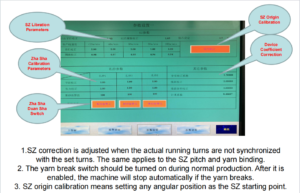
Hongkai equipment comes standard with Siemens/Mitsubishi PLC platforms, supporting recipe storage (≥20 groups), automatic production data logging (CSV export), and OPC UA/SQL interfaces for MES integration. This reserves technical headroom for equipment data collection, remote diagnostics, and predictive maintenance.
IV. Final Thoughts
The optical cable industry is moving from “carrier centralized procurement cycles” to “global computing power growth.” Demand drivers have changed, product structures have changed, and manufacturing methods have changed. The equipment selection logic for cable manufacturers can no longer rely on the experience of the past decade.
Export compliance capability, stranding and sheathing precision, and data interfaces – these are becoming the new “three essential elements” of equipment.
Guangdong Hongkai Optical Cable Equipment Technology Co., Ltd. can provide, upon customer request, factory inspection reports for optical cable equipment, overseas delivery case references, and full‑plant planning proposals. For detailed equipment specifications or to evaluate line‑upgrade solutions, please feel free to contact the Hongkai technical team.