Optical cable equipment manufacturing is not simply “steel welding plus motor assembly.” It is a comprehensive engineering discipline that integrates precision control, materials science, and system integration. Over time, markets change, demand shifts, optical cable products evolve, and the equipment that makes them must evolve as well.

I. The “Three Mountains of Precision” in Optical Cable Stranding Equipment Manufacturing
The core mission of an optical cable stranding line is simple: to twist multiple tubes together at a set pitch to form a structurally stable cable core. But behind this seemingly simple task lies extremely demanding precision control.
The First Mountain: Closed‑loop control of pay‑off tension
The tension at which tubes are drawn from the pay‑off spool must be precisely controlled. Industry research indicates that the stranding process directly determines the cable’s mechanical properties, water‑blocking performance, and transmission consistency. Excessive tension stretches the tubes, consuming the excess fiber length inside; insufficient tension causes the tubes to arch during stranding, resulting in uneven pitch. Hongkai’s SZ stranding line adopts independent servo motor active pay‑off with real‑time closed‑loop tension control via tension sensors. Measured pay‑off tension fluctuation is ≤ ±0.4 N (at 20 m/min line speed), keeping tension deviation well within the industry standard of ±0.5 N.
The Second Mountain: Stable output of stranding pitch
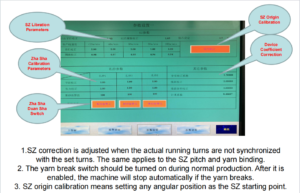
Stranding pitch is the “skeletal parameter” of the cable. The surge in demand for high‑density, high‑fiber‑count cables imposes stricter requirements on stranding accuracy. Traditional equipment relies on mechanical gear changes to set pitch, and after long‑term operation, gear wear causes pitch drift. Hongkai employs a fully differential mechanical structure with PLC stepless setting – no gear changes are required. Pitch values are entered directly through the touchscreen, and measured stranding pitch deviation is ≤ ±0.08 mm.
The Third Mountain: Precise centering of the stranding angle
SZ stranding requires alternating forward and reverse rotation. The zero‑point centering accuracy of the stranding angle directly affects the structural symmetry of the cable core. Hongkai’s SZ stranding line offers an adjustable stranding angle of ±18°, with zero‑point centering and over‑twist alarm protection functions, ensuring consistent starting angles for each batch.
II. The “Dual Challenge of Materials and Process” in Sheathing Equipment Manufacturing
The sheath is the cable’s “armor.” It must protect the optical fiber from mechanical damage and environmental attack while maintaining structural stability under extreme temperatures. The core of sheathing equipment manufacturing lies in the precise control of the extrusion process.
The “Genes” of the extrusion assembly determine quality
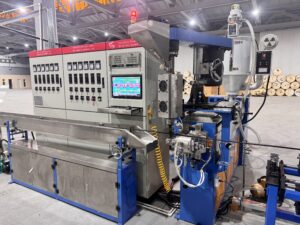
The heart of the sheathing line is the extruder. The material and machining precision of the screw and gearbox directly determine the wall thickness uniformity and surface finish of the sheath. Hongkai’s sheathing line screw is made of 38CrMoAlA, with a nitrided layer depth of 0.5‑0.7 mm and hardness above HV900. Gearbox gears are high‑frequency hardened (HRC 50‑55) and precision‑ground to ensure concentricity retention under long‑term high‑speed operation. Major electrical components use Siemens/Mitsubishi PLC and Siemens/Schneider low‑voltage devices, with global warranties.
The “Eyes” of online inspection must not blur
Traditional sheathing production relies on operators’ visual judgment of wall thickness, which is error‑prone and inefficient. Hongkai’s sheathing line is equipped with a high‑precision laser diameter gauge (accuracy 0.2 μm, scanning speed 200 mm/s), positioned after the cooling water tank and before the first capstan. Diameter data is uploaded to the PLC every 0.1 seconds, and the PLC dynamically adjusts the extruder screw speed via a PID algorithm to keep outer diameter fluctuation within ±0.03 mm. Over 8 hours of continuous production, average concentricity reaches 98.6%, and wall thickness tolerance is ≤0.04 mm (nominal 1.8 mm).
The “Battle of Millimetres” in die design
The precision of the sheathing die directly affects the eccentricity of the finished cable. Industry innovators have developed a new integrated tool‑free die that keeps finished cable eccentricity within 0.2 mm. In its sheathing line design, Hongkai similarly emphasizes precision machining and rapid‑change die design, with die changeover time ≤30 minutes, accommodating butterfly drop cables, round drop cables, indoor soft cables, and more.
III. The “Integration” Trend in Optical Cable Equipment Manufacturing
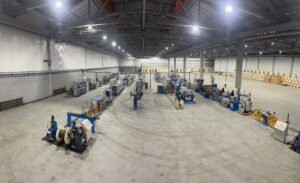
In 2025, a noteworthy technological direction emerged in optical cable equipment manufacturing – the integrated stranding‑and‑sheathing machine. This equipment combines the two processes of stranding and sheathing into one integrated production line, reducing the workforce by 15 operators and freeing up 50% of workshop floor space. Its core innovation, the “cable core spider‑web pay‑off system,” increases cable core threading speed during sheathing from 80 m/min to 120 m/min.
The logic behind this trend is clear: cable manufacturers are moving from decentralized procurement (“buy a stranding line, then buy a sheathing line”) to integrated solutions (“one line solves all processes from stranding to sheathing”). Equipment integration, floor‑space efficiency, and labor efficiency are becoming new competitive dimensions.
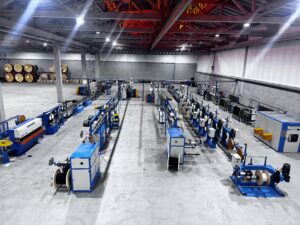
Although Hongkai has not adopted the integrated‑machine design, we provide customers with seamless integration solutions for stranding and sheathing processes at the plant‑planning level – all equipment is developed on a unified PLC platform (Siemens/Mitsubishi), supporting modular networking. Stranding lines and sheathing lines can achieve speed matching and data interoperability via industrial Ethernet, so customers are not troubled by inconsistent interfaces from different suppliers.
IV. The “Data‑Driven” Upgrade in Optical Cable Equipment Manufacturing
Traditional optical cable equipment manufacturing focused on whether a machine “can run.” Today, the focus is on whether it “can speak.”
Research on high‑speed stranding and twisting systems has clearly pointed out that next‑generation equipment must address the shortcomings of traditional equipment in speed, durability, precision, and digital interconnectivity. Industry leaders have already achieved online integration and collaborative optimization of full‑chain quality data. Equipment management is shifting from “breakdown repair” to “predictive maintenance” – 5G gateways collect real‑time operating parameters, leveraging fault knowledge graphs for remote diagnostics and life prediction.
Hongkai pre‑installs data capabilities at the manufacturing stage: standard Siemens/Mitsubishi PLC platforms, recipe storage (≥20 groups), automatic production data logging (CSV export), and OPC UA/SQL interfaces for MES integration. Every shipped machine comes with complete electrical schematics, PLC program backup (USB drive), and a factory inspection report – including measured data on pay‑off tension fluctuation, stranding pitch deviation, sheath concentricity, and more.
V. The “Globalization” Adaptation in Optical Cable Equipment Manufacturing
In 2026, another trend in optical cable equipment manufacturing cannot be ignored: exports.
One of the key drivers of the current cable market cycle is that overseas demand is becoming a core driver, and Chinese optical fiber and cable manufacturers are expanding globally in a systematic way. The annual investment scale of overseas newly built computing centers in 2026 is expected to reach RMB 4.2 trillion. The construction of overseas cable plants directly drives export demand for optical cable equipment.
Exporting optical cable equipment is not as simple as “packing and shipping.” It requires equipment manufacturers to have:
-
Compliance capability: Electrical safety design complies with EN 60204‑1; CE technical documentation can be provided upon request.
-
Language capability: Bilingual operation manuals and electrical schematics are provided.
-
Service capability: Remote video support (response within 2 working hours); on‑site engineer dispatch for installation and commissioning (12‑18 days from arrival to trial production).
-
Spare parts capability: A standard wear‑parts kit is shipped with the equipment; spare parts are delivered by DHL express in 3‑5 working days.
Hongkai equipment has been exported to more than 15 countries and regions across the Middle East, Southeast Asia, South Asia, Africa, and Europe, with cumulative deliveries exceeding 160 sets. We have accumulated extensive experience in the “last mile” of equipment manufacturing – overseas delivery and service.
VI. Final Thoughts: The “New Formula” for Optical Cable Equipment Manufacturing
The value of an optical cable machine can no longer be measured solely by “capacity” and “price.” In the 2026 industry environment, the complete value formula for optical cable equipment manufacturing should be:
Equipment Value = Mechanical Precision × Control Accuracy × Data Capability × Service Reach
-
Mechanical precision is the foundation – stable tension, accurate pitch.
-
Control accuracy is the assurance – fast closed‑loop response, timely feedback.
-
Data capability is the future – can it connect to networks? Can it “speak”?
-
Service reach defines the boundary – how far can it be sold? How long can it be supported?
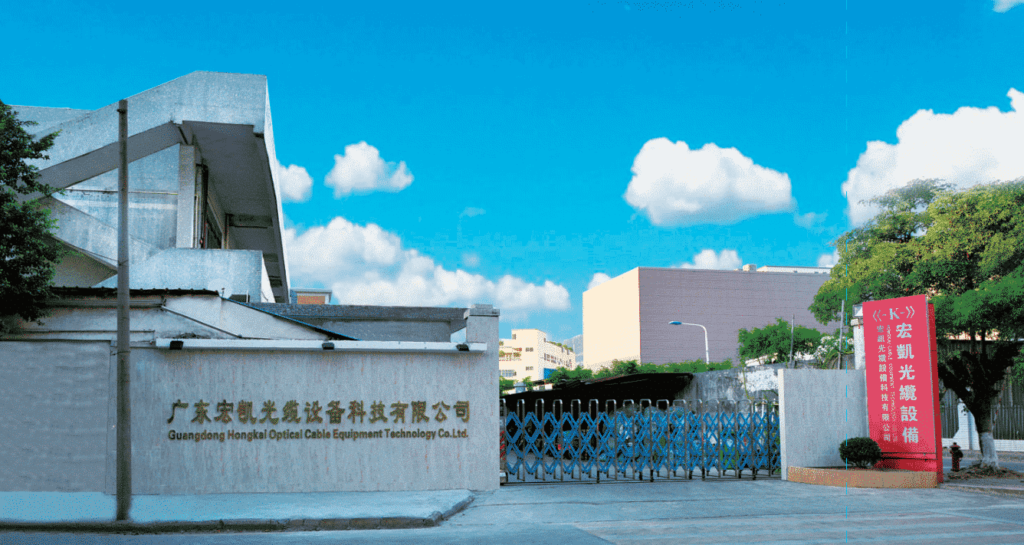
Guangdong Hongkai Optical Cable Equipment Technology Co., Ltd., established in 2015 (with origins dating back to 2005), specializes in the R&D and manufacturing of optical cable equipment – SZ stranding lines, outdoor cable sheathing lines, butterfly drop cable lines, and plastic tube production lines. We continuously advance across the four dimensions of mechanical precision, control accuracy, data capability, and service reach, committed to providing reliable equipment and service systems for optical cable manufacturers worldwide.
For detailed equipment specifications, factory inspection reports, or full‑plant planning proposals, please feel free to contact the Hongkai technical team.