The optical cable sheath is the “armor” of the optical cable—it protects the optical fibers inside from moisture, compression, and tension. The sheathing line is the final process in optical cable manufacturing and a critical step that determines whether the cable is usable.
Many cable plant owners carefully select their stranding machines but become casual when it comes to the sheathing line—thinking, “It’s just a plastic extruder, as long as it works.” In fact, the opposite is true. If the sheathing line is poorly chosen, even the best stranding work will be wasted.
Today, let’s talk about how to choose an optical cable sheathing line.
1. What does a sheathing line do?
Simply put, it applies a plastic protective layer over the cable core.
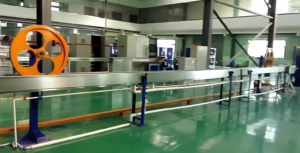
The cable core is payed off from the pay-off stand and passes through the extruder—plastic pellets (PE, PVC, LSZH, etc.) are melted at high temperature and uniformly coated around the core through a die—then it goes through a cooling trough for shaping, is pulled forward by the capstan, and finally wound into finished reels by the take-up.
It sounds straightforward, but there are quite a few nuances to getting it right.
2. Five key points to watch when selecting a sheathing line
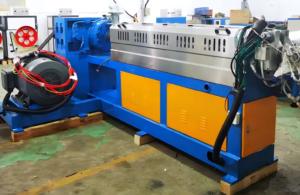
First, look at the extruder screw—different materials require different screws.
Sheathing materials come in several types: PE (polyethylene) for outdoor cables, PVC for indoor cables, and LSZH (low-smoke zero-halogen) for data centers and high-density computer rooms.
Different materials have different requirements for the screw. Extruding PE and extruding LSZH require different screw geometries—they are not interchangeable. When choosing equipment, ask clearly: How many screws are supplied? Do I need to change screws when switching materials?
The recommended screw L/D ratio is 25:1, and the material should preferably be high-quality alloy steel with nitriding treatment for durability. A poor screw results in poor plasticization, uneven sheath surface, and non-uniform wall thickness.
Second, pay attention to concentricity and wall thickness control—this is the “lifeline” of the sheath.
What does the sheath fear most? Eccentricity.
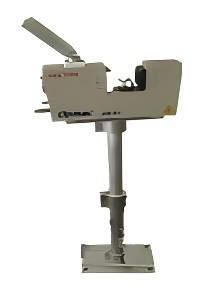
If the sheath wall thickness is thicker on one side and thinner on the other, the thick side wastes material while the thin side provides inadequate protection. Industry standards require sheath thickness deviation ≤ ±10%, and concentricity generally requires that the inner/outer layer deviation be ≤ 0.05 mm. For example, Hongkai’s sheathing line has achieved a measured concentricity of 98.6% and wall thickness tolerance ≤ 0.04 mm.
How to ensure concentricity? Check whether a laser diameter gauge is included. The laser diameter gauge monitors the outer diameter in real time and automatically adjusts if it deviates. Without a diameter gauge, the equipment relies entirely on the operator’s visual judgment—and deviation can easily go unnoticed.
Third, look at the control system—is it stable and user-friendly?
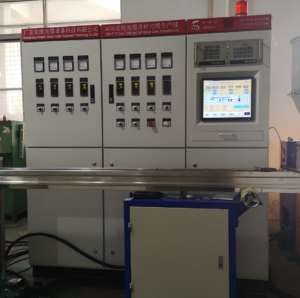
A sheathing line is not a single machine; it involves coordinated operation of the pay-off, extruder, capstan, and take-up. If the control system cannot keep up, things go haywire when speed increases.
A good control system uses a PLC + touchscreen, with all parameters adjustable on one screen. Major electrical components should be from international brands (Siemens, Mitsubishi, Schneider, etc.)—they offer high stability and easy availability of spare parts.
Fourth, check what products it can handle—don’t buy it only to find out it can’t do what you need.
A sheathing line is not just for one specification. Today you may make stranded loose tube cables, tomorrow ADSS cables, and the day after butterfly drop cables. Can the equipment accommodate multiple product types? Is the die change convenient? Is the changeover fast? These must be clarified.
Fifth, consider after-sales service—who will fix it when it breaks down?
Equipment runs 24/7, and problems will eventually occur. Does the manufacturer offer remote support? Are spare parts easy to obtain? Can they send technicians for on-site repairs? These factors affect production more than the equipment price itself.

3. Common misconceptions—four pitfalls to avoid
Misconception 1: Only looking at price, not configuration.
Some equipment is cheap, but uses off-brand electrical components, lacks a diameter gauge, and has poor screw material. You may save a few tens of thousands when purchasing, but then it breaks down frequently during use—the savings are all eaten up by downtime and repairs.
Misconception 2: Using one screw for everything.
As mentioned earlier, PE and LSZH have different screw geometries. Some suppliers provide only one screw and claim it “can extrude anything,” but in reality it extrudes nothing well. At a minimum, equip two screws—one for PE, one for LSZH—and keep a spare for PVC if conditions allow.
Misconception 3: Ignoring the cooling system.
After extrusion, the sheath passes through a cooling water trough for shaping. If the cooling water temperature is incorrect or the trough length is insufficient, uneven cooling will cause later deformation. This is especially critical for large-diameter cables like ADSS.
Misconception 4: Underestimating the diameter gauge.
Some equipment omits the laser diameter gauge to save costs, or uses a cheap one. If the outer diameter drifts, the entire reel of cable may be scrapped. The laser diameter gauge is not a decorative item—it is a lifesaver.
4. A few practical questions
Q: What is the appropriate line speed?
It depends on the product. For conventional optical cables, sheathing line speed is generally 10 to 80 m/min, and some can reach 150 m/min. Faster is not always better—high speed may compromise cooling and reduce sheath quality. For large-diameter cables like ADSS, the speed is generally controlled at 20 to 25 m/min.
Q: How long does the line need to be?
A complete sheathing line, from pay-off to take-up, is typically about 60 meters long. Measure your workshop space before purchasing.
Q: What does center height mean?
The equipment center height refers to the centerline height of all line units (extruder, cooling trough, capstan). This height must be consistent; otherwise the cable core cannot pass through smoothly. The standard center height is usually 1000 mm.
5. About Hongkai
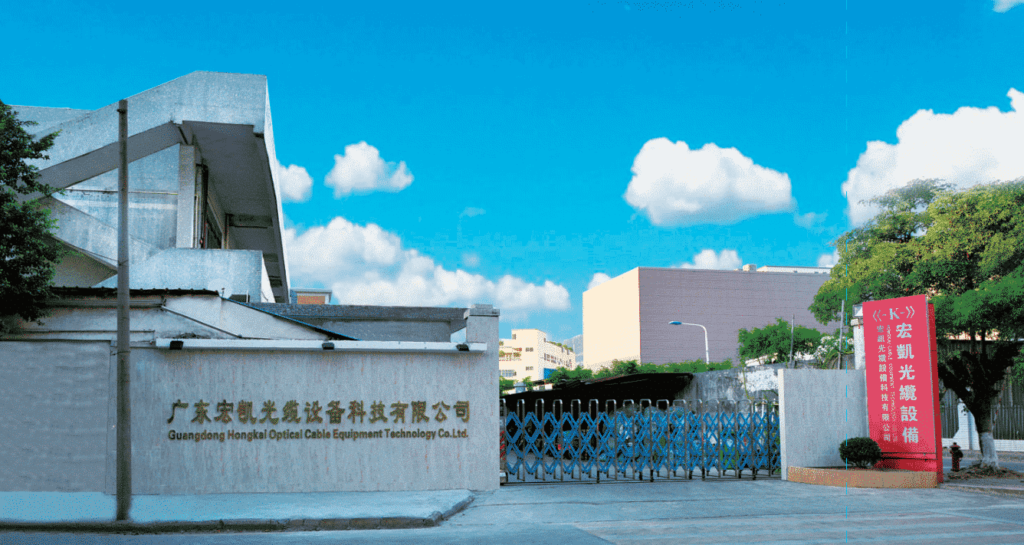
Guangdong Hongkai Optical Cable Equipment Technology Co., Ltd. started in the cable equipment industry in 2005 and was formally established in 2015. Its main products include SZ stranding lines, optical cable sheathing lines, and butterfly drop cable production lines.
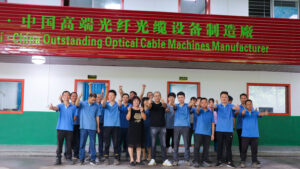
Hongkai’s sheathing lines are equipped with a laser diameter gauge (accuracy 0.2 μm), PLC + touchscreen control, and major electrical components from Siemens/Mitsubishi/Schneider. Measured data: concentricity 98.6%, wall thickness tolerance ≤ 0.04 mm, compatible materials include PE, PVC, and LSZH. The equipment has been exported to more than 15 countries and regions.
If you are considering an optical cable sheathing line, you are welcome to contact the Hongkai technical team. First review the factory inspection report, check the actual data, and then decide whether it suits you.