Buying fiber optic cable equipment doesn’t end when you pay the invoice and the truck pulls away from the factory.
The acceptance inspection – that critical step after equipment arrives at your facility – is what truly determines whether that machine will actually do its job. Get it wrong, and you’ll find yourself stuck in a finger‑pointing loop: the supplier says you installed it incorrectly, you say the equipment was faulty from the start. Months of back‑and‑forth while your production line sits idle.
Fiber optic cable equipment involves large capital expenditure and high technical complexity, so the acceptance process is especially important. Today, let’s walk through exactly how to inspect and accept fiber optic stranding lines and sheathing extrusion lines once they arrive at your plant.

1. Start with the National Standard
There is actually a Chinese national standard that governs equipment acceptance for fiber optic cable plants.
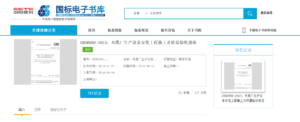
GB 50950‑2013 – Code for Construction and Quality Acceptance of Production Equipment Installation Engineering in Optical Fiber Cable Factories – was issued by the Ministry of Housing and Urban‑Rural Development. It explicitly applies to the installation and quality acceptance of production equipment in optical cable plants, including stranding (cabling) lines and sheathing extrusion lines. The standard requires that equipment performance inspection be conducted after load operation is completed, and that an acceptance report be issued. A piece of production equipment only becomes a useful product for the user after it has been installed and commissioned.
The standard breaks acceptance into several stages: unpacking inspection, installation, single‑machine commissioning, integrated (linkage) commissioning, load operation, and final engineering acceptance. Let’s go through them in order.
2. Step One: Unpacking Inspection – Did You Get What You Ordered?
When the equipment arrives at your plant, don’t rush to tear open the packaging. The first task is verification.
GB 50950‑2013 specifies that unpacking inspection should confirm whether the equipment name, model, and specifications match the packing list, and whether the shipping crates show signs of rust or physical damage. If there is any damage or abnormality, photographic/video evidence should be recorded.
In practice, we recommend the following checks:
Verify the packing list:
-
Does the model number match what’s stated in the contract?
-
Are all components present – main machine, control cabinet, auxiliary units, standard tools, and wear‑parts kit?
-
Is the factory test report included? (This will be your key reference for later acceptance.)
-
Are the electrical schematics and operation manuals (both Chinese and English) provided?
-
Is there a USB drive with the PLC program backup?
Visual inspection:
-
Any dents, scratches, or deformation from shipping?
-
Any signs of water ingress in the control cabinet?
-
Any obvious damage to critical components (dancers, differential boxes, extruder screws)?
If you spot any problems, take photos and video on the spot and contact the supplier immediately. Do not sign the delivery receipt and raise the issue later – at that point, liability becomes very difficult to assign.
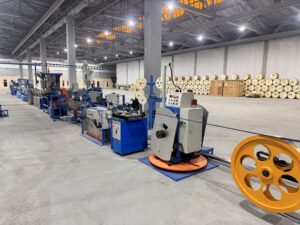
3. Step Two: Installation and Single‑Machine Commissioning – Can Each Unit Operate Independently?
Installation is typically carried out either by the supplier’s technicians with customer assistance, or by the supplier’s team alone.
Once installation is complete, begin single‑machine commissioning – that is, powering up each unit individually to verify that it operates correctly.
For the stranding line, check these points:
-
Pay‑off reels: do they rotate smoothly? Are the brakes responsive?
-
Dancer arms: do they swing freely without sticking?
-
SZ stranding unit: does forward/reverse rotation work properly? Is the twisting angle correct?
-
Binder/yarn applicator: does yarn feed properly? Does the breakage sensor respond?
-
Take‑up: is traverse winding normal? Does the reversal function work?
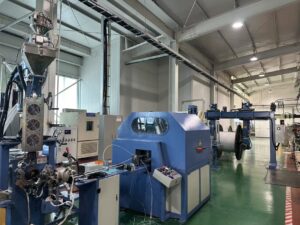
For the sheathing extrusion line, check these points:
-
Extruder: does heating function correctly? Does the screw rotate?
-
Cooling trough: is water circulation working?
-
Capstan/caterpillar: does it pull steadily at variable speeds?
-
Take‑up: is layer winding even?
-
Laser diameter gauge: does it show readings?
Only after single‑machine commissioning passes can you proceed to the next stage.
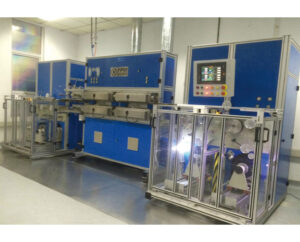
4. Step Three: Linkage Commissioning and Load Operation – Can the Whole Line Run Together?
Once individual units check out, link the entire line and run it unloaded – that is, without any product, with all units running in coordination as they would during production. Verify that speed matching between sections is correct and that all signals communicate properly.
After no‑load testing passes, proceed to load operation – actually feeding real buffer tubes and sheathing compound to produce finished product.
As the national standard specifies, performance inspection must be conducted after load operation is completed, and a formal acceptance report should be issued. In other words, the “main event” of acceptance happens during actual production.
For the Stranding Line – Monitor These Data Points Closely
| Parameter | Standard Requirement | What to Measure |
|---|---|---|
| Pay‑off tension fluctuation | ≤ ±0.5 N | View the real‑time tension curve on the touchscreen; check if fluctuations exceed the limit. (Hongkai’s stranding lines measure ≤ ±0.4 N in production.) |
| Stranding pitch deviation | ≤ ±0.1 mm | Take a section of stranded cable core, measure the actual pitch, and compare with the set value. (Hongkai’s measured deviation ≤ ±0.08 mm.) |
| Stranding angle | ±18° adjustable | Verify that the zero position is accurately centered. |
| Yarn breakage protection | N/A | Deliberately break a yarn to verify that the machine stops within 0.5 seconds. |
For the Sheathing Line – Monitor These Data Points Closely
| Parameter | Standard Requirement | What to Measure |
|---|---|---|
| Concentricity | ≥ 98% | Cut a cross‑section of the sheathed cable; measure wall thickness using a microscope at the thinnest and thickest points. (Hongkai’s line achieved a mean of 98.6% over 8 hours of continuous production.) |
| Wall thickness tolerance | ≤ 0.05 mm (at 1.8 mm nominal) | Measure wall thickness with a micrometer. (Hongkai’s measured tolerance ≤ 0.04 mm.) |
| Outer diameter fluctuation | Varies by spec | Monitor real‑time data from the laser diameter gauge; check if the fluctuation range is stable. |
| Surface quality | No defects | Visually inspect the sheathed cable for surface smoothness, bubbles, or scratches. |
5. Step Four: Engineering Acceptance – Sign on the Dotted Line
Once load operation testing passes, the final step is engineering acceptance.
The national standard states that the acceptance report should follow the format in Appendix C, Table C.0.3 of the standard. In practice, the report should include at least the following:
-
Equipment name, model, and factory serial number
-
Installation date, commissioning date, and acceptance date
-
Results of single‑machine commissioning (whether each unit operated correctly)
-
Results of load operation (measured data for tension, pitch, concentricity, wall thickness, etc.)
-
Trial production output and yield rate
-
Training records for operators
-
Signatures and seals of both parties
Both the construction contractor (or equipment supplier) and the construction owner (i.e., the buyer) should participate in final acceptance. The equipment is considered officially delivered only after acceptance is approved.

6. A Few Easily Overlooked Details
Detail 1 – Don’t lose the factory test report
Every piece of equipment comes with a factory test report that records the measured data from the factory testing – tension, pitch, concentricity, and more. This report is your baseline for comparison during on‑site acceptance. If the actual on‑site data deviates significantly from the factory data, it indicates that problems occurred during shipping or installation.
Detail 2 – Operator training should be part of acceptance
Acceptance isn’t just about whether the equipment can run – it’s also about whether your people know how to use it. Did the supplier provide training? How long did it last? Can the operators independently perform changeovers and routine operations? These items should all be documented in the acceptance report.
Hongkai provides both Chinese and English operation manuals along with on‑site training for every delivered machine. Our engineers don’t leave until your operators can start up the line independently.
Detail 3 – Verify the spare parts kit carefully
The standard wear‑parts kit that comes with the equipment – belts, bearings, sensors, fuses – should be checked for quantity and model correctness. These are exactly the items you’ll need most in the first year of operation. Missing them when you need them can bring production to a halt.
Detail 4 – Run the trial production long enough
Some acceptance tests are “passed” after just one quick run – this is not sufficient. We recommend at least 4 hours of continuous operation to see if any parameters drift over time. Many issues only appear after several hours: concentricity shifting as temperatures rise, tension fluctuation after extended high‑speed operation – these don’t show up in a 15‑minute test.
7. About Hongkai
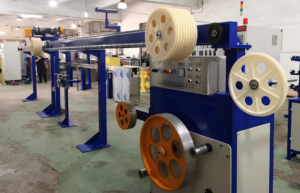
Guangdong Hongkai Optical Cable Equipment Technology Co., Ltd. began manufacturing wire and cable equipment in 2005 and was formally incorporated in 2015. Our core product lines include SZ stranding and cabling lines, fiber optic cable sheathing extrusion lines, and butterfly‑shaped drop cable production lines.
Every Hongkai machine comes with a complete factory test report – containing measured data for pay‑off tension fluctuation, stranding pitch deviation, sheath concentricity, and more – along with electrical schematics, a PLC program backup on USB, and bilingual (Chinese/English) operation manuals. Our equipment has been exported to 15+ countries and regions, with over 160 sets currently running on production lines worldwide.
If you are evaluating fiber optic cable equipment, or if you have equipment arriving soon and are unsure about the acceptance process, feel free to contact the Hongkai technical team. We can provide a detailed acceptance checklist and practical guidance.