When a fiber optic cable machine rolls off the production line, beyond price and delivery time, many business owners overlook a critical question: how capable is the equipment, really? The tooth surface accuracy of differential gears, the fit tolerance of dancer bearings, the nitriding depth of the extruder screw, the machining precision of the sheathing die – these are the invisible factors that determine whether your equipment will hold up over time and maintain consistent accuracy.
Today, drawing on Hongkai’s 21 years of experience in the fiber optic cable equipment industry, we will walk you through how to evaluate the processing technology of your cable equipment from the following perspectives.
1. The “Heart” of the Stranding Machine – How Is the Differential Gearbox Made?
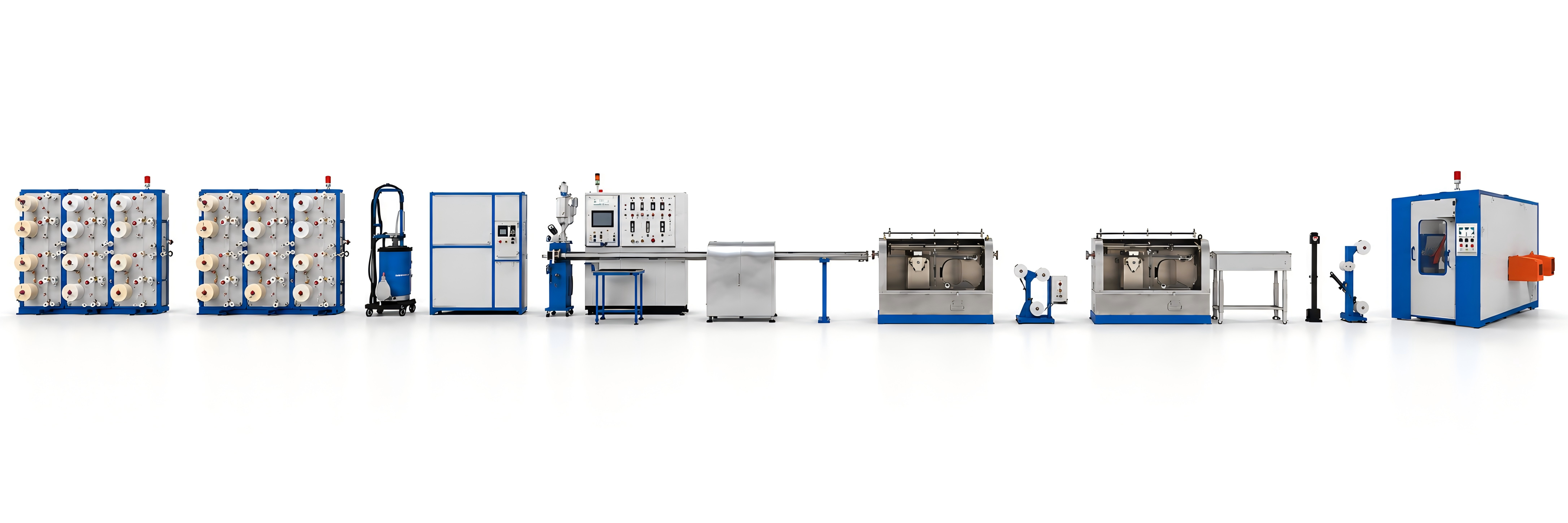
The core of an SZ stranding and cabling machine is the differential gearbox – a cluster of meshing gears that rotate forward and backward tens of thousands of times per day. The machining precision of this gearbox directly determines how many years the stranding machine will last and whether the pitch stays accurate.
Conventional differential gearboxes use ordinary gear cutting, with insufficient surface hardness. After three to five years, they begin to wear, and the pitch drifts more and more. Hongkai’s differential gears are processed using high‑frequency hardening + precision grinding – first hardening the tooth surface to HRC 50–55, then precision grinding to bring surface roughness below 0.8 μm. Hard, smooth, and wear‑resistant – a set of these gears can easily last eight to nine years.
Studies on high‑speed stranding and cabling units show that adopting new servo motors, optimizing mechanical structures, and improving materials can significantly enhance durability and stranding accuracy. The stranding process, being the core of fiber optic cable manufacturing, directly affects mechanical performance, water‑blocking properties, and transmission consistency. Hongkai uses a four‑motor segmented differential drive system that reduces transmission resistance, keeps the buffer tubes from deforming, and ensures product quality.
2. The “Soul” of the Sheathing Line – Machining Precision of the Extrusion Assembly
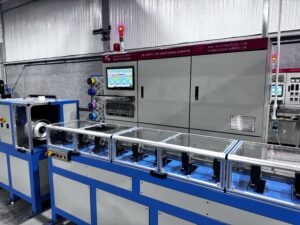
The most critical part of a sheathing line is the extruder. Plastic pellets are melted at high temperature and pushed through the screw to cover the cable core. The machining precision of the screw determines whether the sheath wall thickness is uniform and the surface is smooth.
A good extruder screw demands quality material and proper heat treatment. Hongkai’s sheathing line screws are made of 38CrMoAlA alloy steel, nitrided to a depth of 0.5–0.7 mm, with a surface hardness above HV 900. What does this mean? Ordinary screws need re‑grinding after two or three years; this type of screw maintains accuracy for five to six years.
The gearbox is equally critical. Hongkai’s gearbox gears undergo high‑frequency hardening and precision grinding, resulting in high precision, low noise, and long life. A well‑made gearbox can run continuously on the production line for eight years without major overhaul.
3. Sheathing Dies – From “Assembly” to “One‑Piece Molding”
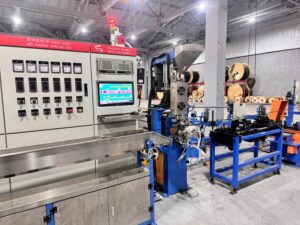
The sheathing die directly determines the concentricity of the optical cable.
Traditional sheathing dies are like “building blocks” – the core and the sleeve are installed separately, and after assembly, you have to manually adjust for eccentricity. An experienced master technician might take 30 minutes to adjust it; a novice might take an hour and still not get it right.
Some manufacturers have already introduced new integrated, adjustment‑free dies – the entire die is one unit, requiring no assembly and no eccentricity adjustment – just mount it and run. The eccentricity of the finished cable cross‑section can be controlled within 0.2 mm. This technology reduces changeover time from the original 30 minutes to just a few minutes, while greatly improving concentricity consistency from batch to batch.
Hongkai also emphasizes precision die machining in our sheathing line design, with die change time controlled within 30 minutes, accommodating a variety of products – butterfly drop cables, round drop cables, indoor soft cables – balancing accuracy with changeover efficiency.
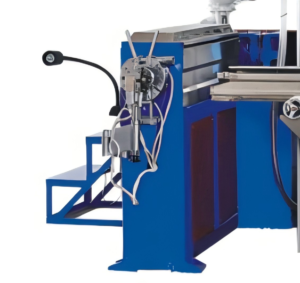
4. Processing Technology Determines Equipment Accuracy – And Accuracy Determines What Orders You Can Take
At the end of the day, fiber optic cable equipment manufacturing is a battle of processing technology. If your machining technology is subpar, even the best design will never materialize.
Hongkai’s processing technology shows up in several concrete areas:
-
Gear machining: High‑frequency hardening + precision grinding – hardness HRC 50–55, roughness ≤ 0.8 μm. Differential gears last eight years without replacement.
-
Screw machining: 38CrMoAlA material + nitriding treatment – nitrided layer 0.5–0.7 mm, hardness above HV 900. Sheath wall thickness is uniform and surface smooth.
-
Bearing selection: Dancer bearings from SKF/NSK, accuracy grade P5 or higher. Tension feedback is responsive, with fluctuation controlled within ±0.4 N.
-
Die machining: Precision grinding + surface treatment – concentricity deviation controlled within 0.04 mm.
With solid processing technology, equipment accuracy naturally follows. Hongkai’s SZ stranding line achieves measured pay‑off tension fluctuation ≤ ±0.4 N and stranding pitch deviation ≤ ±0.08 mm; our sheathing line delivers measured concentricity of 98.6% and wall thickness tolerance ≤ 0.04 mm.

5. Beyond Processing Technology – There’s Also “Processing Data”
The fiber optic cable equipment industry is undergoing another shift: processing technology is moving from “relying on master craftsmen” to relying on data.
At Sichuan Lefei Optoelectronics’ 5G fully connected factory, all‑process equipment – coloring, secondary coating, stranding, sheathing – achieves millisecond‑level data acquisition from PLCs, sensors, and drives, completely breaking down information barriers between equipment and the platform. Equipment management has shifted from “reactive repair” to predictive maintenance. 5G gateways collect real‑time operating parameters, while remote diagnostics and life prediction are powered by a knowledge‑based fault database.
Research on communication cable equipment and manufacturing processes also points out that during product design and manufacturing, process control parameters should be converted into equipment control parameters. By optimizing equipment functional configurations, manufacturers can expand the process window, enabling continuous improvement in production capacity and quality.
Hongkai equipment comes standard with Siemens/Mitsubishi PLC platforms, supporting recipe storage and automatic production data logging. Every machine we ship includes a factory test report – containing measured data for pay‑off tension fluctuation, stranding pitch deviation, sheath concentricity, and more. These figures are not just paper documents – they are the “health reports” of our processing technology.
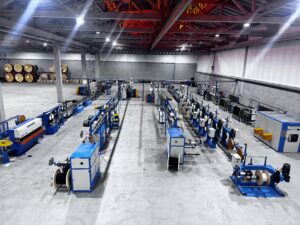
6. About Hongkai
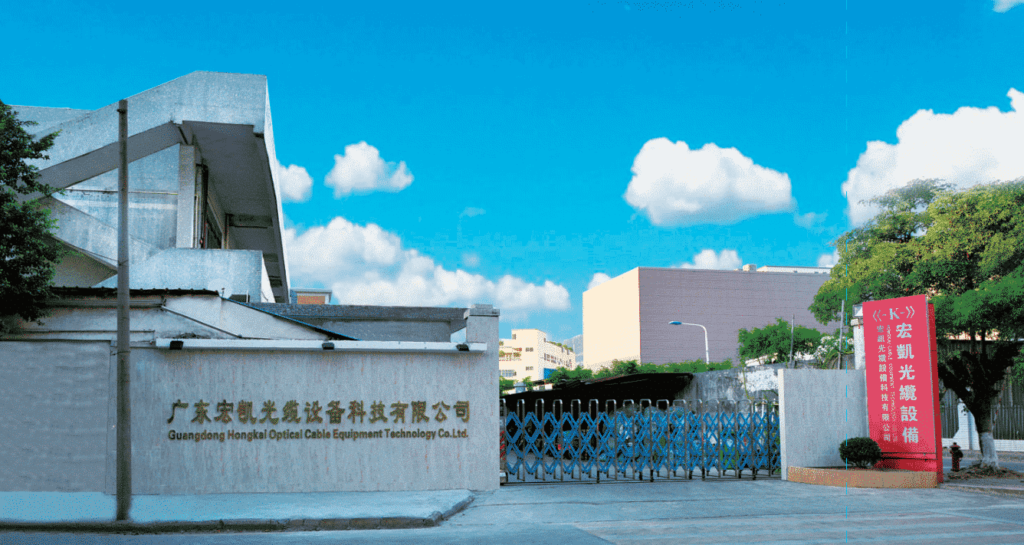
Guangdong Hongkai Optical Cable Equipment Technology Co., Ltd. began manufacturing wire and cable equipment in 2005 and was formally incorporated in 2015. Our main products include SZ stranding and cabling lines, fiber optic cable sheathing extrusion lines, and butterfly‑shaped drop cable production lines.
Hongkai doesn’t rely on flashy marketing – we stand on solid processing technology. Differential gears with high‑frequency hardening and precision grinding, screws of 38CrMoAlA with nitriding, bearings from SKF/NSK, electrical components from Siemens/Mitsubishi/Schneider. Our equipment has been exported to more than 15 countries and regions, with over 160 sets currently running on production lines worldwide.
If you are evaluating fiber optic cable equipment and want to understand the true processing technology behind it, feel free to contact the Hongkai technical team. Start by reviewing the factory test report and the actual measured data – then decide whether it’s the right fit for you.