The booming fiber optic cable market is there for all to see. The stronger the market, the more urgent the need for capacity expansion. Expansion means buying equipment – and buying equipment is far more complex than you might imagine.
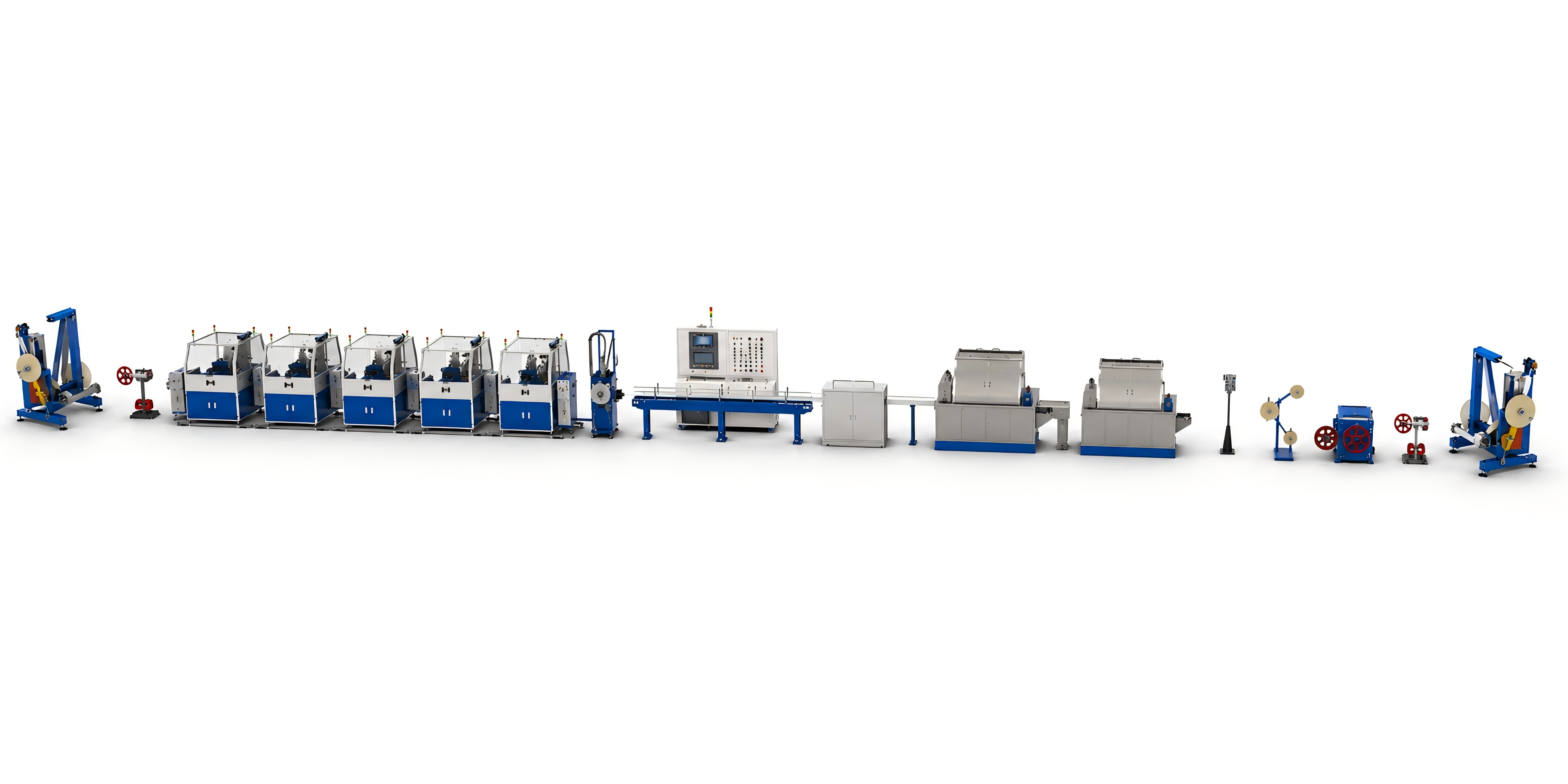
Selecting fiber optic cable production equipment is not simply a matter of comparing price and delivery time. A complete fiber optic cable production line involves multiple stages: coloring equipment, secondary coating lines, stranding and cabling equipment, sheathing lines, and more. Each stage has its own unique logic and potential pitfalls. Choose right, and your production line runs smoothly. Choose wrong, and you’ll be dealing with headaches for years to come.
1. Basic Principles of Equipment Selection: Think First, Act Later
Before diving into specific equipment, let’s clarify a few fundamental principles:
Technological advancement. The technical level of the equipment directly determines the upper limit of product quality. Choose equipment with mature technology and stable performance to ensure feasibility and effectiveness in production.
Production efficiency. Equipment should deliver high production capacity and shorten production cycles. In a market with full order books, efficiency equals profit.
Product quality. Equipment must be capable of producing cable that meets standards and reducing defect rates. A cheap machine with insufficient accuracy is a waste of money, no matter how low the price.
Energy consumption and environmental protection. Prioritize equipment with low energy consumption and environmentally friendly features, in line with sustainable development requirements.
After-sales service. Equipment suppliers should provide comprehensive after-sales service to ensure smooth operation during production. This is especially critical for overseas projects.
Selection work should also establish clear performance indicators and evaluation criteria: technical parameters (temperature, pressure, speed, etc.), production capacity (output per hour and stability under varying loads), energy consumption levels, failure rates, and maintenance costs. Quantify these metrics so that selection is based on solid data.
2. Stranding Machine Selection: Tension and Pitch Are the Two Lifelines
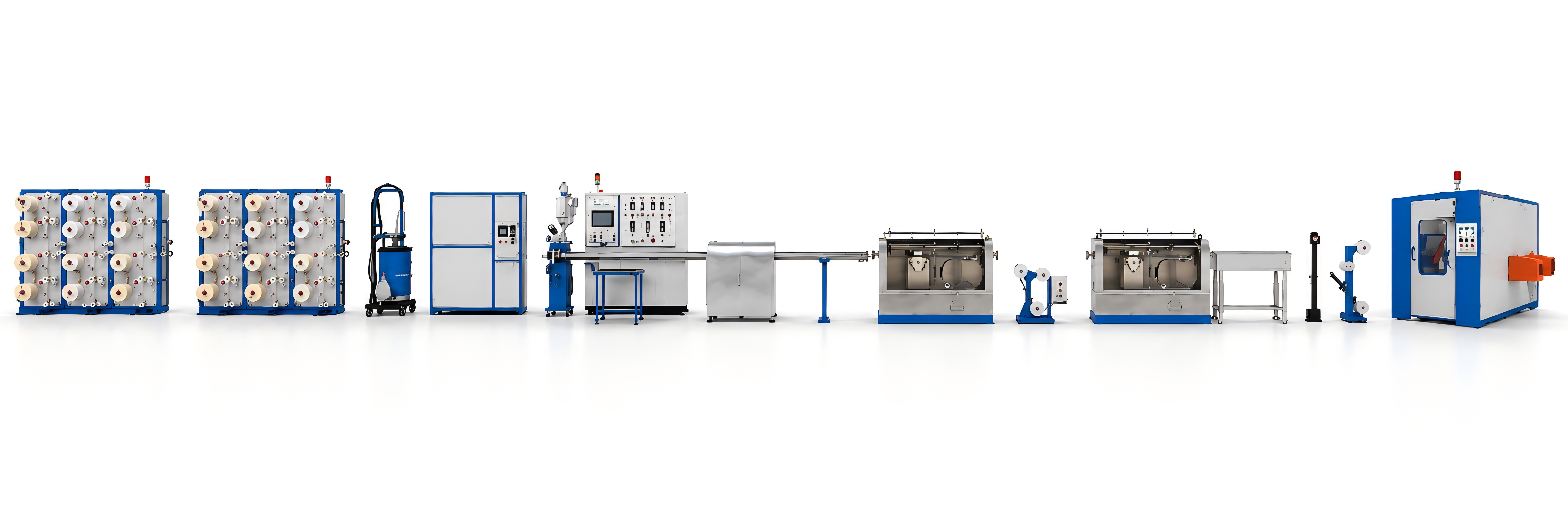
The stranding machine is the core equipment in optical cable production, responsible for twisting multiple loose fiber tubes into a cable core. The SZ stranding and cabling machine is currently the most mainstream model, using alternating forward-reverse twisting to create an S/Z alternating core structure.
Key parameters to focus on during selection:
Tension control accuracy. This is the “lifeline” of the stranding machine. Unstable tension means you can’t maintain pitch; if you can’t maintain pitch, the entire cable reel is scrap. Industry standards require dynamic tension fluctuation ≤ ±0.5 N (at 20 m/min line speed). When selecting, be sure to request the factory test report from the supplier and review the actual measured tension fluctuation data.
Stranding pitch accuracy. Pitch is the “skeleton parameter” of the cable. Excessive pitch deviation means uneven fiber stress, leading to additional loss exceeding limits under temperature changes. The standard requires pitch deviation ≤ ±0.1 mm (at nominal value 1.5–3.0 mm). Traditional equipment uses gear shifting to set pitch – after long-term operation, gear wear causes pitch drift. Good equipment uses a fully differential mechanical structure + PLC stepless setting – pitch is entered directly on the touchscreen.
Stranding angle and tube count. SZ stranding angle is generally adjustable within ±18°. The mainstream loose tube count is 6–12 tubes; higher fiber-count cables require more. When selecting, consider room for future product upgrades – today you’re making 12-fiber cable, tomorrow you might need 24-fiber or higher.
Pay-off and take-up reel specifications. Pay-off reels generally support PN500–PN1250, and take-up reels support PN1250–PN2000. Choose matching sizes based on your factory’s existing reel specifications and product types.
Common selection mistakes: Looking only at price, not accuracy; asking only about capacity, not stability; caring only about delivery time, not gearbox material and heat treatment processes. These “invisible” details are precisely what determine whether equipment lasts five years or ten.
3. Sheathing Line Selection: Concentricity Is the Hard Metric
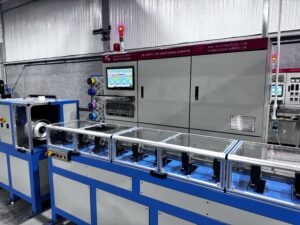
The sheath is the cable’s “armor” – protecting the optical fibers from moisture, pressure, and tensile stress. The core of the sheathing line is the extruder, which melts plastic pellets and evenly coats them around the cable core.
Extruder screw. The screw is the “heart” of the extruder. Different sheath materials (PE, PVC, LSZH, etc.) have different requirements for the screw. A good screw uses 38CrMoAlA alloy steel, nitrided to a depth of 0.5–0.7 mm, with surface hardness above HV 900. Ordinary screws need re-grinding every two to three years; high-quality screws maintain accuracy for five to six years. The length-to-diameter (L/D) ratio should generally be ≥ 25:1.
Concentricity control. The worst enemy of sheathing is eccentricity – wall thickness being thicker on one side and thinner on the other. Industry standards require concentricity ≥ 98%, with thickness tolerance ≤ 0.05 mm (at 1.8 mm nominal). During selection, confirm whether the equipment is equipped with a laser diameter gauge. The gauge monitors outer diameter in real time and automatically adjusts when deviation occurs; equipment without a gauge relies entirely on the operator’s visual judgment – deviations can go undetected.
Material compatibility. Sheath materials come in several types:
-
PE (Polyethylene) – for outdoor cables; good weather resistance but requires higher extrusion temperature.
-
PVC (Polyvinyl Chloride) – for indoor cables; inexpensive and easy to process, but not low-temperature resistant.
-
LSZH (Low Smoke Zero Halogen) – for data centers and equipment rooms; produces no toxic smoke when burning, but demands more from the screw.
A good sheathing line should be compatible with multiple materials – raise the temperature for PE, lower it for LSZH – switching materials without changing the screw. Some equipment is optimized for only one material – runs PE fine, but fails with LSZH (poor plasticization, rough sheath surface).
Cooling system. After extrusion, the sheath must be shaped through a cooling water trough. If water temperature is wrong or the trough length is insufficient, uneven cooling causes subsequent deformation. Large-diameter cables (such as ADSS) are especially sensitive to this.
Common selection mistakes: Using one screw to “rule them all”; omitting the laser diameter gauge to save money; neglecting cooling system design. These “cost-saving” shortcuts will eventually show up in product quality.
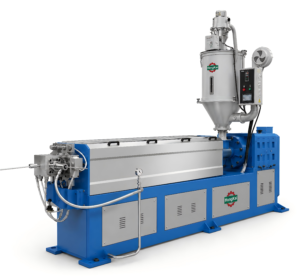
4. Auxiliary Equipment Selection: Details Determine Success or Failure
Beyond the stranding machine and sheathing line, a complete fiber optic cable production line involves several auxiliary stages:
Fiber coloring and rewinding machine. Applies standard color codes (red, blue, green, yellow, white, gray, black, brown, purple, pink, aqua, orange – 12 colors) to natural fiber for production identification. Key concerns: production speed (mainstream 1500–3000 m/min) and UV curing quality.
Fiber secondary coating line. Extrudes PBT or PP plastic tubes over colored fibers and fills with fiber jelly for water blocking. The core factor is fiber excess length control – the fiber inside the tube must be neither too tight nor too loose.
FTTH drop cable production line. Produces flat butterfly-shaped drop cables for premises access. The key is die design – extruding the sheath into a flat butterfly shape with optical fibers in the center and strength members on both sides. During selection, confirm whether it supports single-core/dual-core and multi-core production, as well as automation level (whether it can connect to MES systems).
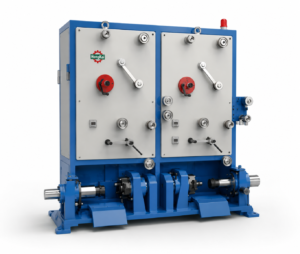
5. Supplier Selection: Beyond the Equipment Itself
Equipment selection is not just about choosing a machine – it’s also about choosing a partner. The following aspects are equally important:
After-sales service capability. Equipment runs 24/7, and problems will eventually arise. Does the supplier provide remote support? Are spare parts readily available? Can they send personnel for on-site repairs? These issues directly affect production and are more critical than the equipment price itself.
Completeness of technical documentation. Are complete electrical schematics, operation manuals, and PLC program backups provided? If parameters get scrambled, can you restore them yourself? These seemingly minor items become life-savers when equipment fails.
Overseas delivery experience. If your factory is overseas or you have future export plans, does the supplier have overseas installation and commissioning experience? Do they provide bilingual technical documentation? Can they send personnel abroad for on-site service? These capabilities determine whether equipment can be successfully deployed overseas.
Data interface capability. More and more factories require equipment to “speak” – automatically recording process parameters, interfacing with MES systems, and supporting remote diagnostics. Without data interfaces, equipment may be phased out by mainstream supply chains.
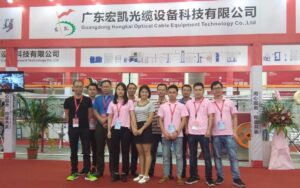
6. Industry Trends: Selection Can’t Look Only at Today
Fiber optic cable equipment selection must also consider industry trends:
AI-driven demand surge. AI data centers are becoming the strongest growth engine for fiber optic cable demand. High-density, high-bandwidth data center cables place stricter requirements on stranding accuracy and sheath concentricity.
Smart manufacturing acceleration. FiberHome’s digital cable factory has achieved 100% equipment data acquisition coverage, with production efficiency up 20% and frontline production staff down 14%. Whether equipment can connect to networks, collect data, and interface with MES is shifting from a “nice-to-have” to a “must-have.”
Product mix diversification. Today’s orders might be for loose tube cables, tomorrow for FTTH drop cables, the day after for high-fiber-count ribbon cables. Whether equipment supports fast changeover, multi-recipe storage, and one-touch loading directly determines overall line efficiency.
Final Thoughts
Fiber optic cable equipment selection is not simply buying a machine – it’s a strategic investment for the next three to five years. Choose right, and your equipment runs stably, product accuracy meets standards, and orders keep coming. Choose wrong, and you’re patching up minor issues every three days and major ones every five – watching others’ machines make money while yours burns cash.
Ask more questions during selection: What is the actual measured tension fluctuation? What range is pitch deviation controlled within? Can concentricity consistently stay above 98%? How long does a changeover take? Are spare parts easy to buy? Can the equipment be networked? Get these questions answered, and you won’t go far wrong.
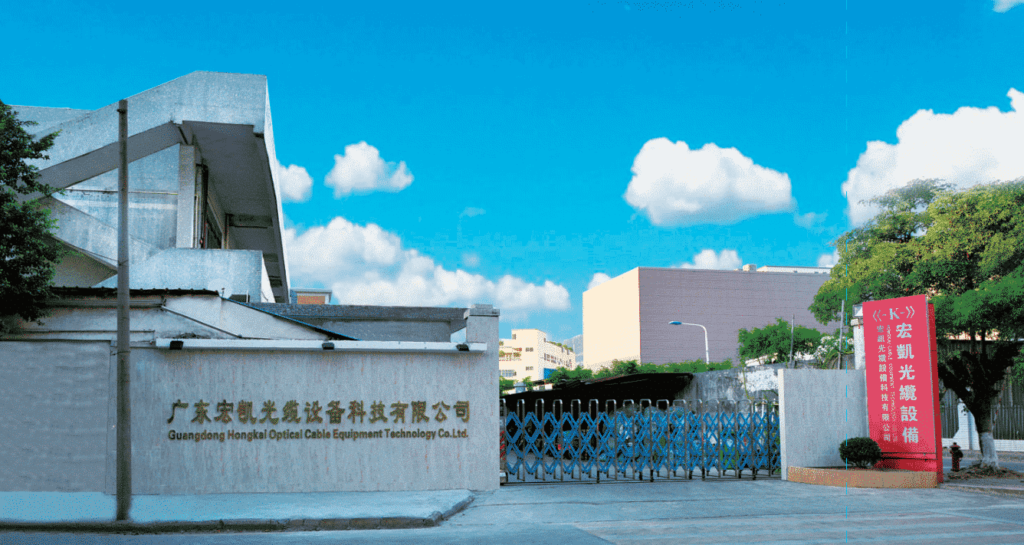
Guangdong Hongkai Optical Cable Equipment Technology Co., Ltd. has over 20 years of experience in the fiber optic cable equipment industry. Our core products include SZ stranding and cabling lines, fiber optic cable sheathing extrusion lines, and FTTH butterfly drop cable production lines. Our equipment has been exported to more than 15 countries and regions worldwide. For technical specifications, factory test reports, or complete plant planning solutions, feel free to contact the Hongkai technical team.