Many business owners have never calculated this carefully: how much money could a slight drop in equipment accuracy cost you over the course of a year?
1. What Exactly Does Fiber Optic Cable Equipment Accuracy Affect?
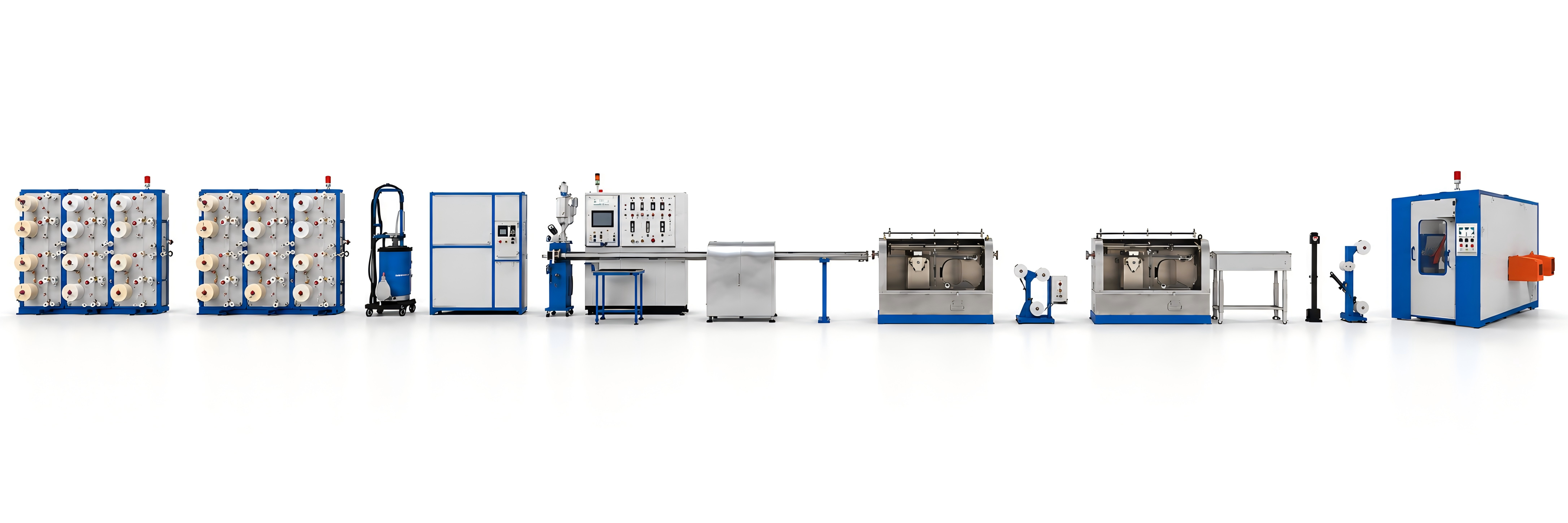
Take an SZ stranding and cabling line, for example. If pay-off tension fluctuation goes from ±0.4 N to ±0.8 N, and pitch deviation goes from ±0.08 mm to ±0.2 mm – it looks like just a difference of one decimal place. But on the actual production floor, the difference is enormous.
A 0.1 mm pitch deviation determines whether an entire reel of cable is usable or scrap.
If stranding tension deviation exceeds 5%, cable core deformation becomes likely. In high-fiber-count cables, tension deviation on any single tube can scrap the entire cable. Data center customers have extremely low tolerance for bending loss – if the pitch is off, loss increases, and the customer rejects the shipment.
A 0.01 mm concentricity deviation determines what tier of orders you can take.
Bend-insensitive fibers like G.657.A2 require sheath concentricity of ≥ 98%. If your sheathing line can only achieve 96%, you can’t take G.657 orders. And G.657.A2 prices have increased more than tenfold compared to last year. If you can’t take these orders, you’re watching others make the profit.
2. The Accuracy Accounting for a Stranding Machine: ±0.1 N Difference – How Much Money Does It Cost per Year?
A cable line with an annual output of 3,000 km, at current G.652.D bare fiber price of RMB 83 per fiber-km:
Annual output value: 3,000 km × RMB 83/fiber-km × 12 fibers (estimated for a 12‑fiber cable) ≈ RMB 2.99 million
But that’s the fiber cost, not the finished cable price – which is higher. The key factor is the scrap rate.
If stranding tension fluctuation goes from ±0.4 N to ±0.8 N, the scrap rate can jump from 1.2% to 4%. That 2.8 percentage point difference:
| Calculation | Amount |
|---|---|
| 3,000 km × 2.8% | 84 km of scrap |
| 84 km × RMB 3,000/km (conservative finished cable price) | RMB 252,000 |
That’s RMB 252,000 lost per year.
And this doesn’t even include losses on high-fiber-count cables – the higher the fiber count, the higher the value per reel, and the greater the scrap loss.
3. The Accuracy Accounting for a Sheathing Line: 1% Concentricity Difference – Losses Beyond Just Material
Sheath concentricity is the core metric for a fiber optic cable sheathing extrusion line. What’s the difference between 98% and 96% concentricity?
That 2% difference can double your scrap rate.
G.657 series bend-insensitive cables have extremely high sheath concentricity requirements. Insufficient concentricity causes loss to spike sharply when the cable bends – and the customer’s acceptance test will fail.
Take a 12‑fiber G.657 cable reel as an example. At current market prices, one reel is worth tens of thousands of RMB. If the entire reel is scrapped due to failing concentricity, you lose not just the material cost – you lose the entire selling price of that reel.
More importantly: without sufficient concentricity, you can’t take high-margin orders.
G.657.A2 orders are already booked through 2028. Data centers are driving rapid growth in demand for high-spec, high-value-added cables like G.657.A1/A2. If your sheathing line lacks the accuracy, you’ll be saying goodbye to these orders.
4. The Changeover Efficiency Accounting: 2 Hours Slower – Losing RMB 2 Million a Year
Today’s cable order mix has changed – data centers want high-fiber-count cables, overseas wants G.657, telecoms want loose-tube cables. Today you’re making 12‑fiber, tomorrow 24‑fiber.
Some equipment takes 4–5 hours for each changeover. Others get it done in 1.5 hours.
That 2.5‑hour difference adds up over a year:
| Calculation | Amount |
|---|---|
| 20 changeovers/month × 2.5 hours | 50 hours/month |
| 50 hours × 12 months | 600 hours/year |
| 600 hours × 20 m/min × 60 min | 720 km/year |
| 720 km × RMB 3,000/km | RMB 2.16 million/year |
Over RMB 2 million lost per year – just because changeover is slow.
Does the equipment have recipe storage? Is changeover one‑touch or manual? These seemingly minor features ultimately show up on the bottom line.
5. The Digital Capability Accounting: If Equipment Can’t “Speak,” Management Is Left Guessing
In traditional cable workshops, equipment PLCs, sensors, and MES systems operate in silos with inconsistent data formats. Production status monitoring suffers from 10–15 minute lag. One company’s internal study showed that its workshop generates over 200,000 equipment data points daily – but only 30% are effectively utilized.
If equipment can’t “speak,” management can’t see real‑time production status. You don’t know when scrap rates rise, when equipment anomalies occur, when changeover times lengthen – and by the time you find out, it’s already too late.
What’s the value of cable equipment that can “speak”?
-
Real‑time visibility into tension curves and pitch data for every machine
-
Automatic recording of process parameters for every batch – available for customer audit at any time
-
Early warning of equipment anomalies – before breakdown occurs
Equipment management is shifting from “reactive repair” to predictive maintenance. By collecting real‑time operating parameters and leveraging fault knowledge databases, remote diagnostics and life prediction become possible. Digital capability is rapidly moving from “nice‑to‑have” to “must‑have.”
6. How to Select Equipment That “Won’t Lose Money on Accuracy”
Step 1: Request the factory test report.
A reputable optical cable making machine manufacturer provides a test report with every machine, recording actual measured data – tension fluctuation, pitch deviation, concentricity. Hongkai provides a factory test report with every machine – the data is there for you to see.
Step 2: Check the brand of key components.
Are bearings SKF or off‑brand? Are electrical components Siemens/Mitsubishi or generic? What material is the screw made of? These directly determine how many years the equipment will last and how stable its accuracy will remain. Hongkai uses SKF/NSK bearings, Siemens/Mitsubishi/Schneider electrical components, and 38CrMoAlA screws with nitriding treatment.
Step 3: Check changeover speed.
Does the equipment have recipe storage? Is changeover one‑touch or manual parameter entry? Hongkai equipment stores up to 20 different product recipes, with changeover completed in under 1.5 hours.
Step 4: Check MES connectivity.
Does the equipment have data interfaces? Can it automatically record production data? Hongkai equipment comes standard with Siemens/Mitsubishi PLC, supporting data acquisition and MES integration.
7. About Hongkai
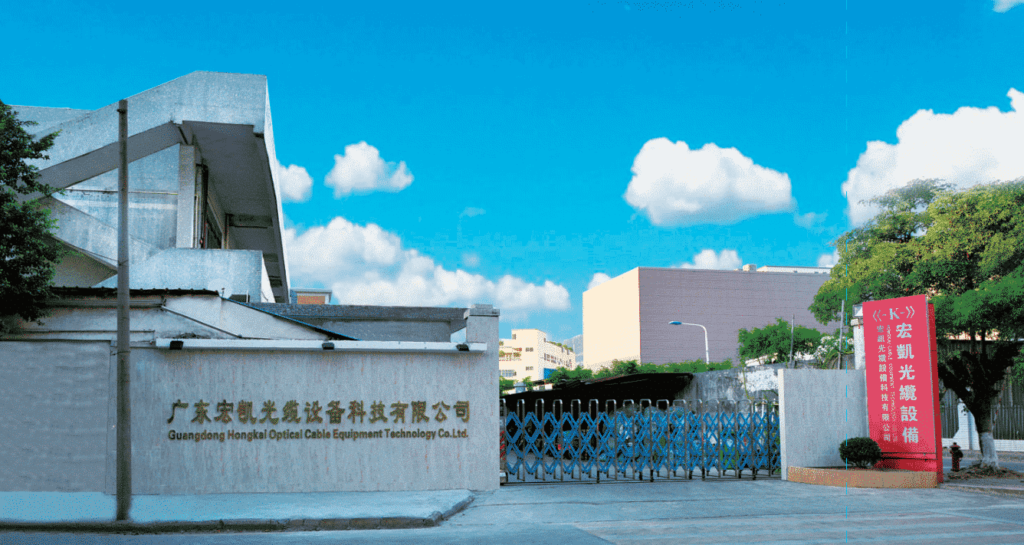
Guangdong Hongkai Optical Cable Equipment Technology Co., Ltd. began manufacturing wire and cable equipment in 2005 and was formally incorporated in 2015. Our main products include SZ stranding and cabling lines, fiber optic cable sheathing extrusion lines, and FTTH drop cable production lines.
Hongkai equipment measured data:
| Parameter | Measured Value |
|---|---|
| Stranding pay‑off tension fluctuation | ≤ ±0.4 N |
| Stranding pitch deviation | ≤ ±0.08 mm |
| Sheathing concentricity | ≥ 98.6% |
| Wall thickness tolerance | ≤ 0.04 mm |
| Changeover time | ≤ 1.5 hours (one‑touch recipe loading) |
Our equipment has been exported to more than 15 countries and regions, with over 160 sets currently running on production lines worldwide. Every machine comes with a factory test report, a PLC program backup on USB, bilingual operation manuals (Chinese/English), and a wear‑parts kit.
If you’re setting up a fiber optic cable production line, or need a custom optical cable production line, feel free to contact the Hongkai technical team.