In 2025, the journal Wire & Cable published a paper on the design of high‑speed stranding and cabling units. The paper pointed out that traditional stranding units in high‑speed cabling processes have shortcomings in speed, durability, accuracy, and digital interconnectivity – issues that need to be addressed through the adoption of new servo motors, optimized mechanical structures, improved materials, and enhanced informatization.
Behind this paper lies a technological upgrade that the fiber optic cable equipment manufacturing industry is undergoing.
The core of an SZ stranding and cabling line is the differential gearbox – a cluster of meshing gears rotating forward and backward, tens of thousands of cycles per day. The quality of the differential gearbox directly determines how many years the stranding machine will last and whether the pitch stays accurate. The core of a fiber optic cable sheathing extrusion line is the laser diameter gauge – if the sheath outer diameter deviates by just 0.01 mm, it detects it and automatically adjusts. The sensitivity of the gauge directly determines whether sheath concentricity can reach above 98%.
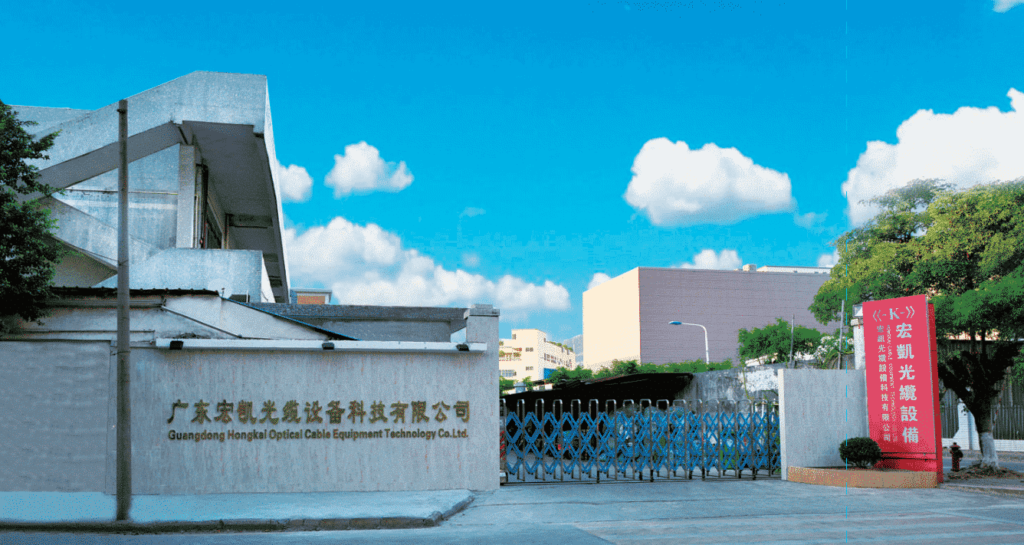
In the workshop of Guangdong Hongkai Optical Cable Equipment Technology Co., Ltd. in Humen, Dongguan, these core components are being crafted one by one by a team of veteran workers who have been in the wire and cable equipment industry for over a decade.

1. The “Metal Core” Inside the Differential Gearbox – Determines How Many Years the Stranding Machine Will Last
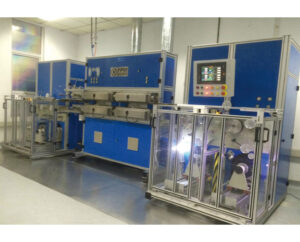
The SZ stranding and cabling line is the core equipment in optical cable production. The loose tubes are paid off from the reels, pass through the dancer tension control system, enter the stranding unit for forward‑reverse stranding, and are then secured with binder yarn to form the cable core. The entire process runs 24/7, 300 days a year.
The heart of the stranding unit is the differential gearbox – gears meshing and rotating, one turn forward, one turn backward. The machining precision of the differential gearbox directly determines how many years the stranding machine will last and whether the pitch stays accurate.
How does Hongkai manufacture its differential gears? First, high‑frequency hardening brings the tooth surface hardness to HRC 50–55. Then precision grinding brings the surface roughness below 0.8 μm. Harder and smoother – the gears are less prone to wear. A set of these gears can easily last eight to nine years.
Bearings are from SKF or NSK. They cost a bit more, but one set lasts seven to eight years without replacement. Electrical components are from Siemens, Mitsubishi, and Schneider – customers can buy replacement parts locally without waiting for us to ship from China.
Every machine comes with a factory test report, recording the actual measured data from factory testing: pay‑off tension fluctuation and pitch deviation. Hongkai’s SZ stranding machine measures pay‑off tension fluctuation ≤ ±0.4 N and pitch deviation ≤ ±0.08 mm.
These figures are not just numbers on paper – customers can measure them themselves upon receipt and get the same results.
2. The Laser Diameter Gauge: The “Eyes” of the Sheathing Line
What does a fiber optic cable sheathing extrusion line fear most? Eccentricity – sheath wall thickness being thicker on one side and thinner on the other. The thick side wastes material; the thin side compromises protection.
Industry standards require sheath concentricity ≥ 98%. A deviation exceeding 0.05 mm can cause microbend loss. G.657 series bend‑insensitive cables have even higher sheath concentricity requirements – these cables are primarily used for high‑density cabling in data centers. If the sheathing line lacks accuracy, high‑margin orders simply cannot be taken.
Traditional sheathing production relies on operators’ eyes and hands. An experienced master technician can spot deviations, but not always with perfect accuracy. For novices, it’s even harder.
Hongkai’s sheathing line is equipped with a laser diameter gauge with 0.2 μm accuracy. If the sheath outer diameter deviates by just 0.01 mm, the gauge detects it. Data is uploaded to the PLC every 0.1 seconds, and the PLC automatically adjusts the extruder speed to bring the diameter back. Over 8 hours of continuous production, concentricity averages 98.6%, with wall thickness tolerance ≤ 0.04 mm.
This isn’t any high‑mystery technology – it’s simply letting the equipment “watch” its own work without requiring constant human supervision.
3. Recipe Storage: Putting the Master Technician’s Experience “Into” the Equipment
One of the biggest headaches for cable factories is changeover.
Today’s cable orders are different from before – data centers want high‑fiber‑count cables, overseas wants G.657, telecoms want loose‑tube cables. Today you’re making 12‑fiber, tomorrow 24‑fiber, the day after butterfly drop cables. Each specification change means spending half a day tweaking parameters.
Pitch, tension, temperature, speed – over a dozen parameters must be entered manually one by one. After entering, there’s trial production, adjustment, and more trial production. If changeover takes 4–5 hours, you’re losing hundreds of kilometers of potential output every year.
Hongkai’s approach is simple: save these parameters as recipes. Complete process parameters for 20 different specifications are stored in the touchscreen. For changeover, just tap once – parameters load automatically. Done in 1.5 hours.
The design research on high‑speed stranding units also points in this direction – next‑generation equipment needs to address the shortcomings of traditional equipment in speed, durability, accuracy, and digital interconnectivity. Hongkai equipment comes standard with Siemens/Mitsubishi PLC platforms, supporting data acquisition and MES integration, with interfaces reserved for digital factories.
4. Overseas Delivery: When the Equipment Arrives, People Must Arrive Too
Exporting equipment overseas is not just about packing and shipping.
In 2026, cable exports are booming, and overseas cable factories are also expanding capacity. Every new overseas cable plant means procurement demand for optical cable manufacturing equipment. But overseas customers fear one thing above all: the equipment arrives, but nobody knows how to install it.
In the Middle East, Africa, Southeast Asia – there are not many people familiar with cable equipment installation. A stranding machine weighs dozens of tons – just assembling the components is no simple task, not to mention electrical wiring, PLC commissioning, and trial production.
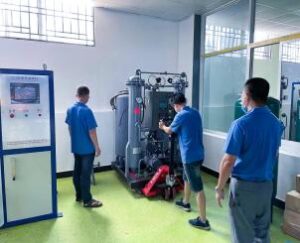
Hongkai’s approach is straightforward – send engineers over. From unpacking to producing the first reel of qualified cable: 12 to 18 days. Before the engineers leave, they train the operators, leaving behind bilingual manuals, electrical schematics, and a complete troubleshooting guide.
Equipment running 24/7 will eventually have issues. Hongkai includes a wear‑parts kit with every machine – belts, bearings, sensors, fuses – shipped with the equipment. For major parts, DHL delivery within 3 days. Remote video support is available with a 2‑hour response time during working hours.
5. Final Thoughts
From blueprints to the production line, a cable machine is the result of countless details being refined. The tooth surface hardness of differential gears, the accuracy of the laser diameter gauge, the convenience of recipe storage, the on‑site service of overseas engineers – these seemingly minor things ultimately become actual output on the customer’s production line.
Guangdong Hongkai Optical Cable Equipment Technology Co., Ltd. began manufacturing wire and cable equipment in 2005 and was formally incorporated in 2015. Our main products include SZ stranding and cabling lines, fiber optic cable sheathing extrusion lines, and FTTH drop cable production lines. Our equipment has been exported to more than 15 countries and regions, with over 160 sets currently running on production lines worldwide.
Every machine comes with a factory test report, a PLC program backup on USB, bilingual operation manuals (Chinese/English), and a wear‑parts kit.
If you’re setting up a fiber optic cable production line, or need a custom optical cable production line, feel free to contact the Hongkai technical team.