When cable factories buy equipment, they’re not buying hunks of metal – they’re buying precision, stability, and years of trouble‑free operation.
The core of an SZ stranding and cabling line is the differential gearbox – a cluster of meshing gears rotating forward and backward, tens of thousands of cycles per day. The quality of the differential gearbox directly determines how many years the stranding machine will last and whether the pitch stays accurate.
The core of a fiber optic cable sheathing extrusion line is the laser diameter gauge – if the sheath outer diameter deviates by just 0.01 mm, it detects it and automatically adjusts. The sensitivity of the gauge directly determines whether sheath concentricity can reach above 98%.
These “invisible” details are what make cable equipment truly valuable.
1. The “Metal Core” Inside the Differential Gearbox: How Are the Four Servo Motors Divided?
The SZ stranding unit is the core of the loose‑tube cable stranding machine, directly affecting the line speed and cable performance.
Traditional stranding units typically use a single high‑power motor for drive. The stranding cage has a relatively large outer diameter, and due to rigidity constraints, it often uses high‑density steel components, resulting in high rotational inertia and long reversal delay times – causing poor cable bending performance.
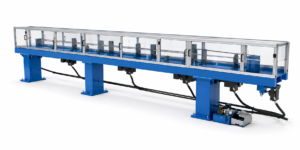
The fully differential SZ stranding unit uses four servo motors as power sources to drive the stranding cage rotation:
-
The first servo motor drives one cage section
-
The second servo motor drives two cage sections
-
The third servo motor drives four cage sections
-
The fourth servo motor drives ten cage sections
With fewer transmission chains and a reduced cage outer diameter, the stranding speed is higher.
The cage uses high‑strength, low‑density materials with lower rotational inertia, allowing higher achievable speeds and better cable bending performance.
Reversal control relies on encoders. The encoder sends pulse signals to the control system, calculating the rotation angle of the stranding head. When the angle meets the preset reversal condition, the control system outputs reverse voltage and the motor reverses. The encoder is built into the servo motor and uses incremental encoding, which does not create cumulative errors.
The synchronous pulleys use taper‑lock bushings – compared to keyed connections, they run more smoothly during reversal, do not impose additional tension on the fiber tubes, do not cause stranding force variations, and ensure accurate stranding.
These technical details are not just concepts written in manuals – they are real features built into the equipment. Hongkai’s SZ stranding machine differential gears undergo high‑frequency hardening and precision grinding to HRC 50–55 hardness, with SKF or NSK bearings – one set lasts eight to nine years without replacement.
2. Tension Control: How Does the Dancer “See” Tension?
During stranding, pay‑off tension of the loose tubes must be precisely controlled. If tension is too high, the tubes are stretched, consuming the fiber excess length inside; if tension is too low, the tubes arch during stranding, causing uneven pitch.
The pay‑off tension control device on the SZ stranding line maintains a constant total length between the pay‑off position and the post‑stranding exit position, stabilizing the dancer and the pay‑off – and thus stabilizing tension.
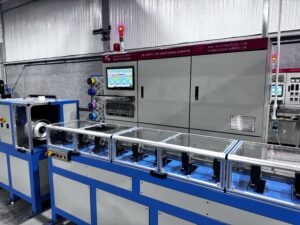
The dancer is a swing‑arm mechanism on the stranding machine. The tube, coming off the pay‑off reel, passes over the dancer before entering the stranding unit. When tension is high, the arm presses down; when tension is low, the arm rises. The angle change of the arm is converted into an electrical signal fed back to the PLC, which automatically adjusts the pay‑off motor speed.
A good dancer uses SKF or NSK bearings – high precision, low resistance. At the slightest movement of the arm, the sensor picks it up, the signal goes to the PLC, and adjustment is completed within 20 milliseconds. A poor dancer uses off‑brand bearings that start to bind after a while. A stuck arm means inaccurate signals; inaccurate signals mean the PLC makes wrong adjustments; wrong adjustments mean tension drifts; tension drift means pitch deviation.
Hongkai’s SZ stranding machine measures pay‑off tension fluctuation ≤ ±0.4 N and pitch deviation ≤ ±0.08 mm.
3. Sheath Concentricity: The Laser Diameter Gauge Is the “Eye,” the PLC Is the “Hand”
What does a fiber optic cable sheathing extrusion line fear most? Eccentricity.
Industry standards require sheath concentricity ≥ 98%. A deviation exceeding 0.05 mm can cause microbend loss. G.657 series bend‑insensitive cables have even higher sheath concentricity requirements – these cables are primarily used for high‑density cabling in data centers. If the sheathing line lacks accuracy, high‑margin orders simply cannot be taken.
Traditional sheathing production relies on operators’ eyes and hands. An experienced master technician can spot deviations, but not always with perfect accuracy. For novices, it’s even harder.
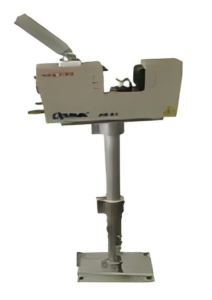
The laser diameter gauge solves this problem. Using laser scanning for non‑contact online measurement, it is primarily used in wire, cable, and pipe production lines to measure outer diameter and adjust extruder screw speed or haul‑off speed for diameter control.
After installation at the required measurement position, the gauge calculates the delay time and distance between the measurement point and the control point, adjusts height and angle for perpendicularity to the measured object, and transmits data to the PLC in real time. The PLC uses a PID algorithm to dynamically adjust extruder speed, bringing the diameter back.
Ultrasonic probes can monitor sheath wall thickness in real time, while the gauge measures outer diameter – combining wall thickness and outer diameter data yields sheath concentricity.
Hongkai’s sheathing line is equipped with a high‑precision laser diameter gauge with 0.2 μm accuracy. If the sheath outer diameter deviates by just 0.01 mm, the gauge detects it. Over 8 hours of continuous production, concentricity averages 98.6%, with wall thickness tolerance ≤ 0.04 mm.
4. Taping and Stranding: How Does the Differential Planetary Gearbox Adjust Pitch Online?
In cable stranding, taping and stranding are two critical processes.
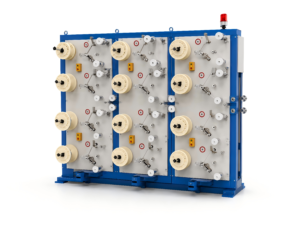
The online‑adjustable cable core taping machine uses a differential planetary gearbox to compensate the rotation angles of the taping head fork and the rotating tape guide cage online – during standstill, constant‑speed production, and line speed ramp‑up/down – thereby adjusting the stranding wrap angle in real time to achieve the appropriate pitch.
The tape pay‑off uses an active drive structure with constant tension control, ensuring smooth tape tension and optimal stranding results. The constant tension value can be actively corrected based on different line speeds.
In simple terms: the machine automatically adjusts stranding pitch in response to production speed changes without stopping – no gear changes, no manual parameter adjustments.
Hongkai’s SZ stranding machine uses a fully differential structure with PLC stepless setting – pitch is entered directly on the touchscreen, and the machine automatically matches stranding speed and haul‑off speed.
5. Recipe Storage: Putting the Master Technician’s Experience “Into” the Equipment
One of the biggest headaches for cable factories is changeover.
Today’s cable orders are different from before – data centers want high‑fiber‑count cables, overseas wants G.657, telecoms want loose‑tube cables. Today you’re making 12‑fiber, tomorrow 24‑fiber, the day after butterfly drop cables. Each specification change means spending half a day tweaking parameters.
Pitch, tension, temperature, speed – over a dozen parameters must be entered manually one by one. After entering, there’s trial production, adjustment, and more trial production. If changeover takes 4–5 hours, you’re losing hundreds of kilometers of potential output every year.
Hongkai’s approach is simple: save these parameters as recipes. Complete process parameters for 20 different specifications are stored in the touchscreen. For changeover, just tap once – parameters load automatically. Done in 1.5 hours.
Equipment comes standard with Siemens/Mitsubishi PLC platforms, supporting data acquisition and MES integration. Workshops are moving from “people watching machines” to “data managing machines.”
6. About Hongkai
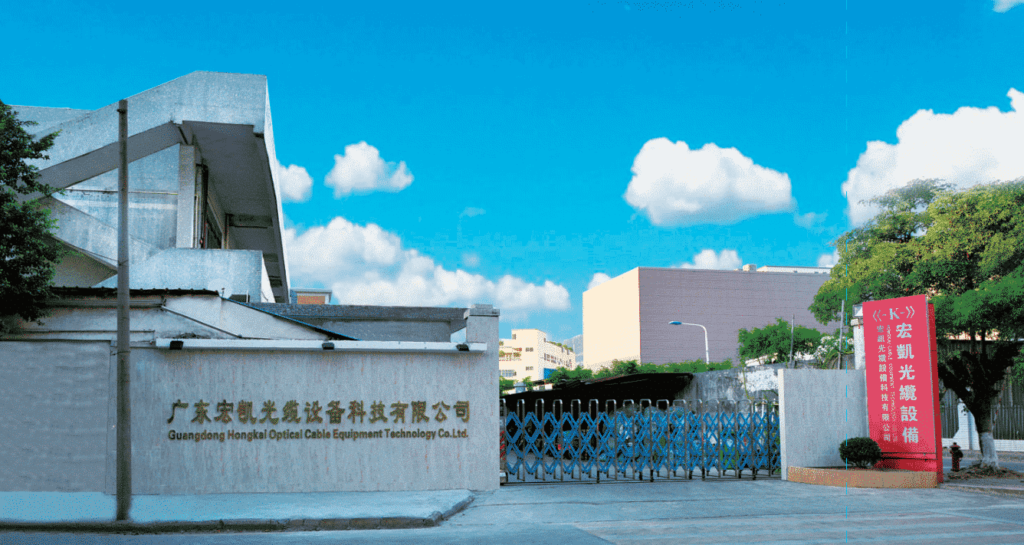
Guangdong Hongkai Optical Cable Equipment Technology Co., Ltd. began manufacturing wire and cable equipment in 2005 and was formally incorporated in 2015. Our main products include SZ stranding and cabling lines, fiber optic cable sheathing extrusion lines, and FTTH drop cable production lines. Our equipment has been exported to more than 15 countries and regions, with over 160 sets currently running on production lines worldwide.
Every machine comes with a factory test report, a PLC program backup on USB, bilingual operation manuals (Chinese/English), and a wear‑parts kit.
If you’re setting up a fiber optic cable production line, or need a custom optical cable production line, feel free to contact the Hongkai technical team.