1. What Is SZ Stranding? Why Is It Called “SZ”?
SZ stranding is a specialized stranding process used in optical cable manufacturing. The “S” and “Z” in its name represent alternating directions of twisting – one rotation forward (S‑direction), one rotation backward (Z‑direction), alternating continuously.
Why use SZ stranding instead of twisting consistently in one direction? Because the internal stresses generated during SZ stranding can be naturally relieved, while keeping the cable core compact and round, improving bending performance, tensile strength, and compression resistance. In simple terms, cables produced with SZ stranding are more flexible and durable than those made with unidirectional stranding. The optical fibers experience less stress during bending, stretching, or temperature changes, ensuring better transmission stability.
In a loose‑tube cable stranding machine, SZ stranding is the core of the entire production line, directly affecting line speed and cable performance.
2. How Does an SZ Stranding and Cabling Line Work?
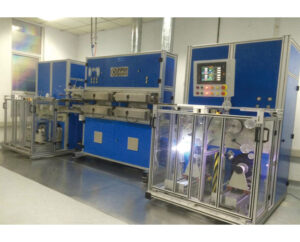
A typical SZ stranding and cabling line consists of multiple units working in coordination:
Pay‑off unit: Loose tubes are paid off from reels, pass through dancer tension control, and enter the stranding unit. Strength members (steel wire or FRP) are paid off from independent stands to form the center of the cable core.
SZ stranding unit: This is the heart of the system. The loose tubes and strength members undergo SZ stranding in the stranding unit – rotating forward for a set number of turns, then backward for the same number, alternating continuously. The stranding angle and pitch are controlled by the PLC.
Binder yarn unit: After stranding, the tubes need to be bound around the central strength member to prevent loosening or sliding. The binder yarn motion is composed of two movements and plays a key role in cable quality and line speed.
Take‑up unit: The stranded cable core is wound onto reels for the next sheathing process.
The entire process is controlled by a PLC. Encoders monitor the rotation angle of the stranding head in real time. When the angle meets the preset reversal condition, the control system outputs reverse voltage and the motor reverses direction.
3. Fully Differential SZ Stranding: The Technological Direction for Next‑Generation Stranding Machines
Traditional SZ stranding units use a single high‑power motor for drive. The stranding cage has a large outer diameter, high rotational inertia, and long reversal delay times, resulting in less than ideal cable bending performance.
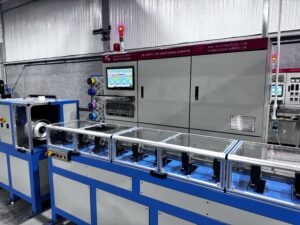
The fully differential SZ stranding unit represents the next‑generation technological direction. It uses multiple motors for segmented drive – four motors drive different numbers of cage sections respectively. With fewer transmission chains and a reduced cage outer diameter, the stranding speed is higher. The cage uses high‑strength, low‑density materials (such as hard aluminum alloy) with lower rotational inertia, allowing higher achievable speeds and better cable bending performance.
Reversal control relies on encoders. The encoder sends pulse signals to the control system, which calculates the rotation angle of the stranding head. When the angle meets the preset reversal condition, the control system commands motor reversal. Incremental encoders are used, which do not create cumulative errors. The synchronous pulleys use taper‑lock bushings – compared to keyed connections, they run more smoothly during reversal, do not impose additional tension on the fiber tubes, and ensure accurate stranding.
4. Key Process Parameters for SZ Stranding and Cabling Lines
When selecting an SZ stranding and cabling line, focus on these key parameters:
| Parameter | Typical Range | Notes |
|---|---|---|
| Number of loose tubes | 6–12 reels | Standard configuration; more available for high‑fiber‑count cables |
| Loose tube diameter | Φ1.5–Φ10.0 mm | Varies by cable type |
| Design speed | 100 m/min | Maximum rated speed of the equipment |
| Production speed | ≥ 80 m/min | Actual operating speed |
| Stranding pitch | 45–500 mm | PLC stepless setting |
| SZ stranding angle | ±(4–18)π | Adjustable range |
| SZ stranding speed | Max 1600–2200 rpm | Maximum stranding head speed |
| Maximum finished core diameter | Φ25–Φ28 mm | Upper limit of core outer diameter |
The fully differential SZ stranding unit uses four‑motor segmented differential drive, reducing resistance, preventing tube deformation, and keeping additional fiber loss low.
5. What Changes Are Happening in the SZ Stranding and Cabling Line Market?
Change 1: High‑fiber‑count cables drive equipment upgrades
AI data centers are driving rapid growth in demand for high‑fiber‑count ribbon cables. Traditional 6‑to‑12‑tube stranding machines are no longer sufficient – high‑fiber‑count cables require more tubes and higher‑precision stranding. The industry is evolving from 12‑tube configurations to 24 or more.
Change 2: Overseas demand boosts equipment exports
In March 2026, China’s fiber optic cable exports reached USD 245 million, up 263.84% year‑on‑year. The accelerated construction of overseas cable factories has directly driven export demand for SZ stranding and cabling lines. Overseas customers focus not only on equipment accuracy but also on delivery speed, installation support, and after‑sales responsiveness.
Change 3: Digital capability becomes standard
Cable manufacturing is moving from “people watching machines” to “data managing machines.” Whether an SZ stranding line has data interfaces, can automatically record process parameters, and can connect to MES systems – these are shifting from “nice‑to‑have” to “must‑have.”
6. Selecting an SZ Stranding Line: Watch These Three Data Points
Data Point 1: Pay‑off tension fluctuation
Industry standards require pay‑off tension fluctuation during stranding ≤ ±0.5 N (at 20 m/min line speed). If the factory test report does not list this data, or says only “qualified” without a specific number, be cautious.
Data Point 2: Stranding pitch deviation
Industry standards require stranding pitch deviation ≤ ±0.1 mm. How to measure? Take a section of stranded cable core and measure the distance of a single helical turn with a steel ruler.
Data Point 3: Stranding angle accuracy
The SZ stranding angle is generally adjustable within ±(4‑18)π. Confirm whether the equipment has a zero‑position alignment function – whether the starting angle after each changeover remains consistent.
7. About Hongkai SZ Stranding and Cabling Lines
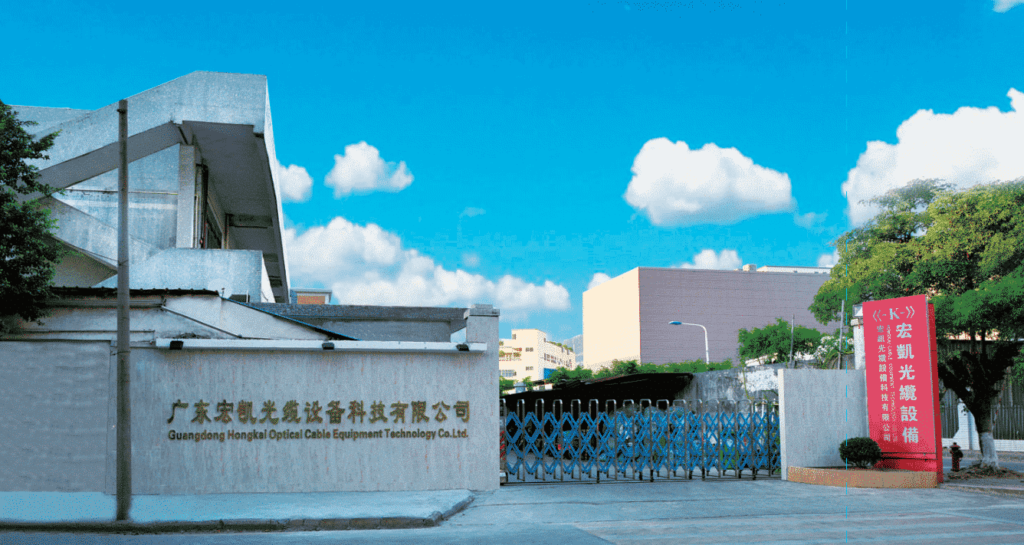
Guangdong Hongkai Optical Cable Equipment Technology Co., Ltd. began manufacturing wire and cable equipment in 2005 and was formally incorporated in 2015. Our main products include SZ stranding and cabling lines, fiber optic cable sheathing extrusion lines, and FTTH drop cable production lines.
Hongkai’s SZ stranding machine uses a fully differential structure with PLC stepless setting – pitch is entered directly on the touchscreen, and the machine automatically matches stranding speed and haul‑off speed.
Key components:
-
Differential gears: High‑frequency hardening + precision grinding, hardness HRC 50–55 – one set lasts eight to nine years
-
Bearings: SKF or NSK, low‑friction design
-
Electrical components: Siemens/Mitsubishi PLC, Siemens/Schneider low‑voltage components
Measured data: Pay‑off tension fluctuation ≤ ±0.4 N, stranding pitch deviation ≤ ±0.08 mm, supporting simultaneous stranding of up to 12 tubes.
Every machine comes with a factory test report, a PLC program backup on USB, bilingual operation manuals (Chinese/English), and a wear‑parts kit. Our equipment has been exported to more than 15 countries and regions, with over 160 sets currently running on production lines worldwide.
If you’re setting up a fiber optic cable production line, or need a custom optical cable production line, feel free to contact the Hongkai technical team.