The sheath is the cable’s “armor.” After the loose tubes are stranded into a core, an outer sheath must be applied to protect the optical fibers from moisture, compression, and tensile stress. The sheathing extrusion line is the final process in cable manufacturing – no matter how well the preceding stranding was done, if the sheathing fails, the entire reel is scrap.
But in actual production, sheathing processes often present more problems than one might expect. This article reviews the most common process issues on sheathing lines and the key points to watch when selecting equipment.
1. Composition and Process Flow of a Sheathing Line
A complete fiber optic cable sheathing extrusion line typically consists of the following units:
-
Pay-off stand: Unwinds the cable core
-
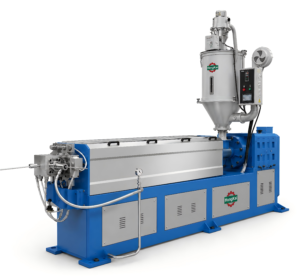
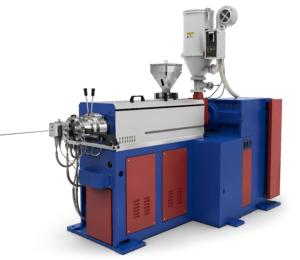
Extruder: Melts the sheath material (PE, PVC, LSZH, etc.) and uniformly coats it over the core through a die
-
Cooling trough: Cools and sets the freshly extruded sheath
-
Capstan: Pulls the cable forward at a constant speed
-
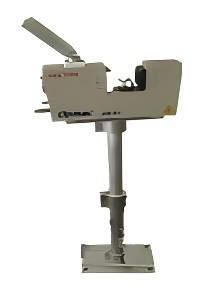
Laser diameter gauge: Monitors the sheath outer diameter in real time
-
Take-up: Neatly winds the finished cable onto reels
The entire process is controlled by a PLC system, which achieves speed synchronization across pay-off, extrusion, capstan, and take-up through closed-loop control, ensuring stable sheath outer diameter.
2. The Five Most Common Problems in Sheathing Production
Problem 1: Sheath Eccentricity – Gravity Is the Culprit
Sheathing lines are horizontally arranged. When plastic is extruded from the die, it is at high temperature and in a molten state. Due to gravity, the molten plastic tends to sag, resulting in a thicker sheath on the underside of the cable core and a thinner sheath on the top. The thinner area offers less protection and is more prone to damage during long-term service.
Additionally, misalignment between the core and the die, or lateral displacement of the cable core within the die, are common causes of eccentricity. Improperly matched dies can also cause cable deformation and dimensional non-conformance.
Industry standard: Sheath concentricity ≥ 98%. A deviation exceeding 0.05 mm can cause microbend loss. G.657 series bend‑insensitive cables have even higher sheath concentricity requirements – these cables are primarily used for high‑density cabling in data centers. If the sheath is eccentric, bending loss is sharply amplified.
Solution: Equip a high‑precision laser diameter gauge for real‑time outer diameter monitoring, with PLC closed‑loop control automatically adjusting extrusion speed. Also regularly check die centering.
Problem 2: Bubbles on the Sheath Surface – Temperature and Material Issues
This is another common issue in sheathing. In the summer of 2026, a cable factory in Anhui encountered this problem during sheathing extrusion: the extruder head temperature was 2°C above the standard value, and the local ambient temperature near the line was 0.5°C higher than the temperature controller displayed. Fine bubbles appeared on the freshly extruded sheath surface. Subsequent inspection confirmed the bubbles were within 0.2 mm diameter – still within factory standards at the time – but the manufacturer raised the issue anyway: buried cables are expected to last 20–30 years, and even these tiny bubbles could absorb moisture over time, potentially causing fiber attenuation to exceed limits.
Common causes: Moisture in raw materials (especially LSZH), excessive extrusion temperature causing material decomposition, and unsuitable cooling water temperature. This problem is particularly common during seasonal transitions – in southern China’s rainy season, high warehouse humidity causes sheath compounds to absorb moisture, leading to bubbles during extrusion.
Solution: Strictly control raw material drying; regularly calibrate extruder heating zone temperatures; during hot weather, record extruder head and workshop ambient temperatures every half hour – if deviation exceeds 1°C, stop and adjust immediately. The screw length‑to‑diameter (L/D) ratio should be at least 25:1 to ensure adequate plasticization.
Problem 3: Excessive Finished Cable Attenuation – Root Cause Lies in Sheathing Stress
Some cables pass OTDR testing through all preceding processes, but after sheathing, the 1550 nm attenuation value suddenly becomes too high. The root cause is stress on the optical fibers within the finished cable.
During sheath extrusion, if capstan speed is unstable, the core is squeezed when passing through the die, or sheath cooling shrinkage is uneven – all can impose stress on the internal fibers. This is especially problematic during line stoppages, which can create sheath discontinuities, material gaps, or lumps. G.657 series bend‑insensitive fibers are more sensitive to stress – these fibers are primarily used for high‑density cabling in data centers, and even minor stress during sheathing can affect final performance.
Taking GYTA‑12B1 cable as an example: loose tube diameter 1.8 mm, excess length requirement 0.1–0.3‰, tube take‑up tension should be controlled at 6 ± 1 N. Stranding pay‑off tension should be controlled at 3 ± 1 N, with a stranding pitch of 60 mm. If capstan speed fluctuation during sheathing changes the stress on the core, the carefully controlled fiber excess length from previous processes is compromised.
Solution: Ensure stable capstan speed on the sheathing line, with synchronized speeds across pay‑off, extrusion, capstan, and take‑up units. A closed‑loop control system with a laser diameter gauge monitors outer diameter changes in real time, helping stabilize process parameters.
Problem 4: Unstable Sheath Wall Thickness – Double Loss of Cost and Quality
Wall thickness has a significant impact on product cost – every 0.01 mm increase in wall thickness per kilometer adds approximately RMB 1.50 to cost. Excessive thickness wastes material; insufficient thickness compromises protection. During production, sheaths are prone to issues of excessive thickness, insufficient thickness, and eccentricity.
The causes of unstable wall thickness are complex: extrusion temperature fluctuations, capstan speed variations, die wear, material batch differences, and more. Traditional solutions rely on operator experience for manual adjustment – but precise control is difficult to achieve.
Solution: Use a laser diameter gauge for real‑time outer diameter measurement, with closed‑loop control automatically adjusting extruder screw speed or capstan speed. Ultrasonic probes can monitor sheath wall thickness in real time, and combining wall thickness and outer diameter data yields sheath concentricity.
Problem 5: Sheath Surface Defects – Die and Cooling Issues
Sheath surfaces may exhibit defects such as bamboo joints, pinholes, fishtail patterns, core marks, die marks, and more. Once wall thickness stability improves, many surface problems are also resolved.
Common causes: Improper die selection, unsuitable cooling water temperature, inadequate plasticization. Moisture in FRP strength members can also cause sheath blistering – passing the FRP through a preheater before entering the extruder often helps.
Solution: Ensure extrusion temperature is within the appropriate range – different materials require different temperatures. For HDPE sheathing, reference extrusion temperatures rise progressively from 160°C at the feed zone to 235°C at the die. Melt temperature should generally be controlled at 190–220°C for adequate melting and plasticization, producing a smooth sheath surface with no voids in cross‑section.
3. Four Key Points for Selecting a Sheathing Line
Point 1: The Screw – Different Materials Require Different Screws
There are three main sheath materials: PE (polyethylene) for outdoor cables, PVC (polyvinyl chloride) for indoor cables, and LSZH (low smoke zero halogen) for data center cables.
Different materials have different screw requirements. The screw structure for PE is different from that for LSZH – they are not interchangeable. The screw L/D ratio should be at least 25:1 to ensure adequate plasticization. For general‑purpose plastic extruders, the compression ratio can be selected based on the specific plastic used.
Hongkai’s sheathing line screws are made of 38CrMoAlA material with nitriding treatment – nitriding depth 0.5–0.7 mm, hardness above HV 900. If the screw material is substandard, plasticization suffers, resulting in rough sheath surfaces and uneven wall thickness.
Point 2: The Diameter Gauge – This Is the “Eye” of the Sheathing Line
A sheathing line without a laser diameter gauge is essentially “extruding blind.”
The laser diameter gauge uses laser scanning for non‑contact online measurement, measuring outer diameter and adjusting extruder screw speed or capstan speed for diameter control. After installation at the required measurement position, the gauge calculates the delay time and distance between the measurement point and the control point, adjusts height and angle for perpendicularity to the measured object, and transmits data to the PLC in real time. The PLC uses a PID algorithm to dynamically adjust extruder speed.
Hongkai’s sheathing line is equipped with a high‑precision laser diameter gauge with 0.2 μm accuracy – if the sheath outer diameter deviates by just 0.01 mm, it detects it. Over 8 hours of continuous production, concentricity averages 98.6%, with wall thickness tolerance ≤ 0.04 mm.
Point 3: The Control System – Stability and Usability
A sheathing line is not a single machine running alone – it’s multiple units (pay‑off, extruder, capstan, take‑up) working in coordination. If the control system can’t keep up, the line goes out of sync as speed increases.
A good control system uses PLC + touchscreen, with all parameters adjustable on one screen. Major electrical components should be from international brands (Siemens, Mitsubishi, Schneider) – high stability and readily available replacement parts.
Hongkai sheathing lines come standard with Siemens/Mitsubishi PLC platforms, supporting recipe storage (saving process parameters for up to 20 different products) and data acquisition. Changeover is one‑touch loading, completed in 1.5 hours.
Point 4: Overseas Delivery Capability – The “Last Mile” of Equipment Exports
In 2026, cable exports are booming, overseas cable factories are accelerating construction, and export demand for sheathing lines is also growing. When overseas customers procure sheathing lines, beyond accuracy and price, they focus on three key issues:
How soon after arrival can the equipment go into production? Hongkai provides bilingual operation manuals, electrical schematics, and CE technical documentation; engineers are dispatched for on‑site installation and commissioning – 12 to 18 days from installation to trial production.
How quickly can it be repaired if it breaks down? Hongkai includes a wear‑parts kit with every machine – belts, bearings, sensors, fuses – shipped with the equipment. Spare parts can be delivered via DHL within 3 days. Remote video support is available with a 2‑hour response time during working hours.
Can the equipment pass destination country certification? Hongkai equipment meets electrical safety design per EN 60204‑1 standards, and CE technical documentation is available upon request. Major electrical components include Siemens/Mitsubishi PLC, Siemens/Schneider low‑voltage components, and ABB/Inovance drives – with global warranty coverage.
4. About Hongkai Sheathing Lines
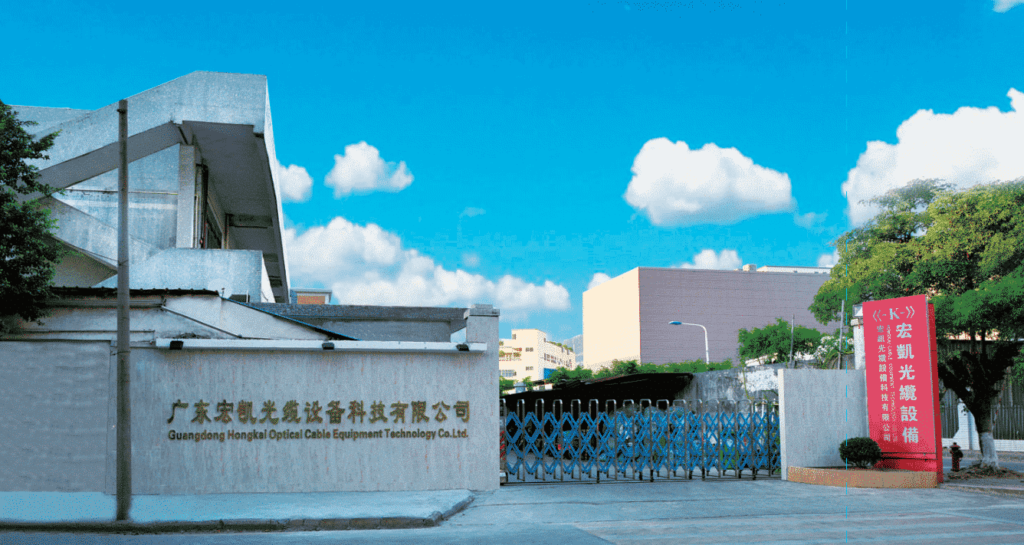
Guangdong Hongkai Optical Cable Equipment Technology Co., Ltd. began manufacturing wire and cable equipment in 2005 and was formally incorporated in 2015. Our main products include SZ stranding and cabling lines, fiber optic cable sheathing extrusion lines, and FTTH drop cable production lines.
Hongkai sheathing line measured data: Concentricity ≥ 98.6%, wall thickness tolerance ≤ 0.04 mm, compatible with PE, PVC, and LSZH, changeover time under 1.5 hours. Our equipment has been exported to more than 15 countries and regions, with over 160 sets currently running on production lines worldwide. Every machine comes with a factory test report, a PLC program backup on USB, bilingual operation manuals (Chinese/English), and a wear‑parts kit.
If you’re setting up a fiber optic cable production line, or need a custom optical cable production line, feel free to contact the Hongkai technical team.