1. Precision: One Relies on the Eye, the Other on Data
Old stranding machines use open‑loop tension control – set a value and leave it; if the actual tension drifts, the operator has to notice it. On old sheathing lines, concentricity depends on the operator manually adjusting the die – loosening screws, repositioning, tightening, trial‑running, checking wall thickness, adjusting again.
New equipment is different.
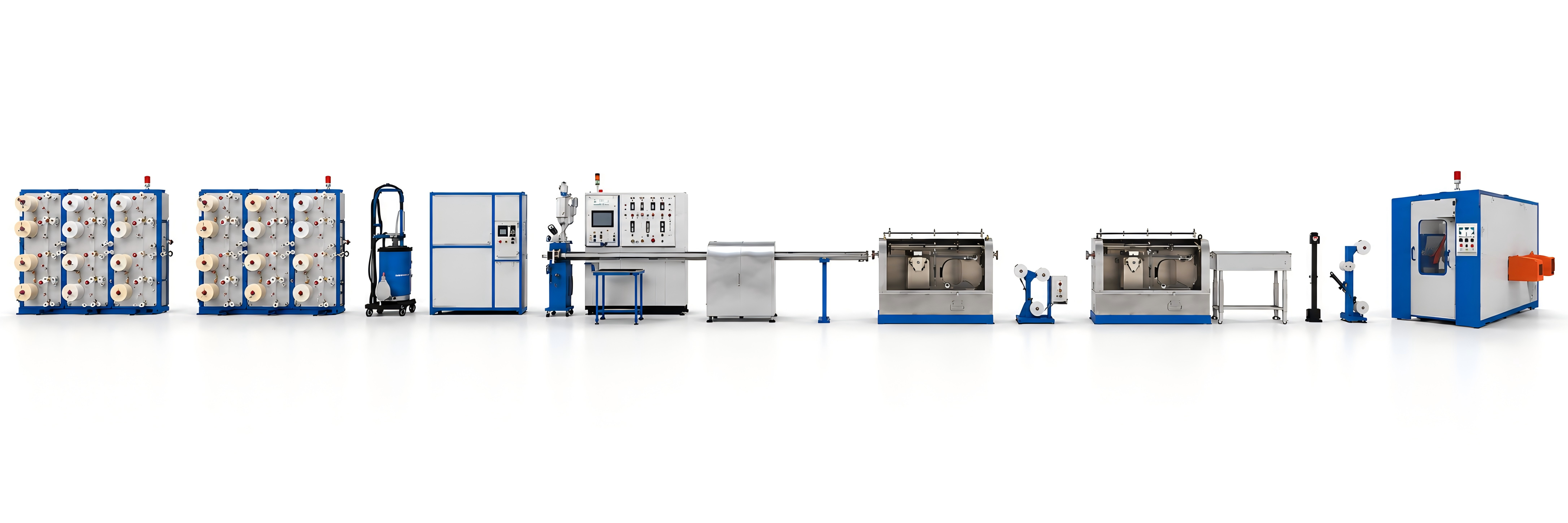
Hongkai’s SZ stranding machine uses independent servo motors for active pay‑off with real‑time closed‑loop tension sensor control. The tension sensor continuously monitors actual tension, feeds data back to the PLC, and the PLC automatically adjusts the pay‑off speed to bring tension back to the setpoint. The entire process completes in 20 milliseconds – the equipment monitors itself, without constant human supervision.
New sheathing lines are equipped with high‑precision laser diameter gauges (accuracy 0.2 μm) – if the sheath outer diameter deviates by just 0.01 mm, the PLC automatically adjusts the extruder speed to bring it back. Over 8 hours of continuous production, concentricity averages 98.6%.
In short: old equipment relies on the operator’s experience; new equipment relies on sensor data.
2. Changeover Speed: One Takes Half a Day, the Other Takes a Single Tap
Today’s cable orders are “multi‑variety, small‑batch” – 12‑fiber today, 24‑fiber tomorrow, butterfly drop cable the day after. Changeover efficiency directly determines output.
Old equipment requires manual adjustment of over a dozen parameters: pitch, tension, temperature, speed – entered manually, trial‑run, adjust, trial‑run again. A master technician takes four hours; a new employee might not finish in a full day.
New equipment stores parameters as recipes. Hongkai’s equipment can store process parameters for up to 20 different products. During changeover, just tap the touchscreen – parameters load automatically. Done in 1.5 hours.
In short: old equipment relies on “adjustment”; new equipment relies on “storage.”
3. Data Capability: One Relies on Paper Records, the Other on Systems
Old equipment data is recorded by operators with pen and paper – daily output, scrap rate, any anomalies – all written in notebooks. Management wants to know line status? They wait for the shift supervisor’s verbal report.
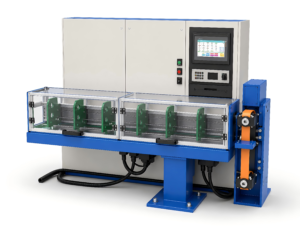
New equipment records data automatically. Hongkai’s equipment comes standard with Siemens/Mitsubishi PLC platforms, supporting data acquisition and MES integration. Process parameters for every batch – tension, pitch, temperature, speed – are all automatically recorded, traceable, and exportable. If a customer needs production data for a specific cable batch, simply retrieve it from the system.
In short: old equipment is “mute”; new equipment can “speak.”
4. Productivity: One Person Watching Three Lines vs. Three People Watching One Line
Old equipment has low automation – operators must constantly monitor tension, temperature, speed, sheath surface. One person watches one line – and even then, it’s hard to keep up.
New equipment has high automation – the equipment monitors itself and adjusts itself. The operator only needs to glance at the tablet; the system alarms if anything is abnormal. One person can oversee two to three lines.
At Sichuan Lefei Optoelectronics’ 5G fully connected factory, a large workshop runs with fewer than ten workers – they control the entire line with tablets. Coloring, stranding, sheathing – all processes achieve millisecond‑level data acquisition.
In short: old equipment relies on “people watching”; new equipment relies on “data managing.”
5. Product Capability: One Can Only Make Standard Cables, the Other Can Make High‑Fiber‑Count Cables
This is the most fundamental difference.
Old stranding machines have 6–12 pay‑off positions, tension fluctuation above ±1 N, pitch deviation ±0.3 mm – they can handle standard loose‑tube cables, but can’t stabilize high‑fiber‑count cables. With dozens of tubes paying off simultaneously, if any one tube’s tension drifts, the entire cable is scrap.
New stranding machines support simultaneous stranding of 12 tubes or more, with tension fluctuation ≤ ±0.4 N and pitch deviation ≤ ±0.08 mm – they can reliably handle the high‑fiber‑count cables that data centers demand.
Old sheathing lines achieve concentricity of around 95% – fine for G.652.D. But G.657 series bend‑insensitive cables require concentricity ≥ 98% – old equipment can’t meet it.
New sheathing lines achieve concentricity ≥ 98.6%, wall thickness tolerance ≤ 0.04 mm – G.657 orders are within reach.
In short: old equipment can’t handle new orders; new equipment can.
One Table to Understand: The Gap Between Old and New Equipment
| Comparison | Old Equipment | New Equipment |
|---|---|---|
| Tension control | Open‑loop, relies on operator detection | Closed‑loop, real‑time sensor feedback |
| Changeover method | Manual adjustment of a dozen parameters – 4 hours | One‑touch recipe loading – 1.5 hours |
| Data recording | Manual, non‑traceable | Automatic, traceable and exportable |
| Operation mode | People watching machines | Data managing machines |
| High‑fiber‑count cables | Insufficient accuracy – can’t handle | Sufficient accuracy – reliably handles |
| G.657 cables | Insufficient concentricity – can’t handle | Concentricity ≥ 98% – can handle |
About Hongkai
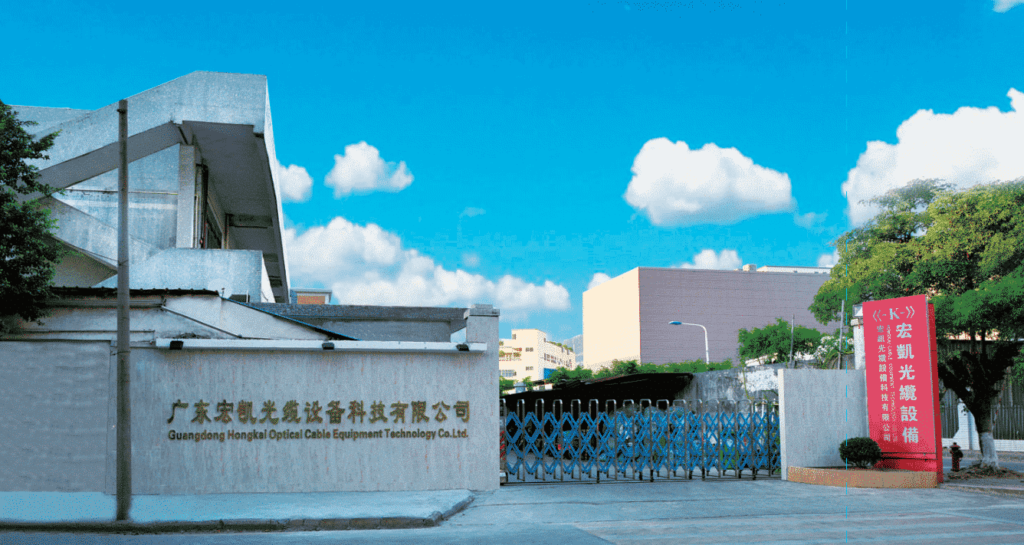
Guangdong Hongkai Optical Cable Equipment Technology Co., Ltd. began manufacturing wire and cable equipment in 2005 and was formally incorporated in 2015. Our main products include SZ stranding and cabling lines, fiber optic cable sheathing extrusion lines, and FTTH drop cable production lines.
Hongkai equipment measured data: SZ stranding machine pay‑off tension fluctuation ≤ ±0.4 N, stranding pitch deviation ≤ ±0.08 mm; sheathing line 8‑hour continuous production concentricity average ≥ 98.6%, wall thickness tolerance ≤ 0.04 mm; changeover time ≤ 1.5 hours (one‑touch recipe loading). Our equipment has been exported to more than 15 countries and regions, with over 160 sets currently running on production lines worldwide. Every machine comes with a factory test report, a PLC program backup on USB, bilingual operation manuals (Chinese/English), and a wear‑parts kit.
If you’re considering upgrading to new equipment, or want to see precision data from new machines, feel free to contact the Hongkai technical team. Start by reviewing the factory test report, then see the equipment in operation, and finally decide if it’s the right fit.