For fiber optic cable manufacturers, choosing an equipment supplier is not just about “looking at price, checking specs, and signing a contract.” When the equipment arrives overseas, who installs it? What if it breaks down? How soon can spare parts arrive? Are the certification documents complete? These are questions that must be clarified before signing the contract.
This article, from the perspective of overseas customers, outlines the five most critical evaluation dimensions when choosing a fiber optic cable making machine supplier.
1. Precision Verification: Can They Provide a Factory Test Report?
Overseas customers often have stricter requirements for equipment precision than domestic customers. For an SZ stranding line, pay-off tension fluctuation must be controlled within ±0.5 N, and stranding pitch deviation within ±0.1 mm. For a fiber optic cable sheathing line, concentricity must reach 98% or above.
These numbers are not “promises” written in a contract – they are what the customer will measure with instruments after the equipment arrives. If the measurements fail to meet the standard, the acceptance form won’t be signed.
Evaluation point: Require the supplier to provide a factory test report showing the measured data for core indicators such as pay-off tension fluctuation, stranding pitch deviation, and sheath concentricity. If the report only says “qualified” without specific figures – be cautious.
Every Hongkai machine comes with a factory test report – SZ stranding line pay-off tension fluctuation ≤ ±0.4 N, stranding pitch deviation ≤ ±0.08 mm; fiber optic cable sheathing line 8-hour continuous production concentricity average ≥ 98.6%, wall thickness tolerance ≤ 0.04 mm. The data is there, and customers can replicate the measurements after receiving the equipment.
2. Delivery and Installation: When the Equipment Arrives, Who Installs It?
An SZ stranding line weighs dozens of tons and contains hundreds of components. After the equipment arrives at port, these components need to be assembled, wired, routed, parameterized, and trial-run – every step requires skilled personnel.
In the Middle East, Africa, and Southeast Asia, there aren’t many people familiar with cable equipment installation and commissioning. If the equipment supplier only provides “bare machines” without sending personnel, the customer may spend two to three months figuring it out on their own. During this period, labor costs, downtime losses, and trial production scrap can add up to more than the equipment itself.
Evaluation point: Ask clearly whether the supplier provides on-site installation and commissioning services, how long engineers stay on-site, and how costs are calculated.
Hongkai dispatches engineers to the site for installation and commissioning – 12 to 18 days from unpacking to producing the first qualified reel. Before they leave, they train the operators, leaving behind bilingual manuals, electrical schematics, and a complete troubleshooting guide. Front-end equipment such as the fiber coloring machine, secondary coating line for optical fiber, and loose tube line also comes with on-site installation guidance.
3. Spare Parts and After-Sales: What If It Breaks Down?
Equipment running 24/7 will eventually have issues. What overseas customers fear most is not equipment failure – it’s failure with no spare parts to replace the faulty component.
A sensor fails, a bearing wears out – if you can’t find replacements locally, you wait for the supplier to ship from China. DHL takes three to five days; sea freight takes twenty to twenty-five days. A week of downtime costs tens of thousands in lost output.
Evaluation point: Before signing the contract, ask: what wear parts are included with the equipment? Can spare parts be shipped quickly? Is remote technical support available?
Hongkai includes a wear-parts kit with every machine – belts, bearings, sensors, fuses – shipped with the equipment. Spare parts are delivered via DHL within 3 to 5 business days. Remote video support is available with a 2-hour response time during working hours. Equipment can optionally be equipped with a remote access module (with customer authorization), allowing engineers to remotely view operating status and diagnose alarm causes.
4. Data and Intelligence: Can the Equipment “Speak”?
Overseas cable manufacturers are increasingly focused on equipment data capability. Can the equipment connect to MES systems? Can it automatically record process parameters? Can it support remote diagnostics?
Evaluation point: Ask clearly whether the equipment has data interfaces, whether it can automatically record production data, and whether changeover is one-touch loading.
Hongkai equipment comes standard with Siemens/Mitsubishi PLC platforms, supporting data acquisition and MES integration. The recipe storage function can save process parameters for up to 20 different products, with one-touch loading for changeover – completed in 1.5 hours. The FTTH optical cable manufacturing machine and indoor optical fiber production line also feature recipe storage and data recording functions.
One Table to Understand: The Five Dimensions Overseas Customers Use to Evaluate Equipment Suppliers
| Evaluation Dimension | Key Questions | Hongkai’s Corresponding Capabilities |
|---|---|---|
| Precision verification | Is there a factory test report? What are the measured values? | Every machine comes with a factory test report – all data listed |
| Delivery and installation | Who installs it when it arrives? How soon can it run? | Engineers on-site – 12 to 18 days from installation to trial production |
| Spare parts and after-sales | Are wear parts included? How fast do spares arrive? Is remote support available? | Wear-parts kit shipped with equipment, DHL delivery within 3 days, remote response within 2 hours |
| Certification and compliance | Are CE documents complete? Are electrical components international brands? | EN 60204-1 design, CE technical documentation, international brand components |
| Data and intelligence | Can it connect to MES? How fast is changeover? | Siemens/Mitsubishi PLC, recipe storage, changeover in 1.5 hours |
About Hongkai
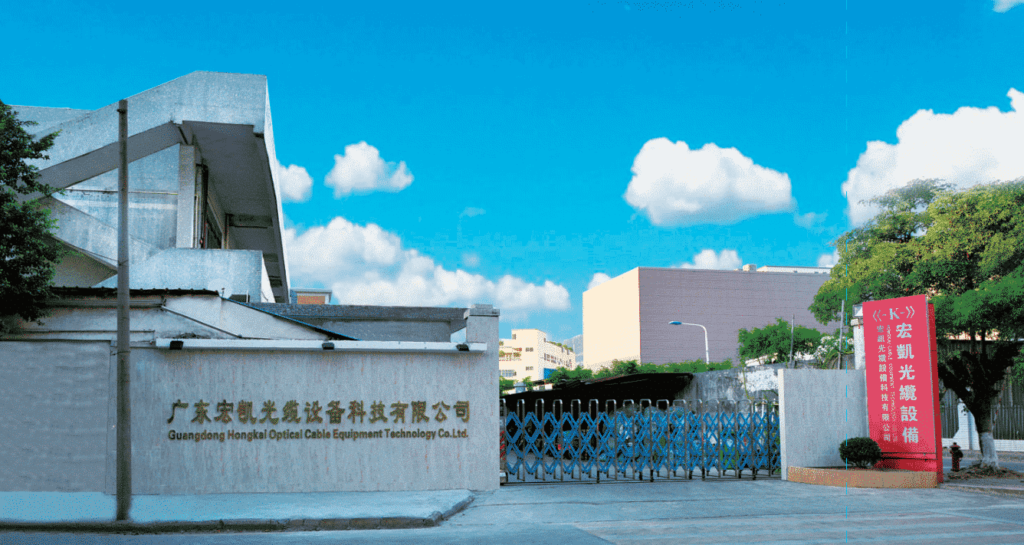
Guangdong Hongkai Optical Cable Equipment Technology Co., Ltd. began manufacturing wire and cable equipment in 2005 and was formally incorporated in 2015. Our main products cover the entire cable production process:
-
Fiber coloring machine / fiber optic coloring line: Coloring speed 3,000 m/min, pay-off tension accuracy ±0.05 N
-
Secondary coating line for optical fiber / loose tube line: Excess length control accuracy ±0.2‰, line speed 350 m/min
-
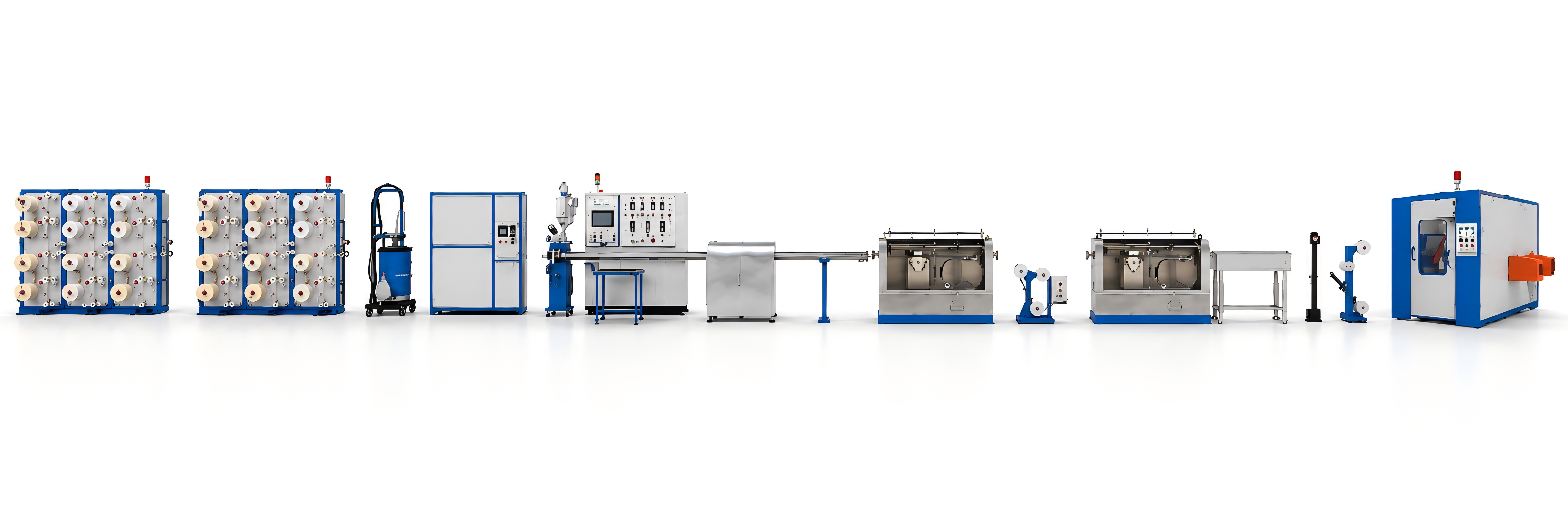
SZ stranding line: Pay-off tension fluctuation ≤ ±0.4 N, stranding pitch deviation ≤ ±0.08 mm
-
Fiber optic cable sheathing line: Concentricity ≥ 98.6%, wall thickness tolerance ≤ 0.04 mm
-
FTTH optical cable manufacturing machine: Compatible with PVC and LSZH, capable of producing single-core and dual-core butterfly drop cables
-
Indoor optical fiber production line: Adapted to data center cables and indoor soft cables
Our equipment has been exported to more than 15 countries and regions, with over 160 sets currently running on production lines worldwide. Every machine comes with a factory test report, a PLC program backup on USB, bilingual operation manuals (Chinese/English), and a wear-parts kit. Major electrical components use international brands and meet RoHS requirements.
If you are procuring a fiber optic cable production line for an overseas project, feel free to contact the Hongkai technical team. First, tell us where you plan to build and what products you want to make – then we’ll help you work out a solution.