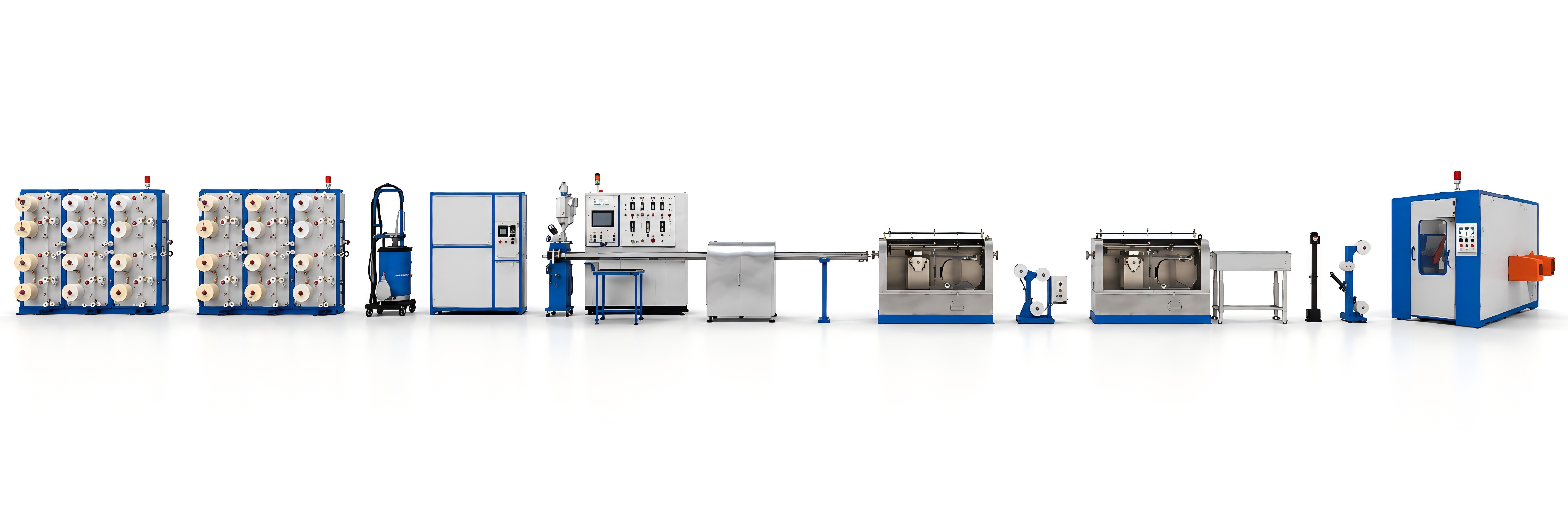
A fiber optic cable production line consists of multiple core machines: fiber coloring machine, secondary coating line for optical fiber, loose tube line, SZ stranding line, fiber optic cable sheathing line, FTTH optical cable manufacturing machine, and indoor optical fiber production line.
Individual machine tests passing doesn’t mean the whole line will run smoothly. Whether the complete line runs smoothly depends on the integration and commissioning between core machines – whether the speed chain, tension chain, and data chain can work in coordination.
Today, from the perspective of equipment manufacturing and delivery, let’s discuss the core equipment integration and commissioning logic of an optical fiber cable production line, and how Hongkai, as a Premier Cable Machine Manufacturer, approaches full-line integration and commissioning.
1. Why Do Individual Machines Pass, but the Whole Line Doesn’t Run Smoothly?
Individual machine testing verifies whether each machine “can run stably on its own.” The fiber coloring machine has pay-off tension accuracy of ±0.05 N, the SZ stranding line has pay-off tension fluctuation ≤ ±0.4 N, and the fiber optic cable sheathing line achieves concentricity ≥ 98.6% – individually, all data meets the standard.
But when the whole line runs, problems often arise at the “interfaces” between machines:
-
Speed mismatch: The fiber coloring machine runs at 3,000 m/min, while the secondary coating line for optical fiber runs at 350 m/min – upstream too fast, downstream too slow, causing upstream backlog and downstream material shortage.
-
Tension discontinuity: The excess length data from the secondary coating line for optical fiber is not transmitted to the SZ stranding line – the stranding machine runs on default values, and pitch deviates.
-
Data incompatibility: The SZ stranding line and fiber optic cable sheathing line use different PLC platforms – data can’t be transmitted, and full-line linkage can’t be achieved.
-
Recipe desynchronization: During changeover, each machine’s parameters are adjusted one by one – upstream is adjusted while downstream isn’t yet, and the material in between is wasted.
Individual machines passing is a “point”; full-line integration and commissioning is a “line.” If the points can’t connect into a line, the production line won’t run smoothly.
2. Integration Step 1: Mechanical Installation and Individual Machine No-Load Testing
Before full-line integration, complete mechanical installation and individual machine no-load testing.
Mechanical installation: The entire fiber optic cable making machine series is positioned, leveled, and anchor bolts tightened. The extruder, cooling trough, capstan, and take-up of the fiber optic cable sheathing line must be on the same centerline, with deviation ≤ 2 mm. The frame levelness of the SZ stranding line must be ≤ 2 mm/m.
Individual machine no-load testing: Each machine is powered on and run individually. Does the fiber coloring machine pay-off stand rotate? Does the secondary coating line for optical fiber extruder heat properly? Is the loose tube line capstan speed stable? Does the SZ stranding line stranding unit reverse smoothly? Is the fiber optic cable sheathing line take-up traverse even? Only after individual machine no-load testing is normal can full-line integration begin.
3. Integration Step 2: Speed Chain Integration – Core Equipment Speed Matching
Goal of speed chain integration: The speeds of the fiber coloring machine, secondary coating line for optical fiber, loose tube line, SZ stranding line, and fiber optic cable sheathing line are linked – no upstream backlog, no downstream material shortage.
Integration method:
-
Set the target line speed for the complete line (e.g., SZ stranding line at 80 m/min).
-
The PLC automatically calculates the matching speeds for the fiber coloring machine and secondary coating line for optical fiber based on the target speed.
-
Upstream equipment runs at reduced speed to match downstream capacity; or downstream equipment speeds up to absorb upstream capacity.
-
Unit speeds are linked via PROFINET or MODBUS TCP/IP protocols – the operator sets it once on the touchscreen, and the entire line synchronizes.
Key points: During speed chain integration, focus on whether there is backlog between the fiber coloring machine and secondary coating line for optical fiber, and whether there is material shortage between the SZ stranding line and fiber optic cable sheathing line. Backlog or shortage indicates that speed matching is not properly done, and the linkage ratio needs to be recalculated.
Hongkai’s entire series is developed on a unified PLC platform (Siemens/Mitsubishi). Speed chain integration is completed before factory release – customers only need to call up recipes on-site.
4. Integration Step 3: Tension Chain Integration – Progressive Transfer from Pay-Off to Take-Up
Goal of tension chain integration: From the pay-off tension of the fiber coloring machine to the take-up tension of the fiber optic cable sheathing line, every stage is stable, and the connections between stages are unbroken.
Integration method:
-
The fiber coloring machine pay-off tension is set at ±0.05 N, keeping colored fiber tension stable.
-
The secondary coating line for optical fiber front and rear capstan speed differential is set, with excess length controlled at ±0.2‰.
-
Each pay-off reel on the SZ stranding line is independently servo-driven, with pay-off tension fluctuation ≤ ±0.4 N. The excess length data from the secondary coating line for optical fiber is transmitted to the SZ stranding line, and the stranding machine adjusts pay-off tension based on excess length.
-
The fiber optic cable sheathing line take-up tension is under closed-loop control, automatically adjusting torque based on reel diameter and take-up speed, keeping cable tension consistent on the reel.
Key points: During tension chain integration, focus on whether the pitch deviation of the SZ stranding line is stable within ±0.08 mm, and whether the concentricity of the fiber optic cable sheathing line is stable at ≥ 98.6%. If pitch deviates or concentricity drops, it indicates that a stage in the tension chain is not properly connected – troubleshoot stage by stage.
5. Integration Step 4: Data Chain Integration – PLC, HMI, and MES Interoperability
Goal of data chain integration: Production data from the entire fiber optic cable making machine series can be collected, uploaded, and traced.
Integration method:
-
The PLCs of each machine are connected via industrial Ethernet, with data uploaded to a centralized monitoring screen or MES system.
-
Coloring speed and tension data from the fiber coloring machine, excess length and temperature data from the secondary coating line for optical fiber, pitch and tension data from the SZ stranding line, outer diameter and concentricity data from the fiber optic cable sheathing line – all collected in real time.
-
Recipe data is synchronized across machines – one-touch loading during changeover, with full-line parameter synchronization.
-
Alarm information is displayed centrally – which machine has an alarm is directly visible on the monitoring screen.
Key points: During data chain integration, focus on whether data collection is complete, upload is stable, and recipe synchronization is accurate. The optical fiber cable production line is fully data-connected – retrievable during customer factory audits.
6. Integration Step 5: Load Trial Run and Process Parameter Tuning
After speed chain, tension chain, and data chain integration pass, proceed to load trial run.
Load trial run: Feed actual tubes and sheath material, and run the entire line in production mode. The fiber coloring machine colors, the secondary coating line for optical fiber applies secondary coating, the loose tube line makes loose tubes, the SZ stranding line strands, and the fiber optic cable sheathing line extrudes the sheath – the entire line runs through and produces the first qualified reel of cable.
Process parameter tuning: Based on load trial run data, fine-tune the process parameters of each machine. The pitch factor of the SZ stranding line, the concentricity compensation value of the fiber optic cable sheathing line, and the excess length setting of the secondary coating line for optical fiber – tuned to optimal conditions and saved into recipes.
Key points: The load trial run should run continuously for at least 2 hours to see whether line speed, tension, temperature, and data are stable. Hongkai equipment completes load trial runs before factory release, with data recorded in the factory test report.
7. Common Integration Problems and Solutions
Problem 1: Upstream backlog, downstream material shortage. Speed chain not properly matched. Recalculate the linkage ratio – reduce upstream speed or increase downstream speed.
Problem 2: Pitch deviation exceeds tolerance. Tension chain not properly connected. Check whether the excess length data from the secondary coating line for optical fiber is transmitted to the SZ stranding line, and whether the stranding machine’s pay-off tension is adjusted based on excess length.
Problem 3: Concentricity fluctuation. The take-up tension or extrusion speed of the fiber optic cable sheathing line is not synchronized. Check the linkage between take-up tension closed-loop control and extrusion speed.
Problem 4: Parameters incorrect after recipe loading. Data chain not connected. Check the communication protocols and address mapping between the PLCs of each machine.
Problem 5: Alarm information not visible. Centralized monitoring not properly configured. Check whether alarm information is uploaded to the monitoring screen or MES.
8. Hongkai’s Full-Line Integration and Commissioning Support
As a Premier Cable Machine Manufacturer, Hongkai provides the following for full-line integration and commissioning:
-
Pre-delivery integration: Speed chain, tension chain, and data chain integration are completed before factory release, with load trial run data recorded in the factory test report.
-
On-site integration: Engineers go on-site for installation and commissioning – 12 to 18 days from unpacking to producing the first qualified reel. Full-line integration proceeds in the order of speed chain, tension chain, and data chain.
-
Recipe presets: Based on the customer’s product type, 20 product process recipes are preset, ready for direct use during on-site integration.
-
Remote support: If problems arise during integration, Hongkai engineers can provide remote video guidance, with a 2-hour response time during working hours. Equipment can optionally be equipped with a remote access module for engineers to remotely view equipment status.
-
Training: Customer operators are trained during the integration process, ensuring they can independently complete changeovers and daily operations.
9. The Value of Full-Line Integration and Commissioning for Overseas Factories
Value 1: Fast production launch. Integration completed before factory release – on-site commissioning focuses on mechanical installation and load testing, with production in 12 to 18 days.
Value 2: Stable precision. With speed chain, tension chain, and data chain properly integrated, full-line pitch deviation ≤ ±0.08 mm and concentricity ≥ 98.6%.
Value 3: Fast changeover. Recipe synchronization enables one-touch loading during changeover, within 1.5 hours.
Value 4: Data traceability. Full-line data connectivity – retrievable during customer factory audits.
Value 5: Fewer problems. Problems discovered during integration are resolved before factory release, reducing on-site pitfalls.
📩 Get a Full-Line Integration and Commissioning Proposal and Core Equipment Configuration
If you are procuring a fiber optic cable production line for an overseas project, or want to learn about Hongkai’s approach to full-line integration and commissioning as a Premier Cable Machine Manufacturer, feel free to contact the Hongkai technical team.
Just tell us three things:
-
What type of cable do you want to make? (Loose-tube / FTTH / indoor cable)
-
Where will the factory be built? (This affects voltage system and certification requirements)
-
Approximately what capacity? (How many kilometers per month or per year)
We will provide a preliminary core equipment configuration proposal, full-line integration and commissioning description, and quotation within 5 working days.
📧 Email: sales2@hkofcmachine.com
🌐 Website: https://hkofcmachine.com/