When purchasing a fiber optic cable production line, buyers often focus on the numbers on the quotation sheet – whose fiber optic cable making machine is cheaper, whose SZ stranding line comes in at a lower price.
But equipment is bought to be used for five, eight years. The number on the quotation sheet is only one part of the total cost.
Industry analysis indicates that in cable production line operations, auxiliary equipment (take-up, pay-off stands, etc.) accounts for only 5% to 10% of total maintenance expenditure, while core main machines such as extrusion lines can account for 45% to 65%. Extrusion lines run continuously at high temperatures of 180–220°C – thermal stress combined with material corrosion makes screw wear and heating element failure the most frequent problems.
This article uses a typical cable production line as an example to break down the five components of five-year Total Cost of Ownership (TCO), helping buyers see exactly where the “lowest-priced” equipment is actually “expensive.”

1. Purchase Price: The Difference Can Be 30% to 50%
An SZ stranding line – the price difference between different configurations can be 30% to 50%. A fiber optic cable sheathing line – different extruder screw materials, whether a laser diameter gauge is included, whether the control system uses international brands or generic components – the quotation gap is similarly significant.
The difference in purchase price is “visible.” But the following four cost items often only reveal themselves after two or three years of operation.
2. Energy Consumption: Equipment Running 24/7 – Electricity Costs Differ by Tens of Thousands per Year
When the cable market is hot, equipment runs 24/7. Energy consumption is an ongoing expense.
A complete fiber optic cable production line requires approximately 80 to 120 kW of power. At 20 hours per day, 300 days per year, the annual electricity bill is substantial. If the equipment’s motors have low energy efficiency ratings, the extruder lacks insulation design, or the take-up doesn’t support non-stop reel changing – the extra electricity costs each year can, over several years, exceed the price difference at purchase.
A technical upgrade case at Yongding Fiber provides a reference: of the company’s 12 production lines, one completed zoned environmental temperature management renovation, saving approximately 2,000 kWh per day. After full implementation, the workshop’s overall electricity consumption is expected to drop by more than another 5%.
The extruder in a fiber optic cable sheathing line is the largest energy consumer. Hongkai’s sheathing line extruder uses double-layer insulation design to reduce heat loss; main motors are equipped with inverters to automatically adjust power based on production speed. The FTTH optical cable manufacturing machine and indoor optical fiber production line also feature variable frequency speed control and optimized heating design.
3. Maintenance and Spare Parts: Annual Expenditure Can Reach 3% to 5% of Equipment Price
Industry data shows that annual spare parts expenditure for cable production lines accounts for approximately 3% to 5% of equipment cost. For a medium-scale cable production line, annual maintenance costs typically range from USD 50,000 to 150,000.
Maintenance expenditure on extrusion lines is the highest of all equipment. Taking a Ø85 extrusion line at a factory in Thailand as an example, two years of maintenance plus overhaul costs reached RMB 92,000 – with major expenses concentrated in screw/barrel overhaul (every 1.5 to 2.5 years) and heater band replacement (one batch every 0.5 to 1 year).
What does this mean? If a fiber optic cable sheathing line has substandard screw material and insufficient wear resistance, the frequency of re-grinding and replacement increases. Re-grinding a screw costs a few thousand RMB; replacing it with a new one costs tens of thousands. The more repairs, the longer the downtime.
Hongkai’s fiber optic cable sheathing line screw is made of 38CrMoAlA alloy steel with nitriding treatment – nitrided layer depth 0.5–0.7 mm, hardness above HV 900. The SZ stranding line differential gears undergo high-frequency hardening and precision grinding – hardness HRC 50–55, one set lasting eight to nine years. Core components of the fiber coloring machine, secondary coating line for optical fiber, and loose tube line are also designed for long-cycle use.
4. Scrap Rate: A Small Difference in Precision Means a Big Difference in Losses
The precision level of equipment directly determines the scrap rate.
If the pay-off tension fluctuation of an SZ stranding line expands from ±0.4 N to ±1.5 N, and the stranding pitch deviation expands from ±0.08 mm to ±0.3 mm, the scrap rate can jump from 1% to over 5%. For a line producing 3,000 km per year, a 4 percentage point difference in scrap rate means 120 km of scrap per year.
If the concentricity of a fiber optic cable sheathing line can only reach 95%, orders for G.657 series bend-insensitive cables cannot be taken. And G.657.A2 prices have increased more than tenfold compared to last year – if you can’t take these orders, you’re watching others make the profit.
Hongkai’s SZ stranding line measures pay-off tension fluctuation ≤ ±0.4 N and stranding pitch deviation ≤ ±0.08 mm; the fiber optic cable sheathing line measures concentricity ≥ 98.6% and wall thickness tolerance ≤ ±0.04 mm.
5. Changeover Downtime: Two Hours Slower – How Much Less Do You Earn per Year?
Today’s cable orders are “multi-variety, small-batch” – 12-fiber today, 24-fiber tomorrow, butterfly drop cable the day after. Changeover efficiency directly determines capacity.
Industry experience shows that rapid changeover technology can reduce changeover time from 2–3 hours to 2–3 minutes, with changeover scrap also greatly reduced. Hongkai equipment features built-in recipe storage – capable of storing process parameters for up to 20 different products, with one-touch loading for changeover completed in 1.5 hours.
The FTTH optical cable manufacturing machine and indoor optical fiber production line also feature recipe storage and data recording functions.
6. Five-Year TCO Comparison: Cheap Equipment May Actually Be More Expensive
Put the five cost items together, and the conclusion is clear.
Suppose the purchase price difference for an SZ stranding line is RMB 200,000, but energy costs are RMB 20,000 more per year, maintenance is RMB 15,000 more per year, and scrap losses are RMB 50,000 more per year – over five years, the additional operating costs far exceed the price difference at purchase.
The lowest-priced equipment often saves money in invisible places. Cheap motors, cheap bearings, cheap screws – the purchase price is lower, but the annual electricity bills, maintenance costs, and scrap losses “pay it back.”
7. Questions Buyers Should Ask When Evaluating Equipment
First, what energy efficiency rating are the motors? IE3 or IE4? Are inverters equipped?
Second, what are the materials and heat treatment of core components? What material is the screw, and what nitriding depth? What hardness are the differential gears? What brand are the bearings?
Third, does the factory test report contain measured data? Pay-off tension fluctuation, stranding pitch deviation, sheath concentricity – what are the numbers?
Fourth, how long does changeover take? Is there a recipe storage function?
Fifth, what is the estimated spare parts expenditure? Which parts should be kept in stock? How soon can spares arrive?
About Hongkai
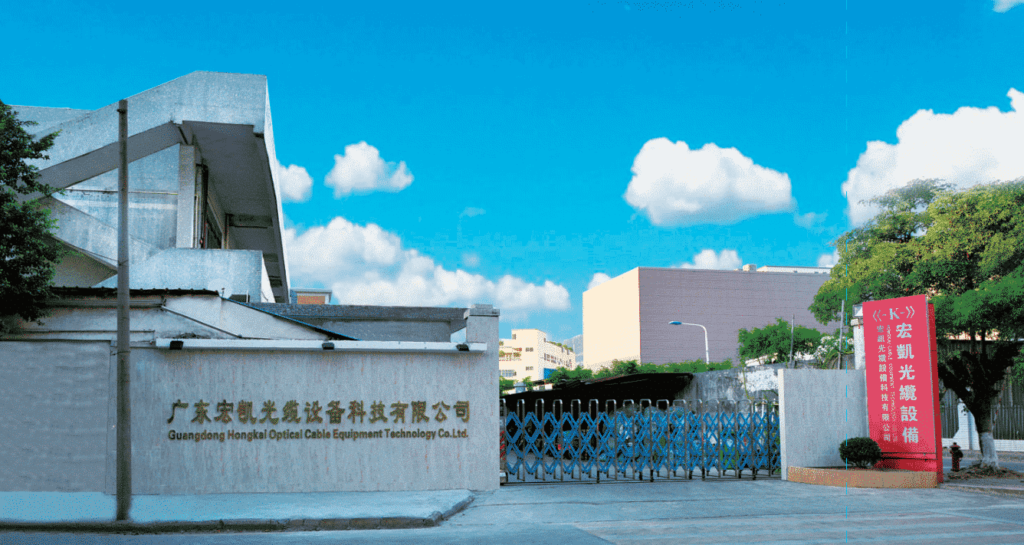
Guangdong Hongkai Optical Cable Equipment Technology Co., Ltd. began manufacturing wire and cable equipment in 2005 and was formally incorporated in 2015. Our main products cover the entire cable production process:
-
Fiber coloring machine / fiber optic coloring line: Coloring speed 3,000 m/min, pay-off tension accuracy ±0.05 N
-
Secondary coating line for optical fiber / loose tube line: Excess length control accuracy ±0.2‰, line speed 350 m/min
-
SZ stranding line: Pay-off tension fluctuation ≤ ±0.4 N, stranding pitch deviation ≤ ±0.08 mm
-
Fiber optic cable sheathing line: Concentricity ≥ 98.6%, wall thickness tolerance ≤ ±0.04 mm, screw 38CrMoAlA with nitriding treatment
-
FTTH optical cable manufacturing machine: Compatible with PVC and LSZH, capable of producing single-core and dual-core butterfly drop cables
-
Indoor optical fiber production line: Adapted to data center cables and indoor soft cables
Every machine comes with a factory test report – pay-off tension fluctuation, stranding pitch deviation, sheath concentricity – all listed. A PLC program backup on USB, bilingual operation manuals (Chinese/English), and a wear-parts kit are shipped with the equipment. Our equipment has been exported to more than 15 countries and regions, with over 160 sets currently running on production lines worldwide.
If you are procuring a fiber optic cable production line for a project, beyond the numbers on the quotation sheet, it’s worth calculating the five-year TCO. Feel free to contact the Hongkai technical team – check the configuration first, then discuss the solution.