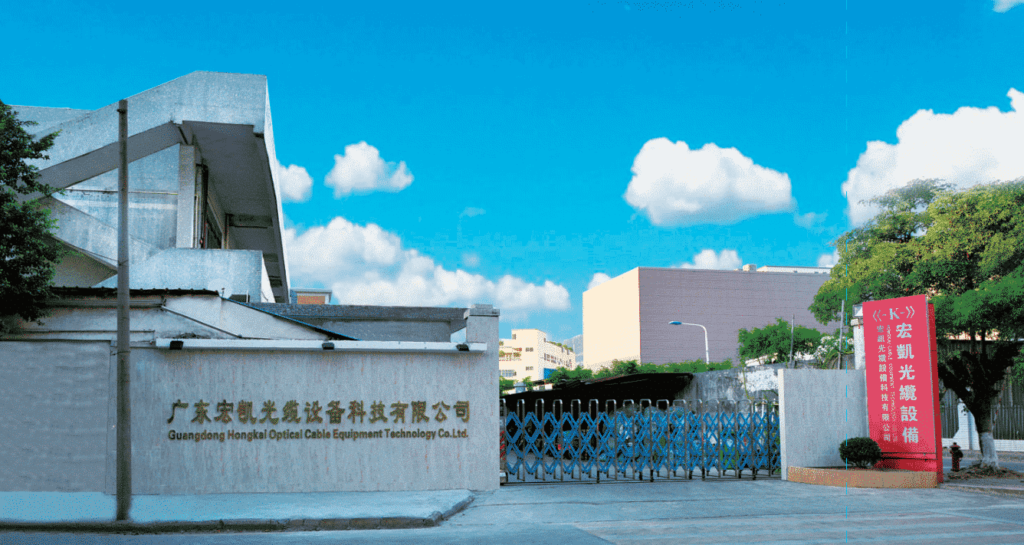
When purchasing an optical cable stranding line, buyers typically focus on obvious metrics such as production capacity, price, and delivery time. However, in actual production, some easily overlooked design details—from the friction coefficient of the dancer arm to the response speed of the broken yarn switch—can become “hidden killers” affecting yield and production efficiency. Based on service records from dozens of customer sites by Guangdong Hongkai Optical Cable Equipment Technology Co., Ltd., this article summarizes 5 common yet often neglected equipment details for reference by optical cable manufacturers during equipment selection.

Detail 1: Bearing and Low-Friction Design of the Dancer Arm
Problem phenomenon: Some equipment uses ordinary bearings or lacks low-friction treatment. After prolonged operation, the dancer arm becomes sluggish or does not return smoothly, causing delayed feedback of pay-off tension signals, with actual tension fluctuation exceeding ±1.2N.
Consequences: Tension lag causes the loose tube to be periodically stretched or relaxed during stranding, directly resulting in inconsistent stranding pitch and uneven fiber excess length distribution. Ultimately, the finished optical cable shows excessive additional attenuation during temperature cycle testing.
Hongkai design:
The dancer arm pivot uses low-friction cylinders + high-precision ball bearings, with friction coefficient ≤0.05
Arm angle is linked in real-time with the tension sensor; signal refresh cycle is 20ms
48-hour continuous swing fatigue test before delivery to ensure no sticking
Measured data: After 8 hours of continuous production, Hongkai SZ stranding line maintains pay-off tension fluctuation within ±0.4N (at 20 m/min line speed).
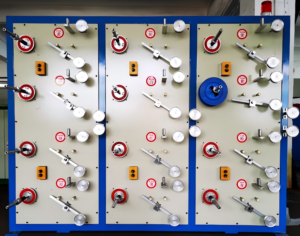
Detail 2: Installation Position and Sensitivity of the Broken Yarn Switch
Problem phenomenon: On some equipment, the broken yarn switch is installed after the yarn passes through a guide wheel, and the switch actuation travel is too large (≥3mm). When the yarn breaks, the switch only triggers after the yarn completely detaches from the guide wheel, causing a delay of 0.5–1 second.
Consequences: A 0.5-second delay means the equipment continues running for about 15–30 cm (at 20 m/min). This section of loose tube without yarn binding becomes scrap. If not detected in time, the missing yarn section will cause bulging or lifting during subsequent sheathing, scrapping the entire cable length.
Hongkai design:
The broken yarn switch is installed directly 1 cm before the yarn exit nozzle, using a light-touch microswitch (actuation travel ≤0.5mm)
Each yarn bobbin has an independent broken yarn sensor; the switch signal is directly connected to the PLC emergency stop circuit
Equipment stops within ≤0.1 second after yarn break; scrap length is controlled within 5 cm
Customer feedback: A Malaysian customer using another brand’s equipment experienced about 80 meters of scrap per shift due to broken yarn delay. After switching to Hongkai equipment, scrap from yarn breaks dropped to an average of 5–8 meters.
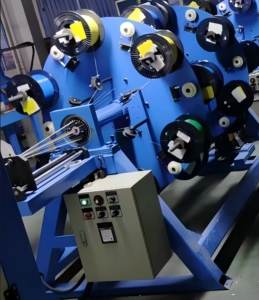
Detail 3: Ease of Homing and Centering Operation for the Stranding Basket
Problem phenomenon: Some SZ stranding baskets require a centering and homing operation before threading, but the home position must be set by modifying parameters via computer software, which is complicated and error-prone. Operators sometimes skip the homing step to save time and thread directly.
Consequences: An offset home position causes an incorrect starting angle for stranding. When the machine rotates forward and reverse according to the set pitch, the actual stranding trajectory deviates from the theoretical path, potentially damaging or breaking the loose tube.
Hongkai design:
An independent “SZ Home Set” button on the touchscreen allows one-touch setting of the current position as the starting home position at any angle
A mandatory prompt “Please confirm SZ centering” appears before threading; production cannot start without confirmation
The home position is displayed in real-time on the touchscreen for operator confirmation
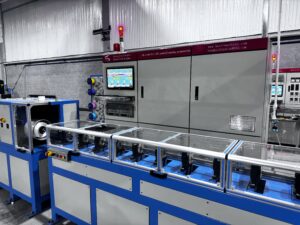
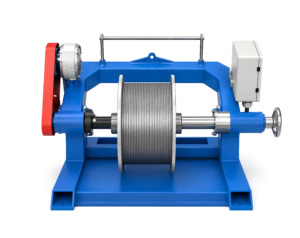
Detail 4: Convenience of Manual/Automatic Shifting for the Take-up Unit
Problem phenomenon: The take-up unit usually requires gear shifting depending on the reel size (PN500–PN1600). On some equipment, the shift mechanism is located at the back of the take-up unit and requires tools to remove the protective cover. Operators often stick with one gear for all reels to avoid the hassle, resulting in excessive torque for small reels and insufficient torque for large reels.
Consequences: Mismatched torque causes uneven winding and poor layering, with loose inner layers and tight outer layers. The cable may loosen or fall off the reel during delivery. In severe cases, the take-up shaft overloads and damages the gearbox.
Hongkai design:
The shift lever is placed on the front panel of the take-up unit, requiring no tools for manual shifting; gear positions are clearly marked (high speed / low speed)
The PLC automatically matches the torque curve based on the selected reel size, providing dual protection
A “Take-up Reel Size Selection” dropdown menu is available on the touchscreen; the system alarms if the operator selects the wrong size
Detail 5: Ease of Calibration and Accuracy Maintenance of the Length Counter
Problem phenomenon: Length measurement accuracy in optical cable production directly affects cost calculation and customer delivery. On some equipment, calibrating the length counter requires opening the control cabinet and connecting a computer to modify internal coefficients—a high-barrier operation. As a result, many factories never calibrate, leading to accumulated length errors (sometimes as high as 3–5%).
Consequences: Over-counting means the actual shipped quantity is less than the billed amount, causing financial loss. Under-counting leads to customer claims for shortages. In export trade, length measurement errors can even trigger customs inspections and commercial disputes.
Hongkai design:
Length counter coefficient calibration is done directly on the touchscreen parameter page, requiring no external tools
Procedure: Measure an actual finished cable length L2; the touchscreen displays the current measured length L1 and old coefficient F1. After entering L2, the system automatically calculates the new coefficient F2 = F1 × L2 / L1, then one-key save.
Dual length measurement wheels (main wheel + pinch wheel) prevent slippage; factory calibration accuracy error ≤0.2%
How Hongkai Equipment Systematically Avoids the 5 Detail Issues Above
| Detail Issue | Hongkai Solution | Measured Improvement |
| Dancer arm sticking causing tension fluctuation | Low-friction bearings + high-speed feedback (20ms) | Tension fluctuation ≤ ±0.4N |
| Broken yarn switch delay | Installed 1cm before yarn nozzle, actuation travel ≤0.5mm | Stop delay ≤0.1 sec, scrap ≤8 meters |
| Complicated centering/homing operation | One-key touchscreen homing + mandatory prompt | Operator training reduced to 4 hours |
| Inconvenient take-up shifting leading to torque mismatch | Front-mounted lever + PLC torque auto-matching | Zero gearbox damage in three years |
| High barrier to length counter calibration | Touchscreen calibration + dual anti-slip wheels | Error ≤0.15% |
About Guangdong Hongkai Optical Cable Equipment Technology Co., Ltd.
Guangdong Hongkai Optical Cable Equipment Technology Co., Ltd. was established in 2015 (with a predecessor dating back to 2005) and is located in Humen Town, Dongguan City, Guangdong Province. The company specializes in the R&D and manufacturing of SZ stranding lines, outdoor optical cable sheathing lines, FTTH drop cable production lines, and plastic tube production lines. Our equipment has been exported to more than 15 countries and regions, including the Middle East, Southeast Asia, South Asia, Africa, and Europe, with over 160 units delivered to date.
We provide free turnkey plant planning consultations and can offer remote or on-site equipment installation guidance and operator training. If you are planning to purchase optical cable stranding equipment, please contact Hongkai for detailed technical specifications and factory inspection standards.