Cables are going global – and so is cable equipment.
But equipment export is far more complex than it seems. Customers in the Middle East, Southeast Asia, and Africa buying equipment fear three things above all: miscommunication, failed installation, and poor after-sales support.
1. Miscommunication: Language Is Only the Surface Issue
A Middle Eastern customer sends an inquiry for an FTTH drop cable production line. Their English is good, but their product description is just one sentence: “We need a machine for drop cable.”
Anyone in the cable business knows that “drop cable” means different things in different markets. Europeans mean round drop cables; Southeast Asian customers may mean butterfly-shaped drop cables. Even under the name “FTTH drop cable,” the structure can be completely different – single-core, dual-core, with or without strength members, PVC or LSZH sheathing. If these details aren’t clarified, the equipment that arrives is a pile of scrap.
But this isn’t the customer’s fault. Many overseas customers don’t understand cable production in detail – they just know they need equipment, but can’t articulate exactly what they need. If the equipment supplier simply “quotes to order” without clarifying product specifications, process requirements, or target capacity, both parties end up losing.
A friend in equipment export once told me: “Overseas customers aren’t most afraid of expensive equipment – they’re afraid of equipment that doesn’t work after purchase. Half the reasons are equipment issues; the other half are things left unclear during communication.”
How to solve it? Before signing the contract, thoroughly understand what the customer wants to produce – cable type, fiber count, sheath material, daily capacity. The more specific the product requirements, the more accurate the equipment recommendation. If the customer themselves can’t articulate it clearly, ask for sample photos, technical specification sheets, or similar case studies.
2. Failed Installation: Equipment Arrives – No One to Install It
This is the most common and most underestimated problem for overseas customers.
An SZ stranding and cabling line weighs dozens of tons and contains hundreds of components. After the equipment arrives at port, these components need to be assembled, wired, routed, parameterized, and trial-run – every step requires skilled personnel. In the Middle East, Africa, and Southeast Asia, there aren’t many people familiar with cable equipment installation and commissioning.
In 2026, optical communications companies are experiencing growing pains – the reality of building factories overseas has become a key obstacle to industry differentiation. Thailand and Vietnam are current top choices for factory locations, but the local industrial worker base is weak, and line proficiency falls far short of China’s. If the equipment supplier only provides “bare machines” without sending personnel, the customer may spend two to three months figuring it out on their own.
During this period, labor costs, downtime losses, and trial production scrap can add up to more than the equipment itself.
A real case: a cable factory in Southeast Asia bought equipment, and the supplier shipped it and disappeared. The customer spent over two months trying to commission it themselves – and the cost of wasted materials and labor during that time exceeded the price of the equipment. In the end, they found another supplier who could send installation personnel, paid more, but finally got the line running.
How to solve it? Ask clearly whether the supplier provides on-site installation and commissioning services, and how long engineers stay. Hongkai’s approach: send engineers to the site – 12 to 18 days from unpacking to producing the first qualified reel. Before they leave, they train the operators, leaving behind bilingual manuals, electrical schematics, and a complete troubleshooting guide.
3. Poor After-Sales Support: Equipment Breaks – No One to Fix It
Equipment running 24/7 will eventually have issues. Overseas customers fear most not equipment failure – but failure with no one to fix it and no spare parts to replace.
If a critical component fails and no local replacement is available, the customer waits for the supplier to ship from China. DHL takes three to five days; sea freight takes twenty to twenty-five days. A week of downtime costs tens of thousands in lost output.
The laser industry confirms this pattern: after installation and daily operation, operational stability quickly becomes the top concern. Delayed spare parts shipments, unclear after-sales responsibilities, and limited troubleshooting support can quickly turn minor technical issues into extended downtime.
One cable factory had equipment failure – a local electrician spent three days trying to fix it. Eventually, they contacted the supplier for remote video support – and found the problem in half an hour: a loose sensor. The local electrician wasn’t incompetent – just unfamiliar with cable equipment.
How to solve it? Before signing the contract, ask: what wear parts are included? Can spare parts be shipped quickly? Is remote technical support available? Hongkai includes a wear-parts kit with every machine – belts, bearings, sensors, fuses – shipped with the equipment. For major parts, DHL delivery within three days. Remote video support is available with a two-hour response time during working hours.
One Table to Understand: What Overseas Customers Really Care About When Selecting Equipment
| Stage | What Customers Ask | What It Really Means |
|---|---|---|
| Before signing | Can this machine make what I need? | Is communication clear enough? |
| After arrival | Who installs it? How soon can it run? | Installation and commissioning capability |
| After production | What if it breaks? How fast can spares arrive? | After-sales support system |
Final Thoughts
Exporting cable equipment is not just about the equipment itself.
It’s about understanding what the customer didn’t say – about being able to install it so they can use it – about being able to solve problems quickly when they arise.
A high-precision stranding machine is just a pile of scrap metal in the customer’s eyes if no one can install it or fix it. Conversely, a moderately configured machine – properly installed, with responsive after-sales support – feels “reliable” to the customer.
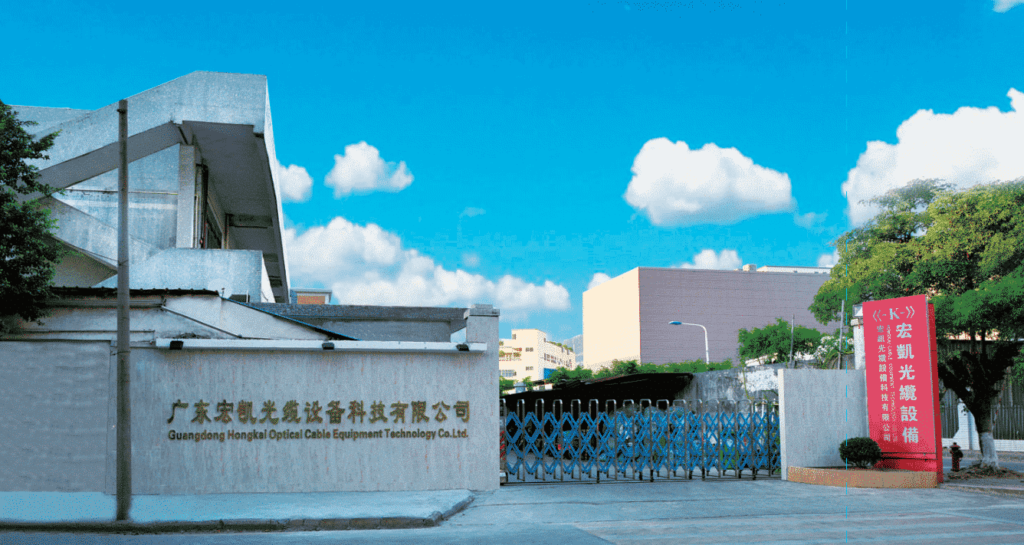
Guangdong Hongkai Optical Cable Equipment Technology Co., Ltd. began manufacturing wire and cable equipment in 2005 and was formally incorporated in 2015. Our main products include SZ stranding and cabling lines, fiber optic cable sheathing extrusion lines, and FTTH drop cable production lines.
Hongkai equipment has been exported to more than 15 countries and regions, with over 160 sets currently running on production lines worldwide. Addressing the real pain points of overseas customers, Hongkai delivers on three fronts:
-
Installation: Engineers on-site – 12 to 18 days from installation to trial production
-
Documentation: Bilingual operation manuals and electrical schematics shipped with every machine
-
Spare parts: Standard wear-parts kit shipped with equipment – DHL delivery within three days; remote video support with two-hour response during working hours
Every machine comes with a factory test report, a PLC program backup on USB, bilingual operation manuals (Chinese/English), and a wear-parts kit.
If you’re procuring cable equipment for an overseas project, or if your equipment has arrived and you’re not sure how to install it, feel free to contact the Hongkai technical team. First, tell us what products you want to make and where your factory is – then we’ll help you work out a solution.