This year, China’s optical cable industry is experiencing an unprecedented wave of global expansion. According to China’s customs statistics, exports of optical fiber and cable products increased significantly in early 2026, reflecting strong overseas demand for optical communication infrastructure. Many Chinese manufacturers have reported strong overseas order growth and increasing long-term investment from international customers. In its research report, Guosheng Securities pointed out that one of the key drivers of this market cycle is the growing role of overseas demand, and Chinese optical fiber and cable manufacturers are beginning to expand globally in a systematic way.
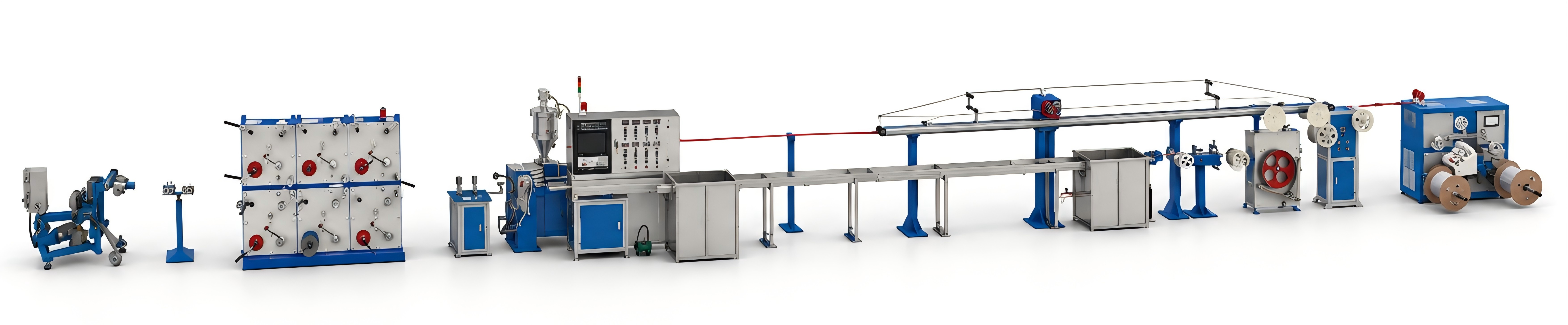
Optical cables are going global – but what about optical cable equipment?
Every new overseas optical cable plant represents procurement demand for equipment such as SZ stranding lines and cable sheathing lines. However, exporting optical cable equipment is fundamentally different from exporting ordinary goods – it is not a transaction that ends with “packing and shipping.” When overseas customers purchase optical cable equipment, they evaluate far more than just the product itself.
1.Four “Hidden Questions” in Overseas Optical Cable Equipment Procurement
In the past, the decision-making logic for cable equipment buyers was relatively simple: sufficient capacity, low price, fast delivery. But in overseas markets, this logic is far from sufficient. Based on the delivery experience of Chinese optical cable equipment suppliers in overseas markets.overseas customers are now evaluating suppliers across the following four dimensions:
Question 1: After the equipment arrives at port, how soon can production start?
Arrival at port is only the beginning. Installation, wiring, commissioning, and trial production – each step takes time. For overseas customers, there is often a shortage of local technical personnel familiar with the installation and commissioning of optical cable equipment. If the equipment supplier only provides “bare machines,” the customer may spend several weeks completing installation and commissioning. to figure out installation and commissioning on their own.
One customer from the Middle East commented during project delivery: “A one-month delay in production could cost more in lost order profits than 10% of the equipment price itself.” Whether an optical cable equipment supplier has overseas on-site installation capabilities, can dispatch engineers to the site, and provides bilingual technical documentation – these are becoming the “first threshold” for overseas customers in supplier selection.
Question 2: If the equipment breaks down, how soon can it be repaired?
Overseas cable plants face a harsh reality: long lead times for spare parts (DHL from China takes 3-5 days, sea freight 20-25 days), scarcity of local maintenance technicians, and high operator turnover. If a critical component fails, the production line may be down for days or even weeks.
In a period of rising cable prices and full order books, any unplanned downtime means significant financial loss. Does the equipment supplier provide a standard wear-parts kit? Can spare parts be shipped quickly? Is remote video diagnostics supported? These capabilities determine whether a breakdown stops the line for significantly reducing production downtime.
Question 3: Can equipment integrate with MES or factory management systems?
A growing number of overseas customers are asking a new question: “Can equipment data be uploaded to our management system?” This is not a nice-to-have – it is a requirement for supply chain transparency. Can the equipment automatically record process parameters (pay-off tension, stranding pitch, sheath concentricity) for each batch? Can it interface with an MES system? Can it support remote diagnostics?
Analysts point out that for Chinese optical fiber and cable companies to truly enter the overseas data center supply chain, they must strengthen overseas certifications, local services, customer qualification, quality traceability, and compliant delivery capabilities. The data capability of equipment is precisely the technical foundation for “quality traceability” and “compliant delivery.”
Question 4: Can changeover speed keep up with multi-variety orders?
Current optical cable orders feature a “multi-variety, small-batch” pattern – layer-stranded cables, butterfly drop cables, high-fiber-count ribbon cables – with multiple specifications to be switched daily. If lengthy product changeovers can significantly reduce production efficiency. the line’s effective annual output drops significantly. Whether equipment has recipe storage and one-click recall is becoming a core metric for overseas customers evaluating line flexibility.
2.The “Capability Checklist” for Optical Cable Equipment Exports
Behind the four questions above lies a complete set of capabilities that overseas customers expect from optical cable equipment suppliers. This checklist can be summarized in five dimensions:
| Capability | Key Considerations |
| Delivery | How long from contract to shipment? Is there standardized production and buffer stock of key components? Overseas customers have high time costs – a one-month delay could mean missing the order window. |
| Installation | After arrival, does the supplier provide on-site installation guidance or dispatch engineers? Are bilingual operation manuals and electrical schematics provided? The on-site commissioning cycle directly determines production start-up time. |
| Service | Can the supplier respond quickly to faults? Is remote video diagnostics supported? Can spare parts be delivered within 3-5 working days? These determine unplanned downtime duration. |
| Compliance | Does the equipment meet destination country certification requirements? Is the electrical system adapted to local voltage? Are CE and other technical documents provided? These determine whether equipment clears customs and passes acceptance smoothly. |
| Data | Can equipment automatically record production data? Can it interface with MES? Does it support remote diagnostics? These capabilities are moving from “nice-to-have” to “must-have.” |
3. Hongkai Optical Cable Equipment: Serving Global Customers with Five Core Capabilities
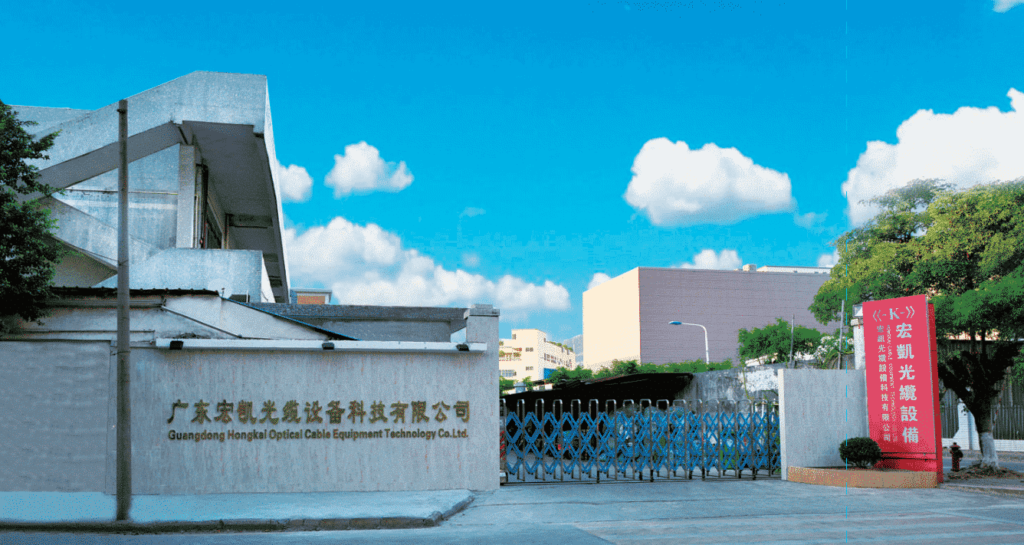
Guangdong Hongkai Optical Cable Equipment Technology Co., Ltd., established in 2015 (with origins dating back to 2005), specializes in optical cable manufacturing equipment – SZ stranding lines, outdoor cable sheathing lines, butterfly drop cable lines, and plastic tube production lines. The equipment has been exported to more than 15 countries and regions across the Middle East, Southeast Asia, South Asia, Africa, and Europe, with cumulative deliveries exceeding 160 sets.
Addressing the four “hidden questions” of overseas customers, Hongkai provides systematic support across the following five dimensions:
Delivery Capability: Complete line shipment in 45-60 days
Key components (differential gearboxes, dancers, pay-off stands, etc.) are designed with standardization and batch pre-fabrication; Siemens/Mitsubishi frequency converters and PLCs are kept in stock. The entire line is shipped within a standard cycle of 45-60 days from contract signing, with no less than 2 hours of no-load and load testing performed in-house. Each shipment includes a Factory Inspection Report with measured data on tension fluctuation, pitch deviation, concentricity, and more.
Installation Capability: 12-18 days overseas on-site handover
Hongkai provides bilingual operation manuals, electrical schematics, and CE technical documentation; remote video support (response within 2 working hours); and on-site engineer dispatch for installation and commissioning (12-18 days from arrival to trial production). One overseas customer reported that after the Hongkai engineer arrived on site, “from equipment unpacking to producing the first qualified cable reel took only two weeks.”
Service Capability: Remote diagnostics + rapid spare parts
A standard wear-parts kit is shipped with the equipment; spare parts are delivered by DHL express in 3-5 working days; a remote access module (subject to customer authorization) is optional, allowing engineers to remotely monitor equipment status and diagnose alarm causes. In 2024, Hongkai completed 89 overseas remote video support sessions, with an average resolution time of 32 minutes per session.
Compliance Capability: Adapting to multiple market access requirements
The electrical safety design complies with EN 60204-1, with standard protective covers, emergency stop circuits, and safety relays. CE technical documentation can be provided and certification processes supported upon request. Major electrical components use Siemens/Mitsubishi PLC, Siemens/Schneider low-voltage devices, ABB/Inovance frequency converters – with global warranties and local availability.
Data Capability: Intelligent interface pre-provisioned
Hongkai equipment comes standard with Siemens/Mitsubishi PLC platforms, supporting recipe storage (≥20 groups), automatic production data logging (CSV export), and OPC UA/SQL interfaces for MES integration. Equipment precision guarantees:
Pay-off tension fluctuation ≤ ±0.4 N (at 20 m/min line speed)
Stranding pitch deviation ≤ ±0.08 mm
Average sheath concentricity over 8 hours continuous production: 98%
Wall thickness tolerance ≤0.04 mm (nominal 1.8 mm)
Changeover time ≤1.5 hours (one-click recipe recall)
4.Final Thoughts
The global optical cable industry is undergoing a structural transformation driven by AI. Optical fiber and cable are evolving from traditional telecom transmission media to key components supporting AI computing networks. In this context, cable manufacturing capacity is shifting from “concentrated in China” to “distributed globally.”
For optical cable equipment manufacturers, this transformation brings not only growth in export orders but also a shift from “equipment supplier” to “production-line solution service provider.” Equipment precision is the foundation – but delivery speed, installation efficiency, after-sales service, compliance, and data capability have become the complete yardstick by which overseas customers measure suppliers.
Guangdong Hongkai Optical Cable Equipment Technology Co., Ltd. can provide, upon customer request, factory inspection reports for optical cable equipment, overseas delivery case references, and full-plant planning proposals. For detailed equipment specifications or to evaluate equipment solutions for overseas plant construction, please feel free to contact the Hongkai technical team.