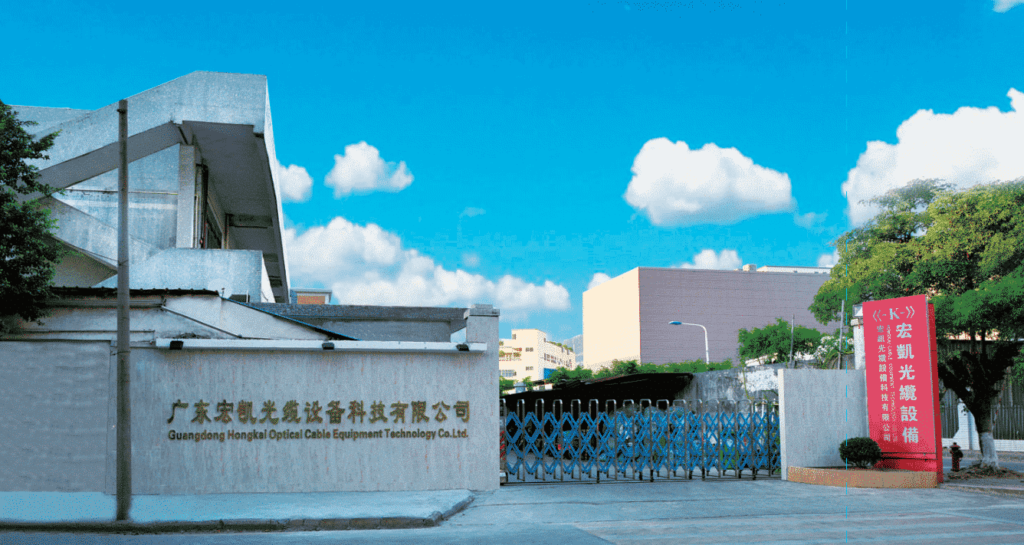
Building an optical cable production line is not simply stacking equipment. Behind the process—from factory layout design, equipment manufacturing, joint commissioning, to finally producing the first qualified coil of optical cable at the customer’s overseas site—lies a complete manufacturing and delivery system. This article takes the actual delivery process of Guangdong Hongkai Optical Cable Equipment Technology Co., Ltd. as a blueprint to break down the entire journey of an optical cable production line from contract signing to mass production, helping buyers understand the essential difference between an “equipment manufacturer” and a “complete line solution provider.”
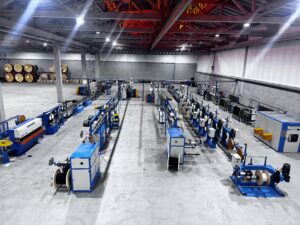
1. Requirements Phase: From Capacity Goals to Line Configuration
1.1 Define Three Core Parameters (illustrated with our Vietnam case example)
Before starting any design work, the Hongkai technical team works with the customer to determine the following three sets of data:
| Parameter Category | Specific Content | Example |
|---|---|---|
| Target capacity | Annual production (km/year) or monthly output | 1,500 km/month |
| Product type | Main cable specifications to be produced | Stranded outdoor optical cable |
| Export market | Destination country and certification requirements | Southeast Asia (no mandatory certification) |
1.2 Deliver the “Whole-Plant Planning Proposal”
Based on the above parameters, Hongkai provides:
-
Equipment list (including model, quantity, unit price)
-
Factory layout drawing (equipment footprint, material flow)
-
Utility requirements (compressed air, cooling water, power capacity)
-
Staffing recommendations (operators per shift)
-
Payback period calculation
Actual case: In 2024, a Vietnamese optical cable company planned to expand production with a target monthly capacity of 3,000 km. Within 7 working days of receiving the customer’s factory drawing, Hongkai submitted a planning proposal: 1 SZ stranding line + 1 sheathing line, total footprint 2,000 m², 6 operators per shift.
2. Manufacturing Phase: Equipment Production Cycle and Quality Control
2.1 Standard Manufacturing Lead Time (based on the Vietnam order)
| Equipment | Manufacturing Lead Time (working days) | Key Processes |
|---|---|---|
| SZ stranding and cabling machine | 70 | Frame welding → assembly → pay-off rack assembly → electrical wiring |
| Sheathing production line | 70 | Extruder assembly → cooling trough → capstan → take-up |
| Plastic tube production line | 70 | Extruder screw and barrel assembly → Calibration tank → Inkjet printer → Haul-off and cutting → Winding or stacking |
| Auxiliary equipment (dancer, taping machine, etc.) | 70 | Sheet metal fabrication → assembly → testing |
Complete line delivery lead time: From contract effective to factory shipment, standard is 70 days (including in-plant no-load test run).
2.2 Quality Control Checkpoints
Hongkai sets 5 mandatory inspection points during manufacturing:
-
Incoming raw material inspection: Steel grade, motor brand (Siemens), bearing model (SKF/NSK)
-
Engineering drawing issuance
-
Welding and machining inspection: Acceptance according to engineering drawings
-
Assembly: Acceptance of component brands, models, and parameters according to customer specifications
-
Electrical wiring: 2-hour continuous no-load and loaded run
-
Full line interlocking test: Production using customer-provided sample (or simulated cable core)
-
Pre-shipment parameter recording: Each machine comes with a Factory Acceptance Test Report
3. Overseas Delivery: Full-Process Service from Packing to Trial Production
3.1 Packaging and Shipping (illustrated with Vietnam case example)
Hongkai uses standard export packaging for equipment:
-
Electrical cabinets: Inner moisture-proof film + heat-treated wooden frames
-
Mechanical parts: Stretch film wrapping + steel strap reinforcement; large items have wooden pallets at the bottom
-
Shipping method: Sea freight (4 × 40-ft high cube containers), shipped from Shekou Port (Shenzhen). Destination ports cover major routes in the Middle East, Southeast Asia, Africa, etc.
3.2 On-Site Installation and Commissioning
Hongkai offers two service modes:
| Mode | Description | Applicable Scenario |
|---|---|---|
| Remote guidance | Chinese/English installation manual + video guidance + real-time support via WeChat/WhatsApp | Customer has basic mechanical/electrical skills and wants to save cost |
| Engineer on site | Dispatch 1–2 engineers to complete installation, commissioning, and training | First cooperation or customer has no technical team |
On-site commissioning timeline:
-
Mechanical installation: 15 days
-
Electrical wiring and testing: 5 days
-
Full line interlocking and trial run: 4 days
-
Operator training: 3 days
-
Total: 30 days (from engineer arrival to departure)
3.3 Trial Production Acceptance Criteria (illustrated with Vietnam case example)
During trial production, Hongkai engineers jointly complete acceptance with the customer:
-
Continuous run for 4 hours, producing ≥1,000 m of optical cable
-
Cable data meets specifications
-
Operator independently performs one product changeover (GYTA 48 fibers)
-
Upon passing acceptance, both parties sign the Equipment Acceptance Certificate.
4. Typical Project Timeline (Example: Vietnam export project in 2024)
| Phase | Date | Notes |
|---|---|---|
| Contract signed | 2024‑02‑10 | — |
| Manufacturing completed | 2024‑04‑21 | 70 days |
| Shipped (Shekou Port, Shenzhen) | 2024‑04‑26 | — |
| Arrived at port (Ho Chi Minh Port) | 2024‑05‑12 | 20 days sea freight |
| Engineer arrived on site | 2024‑05‑20 | Visa arranged by customer |
| Installation & commissioning completed | 2024‑06‑20 | 30 days on-site work |
| Trial production accepted | 2024‑07‑23 | Passed on first attempt |
Contract to acceptance: 163 days.
5. Why Choose a Complete Line Manufacturer Instead of Piecemeal Sourcing?
| Comparison Item | Piecemeal Sourcing (multiple suppliers) | Hongkai Complete Line Delivery |
|---|---|---|
| Communication protocol | May be inconsistent, difficult integration | Unified PLC platform, plug‑and‑play |
| After‑sales responsibility | Each party shifts blame, hard to locate issues | Single point of contact, Hongkai takes full responsibility |
| Spare parts inventory | Need to stock multiple brands | Unified model numbers, lower inventory cost |
| Commissioning cycle | 2–3 months | 3–4 weeks |
| Operator training | Multiple sessions with different trainers, overlapping content | One‑stop training covering the whole line |
| Expansion and upgrade | Need to re‑coordinate with each supplier | Hongkai modular expansion without altering original structure |
6. How to Get a Customized Production Line Proposal?
Guangdong Hongkai Optical Cable Equipment Technology Co., Ltd. provides free preliminary technical consultation. If you are planning to build a new optical cable production line or expand an existing one, please provide the following information, and we will issue a preliminary proposal within 5 working days:
1.Target product types and fiber count range
2.Expected monthly capacity (km/month)
3.Available factory area (length × width)
4.Export destination (related to certification and voltage system)