When overseas customers select a fiber optic cable production line, they often ask “what’s the precision?” and “what’s the capacity?” But behind precision and capacity lies a more fundamental core function: the drive system.
The same SZ stranding line – driven by an ordinary variable-frequency motor versus a servo motor – can produce pitch stability that differs by an order of magnitude. The same fiber optic cable sheathing line – with variable-frequency or servo capstan drive – will have different long-term concentricity stability.
The drive method is the “ceiling” of equipment precision. Today, from the perspective of core equipment functions, let’s discuss Hongkai’s design logic for drive systems as a Premier Cable Machine Manufacturer.
1. Drive Method Determines the Precision Ceiling
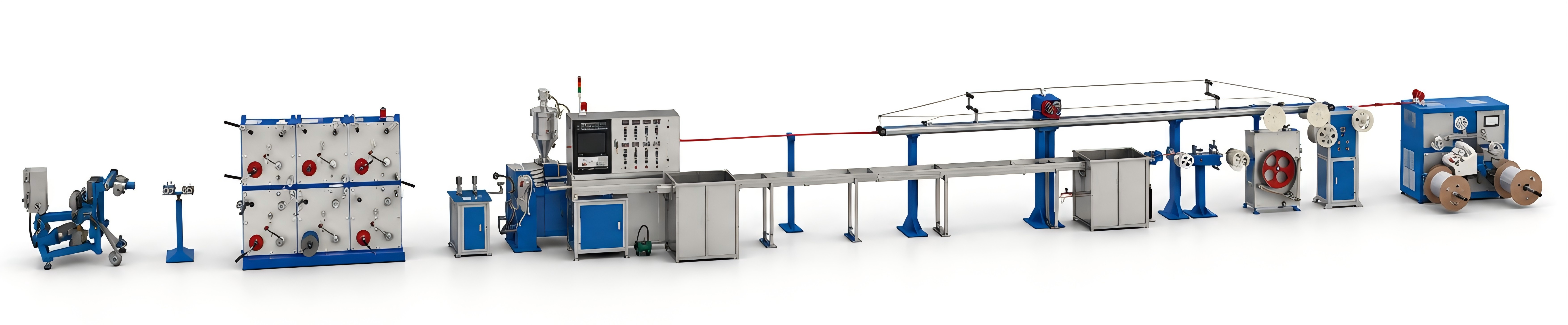
Drives on cable equipment fall into two main categories: variable-frequency drive and servo drive.
Variable-frequency drive: Motor with or without encoder; the inverter adjusts frequency to change speed. Low cost, simple structure – suitable for fans, pumps, ordinary conveyors, and other applications with low speed-precision requirements.
Servo drive: Servo motor with built-in encoder; the drive provides closed-loop control of position, speed, and torque. Fast response, high precision, high low-speed torque – suitable for tension control, synchronization control, and frequent changeover applications.
In the entire fiber optic cable making machine series, where must servo be used? Where is variable-frequency sufficient? This determines the equipment’s precision ceiling and cost structure.
2. Tension Control: Why Must Servo Be Used?
Pay-off tension control on the SZ stranding line is the first checkpoint for stranding precision.
During tube pay-off, the pay-off reel’s outer diameter constantly changes from full to empty. To maintain constant tension, the pay-off motor speed must adjust in real time with the reel diameter. Variable-frequency motors respond slowly, causing large tension fluctuation; servo motors respond fast, completing adjustment within 20 milliseconds.
Hongkai’s SZ stranding line uses independent servo motors for active pay-off + real-time closed-loop tension sensor control – pay-off tension fluctuation ≤ ±0.4 N, stranding pitch deviation ≤ ±0.08 mm. Each pay-off reel is independently servo-driven; with 24 tubes stranding simultaneously, the tension of every tube is independently controlled.
The fiber coloring machine achieves pay-off tension accuracy of ±0.05 N, also relying on servo drive. The capstan and take-up of the secondary coating line for optical fiber and loose tube line also use servo to ensure excess length control accuracy of ±0.2‰.
3. Synchronization Control: Why Must Servo Be Used?
The stranding speed and capstan speed of the SZ stranding line must be strictly synchronized – one revolution of stranding corresponds to one pitch of forward travel. Without synchronization, pitch fluctuates.
Hongkai’s SZ stranding line uses servo drives for both the stranding motor and the capstan motor. The PLC “locks” the speed ratio of the two motors together via the electronic gear function. After setting the pitch, the electronic gear ratio is automatically calculated, and the two motors run synchronously in proportion. Pitch deviation ≤ ±0.08 mm.
The extruder screw speed and capstan speed of the fiber optic cable sheathing line are likewise synchronized with servo. When the laser diameter gauge detects an outer diameter deviation, the PLC adjusts the extruder servo motor speed in real time – sheath outer diameter fluctuation is controlled within ±0.03 mm, with concentricity ≥ 98.6%.
With variable-frequency drive, response is slow and synchronization precision is low – neither pitch nor concentricity can be held stable.
4. Changeover Response: Why Is Servo Faster?
During changeover on an optical fiber cable production line, the speeds of all units must switch synchronously. Servo motors respond quickly, adjusting to the new speed immediately upon receiving PLC commands; variable-frequency motors respond slowly, requiring time to accelerate and decelerate.
Hongkai equipment features one-touch recipe loading. The servo motors of the fiber coloring machine, fiber optic coloring line, secondary coating line for optical fiber, loose tube line, SZ stranding line, fiber optic cable sheathing line, FTTH optical cable manufacturing machine, and indoor optical fiber production line respond synchronously – changeover completed within 1.5 hours.
With variable-frequency drive, unit speeds switch asynchronously during changeover – upstream fast, downstream slow – tension fluctuates and scrap occurs.
5. Where Is Variable-Frequency Sufficient?
Not everything requires servo. On a fiber optic cable production line, variable-frequency drive is sufficient for the following:
-
Cooling water circulation pumps: Speed doesn’t need frequent adjustment; variable-frequency constant-pressure water supply is sufficient.
-
Electrical cabinet cooling fans: Fixed speed or simple speed control – variable-frequency is enough.
-
Some auxiliary conveyors: Speed precision requirements are not high; variable-frequency is sufficient.
-
Take-up traverse auxiliary motors: Reciprocating traverse motion – variable-frequency + proximity switch control is sufficient.
Hongkai equipment is configured on the principle of “servo where servo is needed, variable-frequency where variable-frequency is sufficient” – ensuring precision while controlling cost. The drive configurations across the entire fiber optic cable making machine series are designed according to this principle.
6. The Practical Value of the Drive System for Overseas Factories
Value 1: Precision holds. Servo-driven tension closed-loop and synchronization control keep pitch and concentricity stable long-term. SZ stranding line pay-off tension fluctuation ≤ ±0.4 N, fiber optic cable sheathing line concentricity ≥ 98.6%.
Value 2: Fast changeover. Servo responds quickly, with synchronous switching across all units – changeover within 1.5 hours.
Value 3: High-value-added orders can be taken. G.657.A2 requires concentricity ≥ 98%, and high-fiber-count cables require pitch deviation ≤ ±0.1 mm – only servo drive can hold these stable.
Value 4: Reasonable energy consumption. Servo motors output torque on demand, doing no wasted work; variable-frequency drives for fans and pumps run energy-efficiently. Full-line energy consumption on the optical fiber cable production line is controllable.
7. What Should Overseas Buyers Ask When Selecting Equipment?
Question 1: Is the stranding machine’s pay-off servo or variable-frequency? Servo drive is what keeps tension stable.
Question 2: Are stranding and capstan servo-synchronized? Servo synchronization is what keeps pitch accurate.
Question 3: Are the sheathing line’s extrusion and capstan servo-synchronized? Servo synchronization is what keeps concentricity stable.
Question 4: Can unit speeds switch synchronously during changeover? Fast servo response is what makes changeover fast.
Question 5: Where is variable-frequency used? Variable-frequency for auxiliary equipment keeps costs reasonable.
📩 Get a Drive System Configuration List
If you are procuring a fiber optic cable production line for an overseas project, or want to learn about Hongkai equipment’s configuration logic and measured data for servo and variable-frequency drives, feel free to contact the Hongkai technical team.
Just tell us three things:
-
What type of cable do you want to make? (Loose-tube / FTTH / indoor cable)
-
Where will the factory be built? (This affects voltage system and certification requirements)
-
Approximately what capacity? (How many kilometers per month or per year)
We will provide a preliminary equipment configuration proposal, drive system configuration list, and quotation within 5 working days.
📧 Email: sales2@hkofcmachine.com
🌐 Website: https://hkofcmachine.com/