Cable factories are eager to expand capacity and build new production lines, but different products have very different equipment requirements. A fiber optic cable production line is not a one-size-fits-all configuration – making outdoor loose-tube cables and FTTH butterfly drop cables requires completely different equipment.
This article breaks down the equipment configurations for different cable products, helping cable manufacturers plan their fiber optic cable making machine procurement based on their product positioning.
1. Outdoor Loose-Tube Cable: The Most Classic Configuration
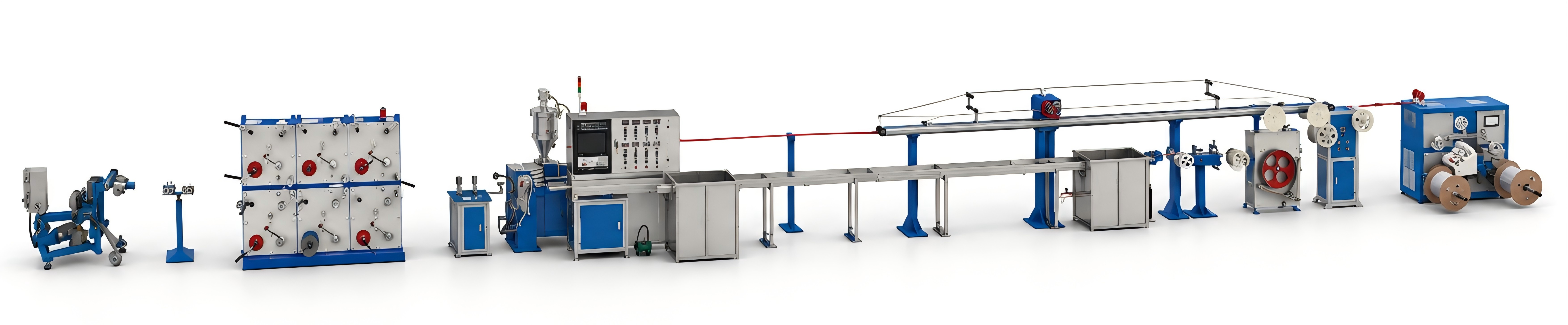
Outdoor loose-tube cable is currently the most widely used cable type, extensively applied in telecom backbone networks, metropolitan area networks, and access networks. A complete outdoor cable production line typically includes the following core equipment:
1. Fiber Coloring Machine / Fiber Optic Coloring Line
Fiber coloring is the first process in cable production. Transparent fiber is coated with one of 12 standard colors to distinguish different fiber counts during stranding. The core indicators of a fiber optic coloring line are coloring speed and tension control accuracy. Industry mainstream speed is 1,500–3,000 m/min, with pay-off tension accuracy of ±0.05 N. Hongkai’s high-speed fiber coloring machine achieves coloring speed of 3,000 m/min and pay-off tension accuracy of ±0.05 N.
2. Secondary Coating Line for Optical Fiber / Loose Tube Line
Colored fiber needs to be made into loose tubes for initial protection. This process uses a secondary coating line for optical fiber, also known as a loose tube line. The core indicator is excess length control accuracy – industry standard ±0.2‰. Hongkai’s secondary coating line achieves excess length control accuracy of ±0.2‰, line speed of 350 m/min, and is compatible with PBT, PP, PE, nylon, and other materials.
3. SZ Stranding Line
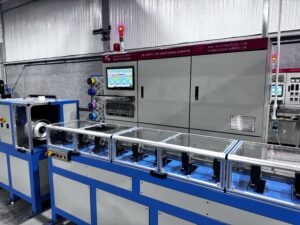
After the loose tubes are made, they are stranded together with strength members to form the cable core. The SZ stranding line is the core equipment of an outdoor cable production line. Core indicators: pay-off tension fluctuation ≤ ±0.5 N, stranding pitch deviation ≤ ±0.1 mm. Hongkai’s SZ stranding machine measures pay-off tension fluctuation ≤ ±0.4 N and pitch deviation ≤ ±0.08 mm, supporting simultaneous stranding of up to 12 tubes.
4. Fiber Optic Cable Sheathing Line
The final process is sheath extrusion. The core indicators of a fiber optic cable sheathing line are concentricity and wall thickness tolerance. Industry standards: concentricity ≥ 98%, wall thickness tolerance ≤ 0.05 mm. Hongkai’s sheathing line measures concentricity ≥ 98.6% and wall thickness tolerance ≤ 0.04 mm, compatible with PE, PVC, LSZH, and other materials.
2. FTTH Butterfly Drop Cable: Dedicated Production Line – The Die Is Key
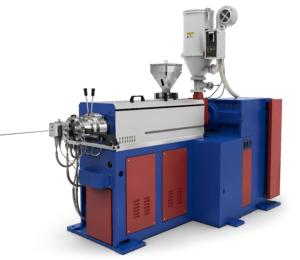
The butterfly-shaped drop cable used for FTTH (fiber-to-the-home) has a completely different structure from outdoor cables – a flat butterfly cross-section with fibers in the center and strength members on both sides. Producing this cable requires an FTTH optical cable manufacturing machine, not a conventional stranding machine + sheathing line combination.
The core of an FTTH optical cable manufacturing machine is the extrusion die. The die must extrude the sheath into a flat butterfly shape with high dimensional accuracy. Key selection points:
-
Fiber count capacity: Single-core and dual-core are the most common; can it handle multi-core?
-
Extrusion speed: Higher speed means higher capacity
-
Die precision: Is the butterfly cross-section dimension stable?
-
Strength member pay-off: Can steel wire and FRP be paid off simultaneously?
-
Automation level: Automatic reel change? Can it connect to MES?
Hongkai provides complete FTTH optical cable manufacturing machine solutions, compatible with PVC and LSZH extrusion materials, capable of producing single-core, dual-core butterfly drop cables and round drop cables.
3. Indoor Cable: Softer, Thinner – Different Equipment Requirements
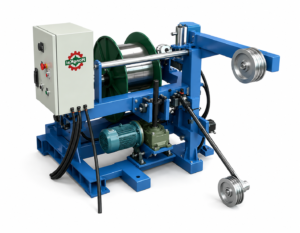
Indoor cable differs from outdoor cable – softer, thinner, and lighter. Producing indoor cable requires an indoor optical fiber production line.
Indoor cables typically use a tight-buffered fiber structure. Key selection points for an indoor optical fiber production line:
-
Tight-buffered fiber production line: Processes bare fiber into tight-buffered fiber, with finished diameter of Φ0.6 mm or Φ0.9 mm
-
Soft cable production line: Produces indoor soft cables, with PVC and LSZH as the main sheath materials
-
Pay-off tension: Bare fiber is fragile; pay-off tension is generally controlled at 0.3–2.0 N, with deviation ±0.05 N
-
Extruder precision: The tight buffer layer is only 0.15–0.3 mm thick; insufficient extruder precision results in uneven tight-buffered fiber diameter
Hongkai provides indoor optical fiber production line solutions, adapted to the production needs of data center cables and indoor soft cables.
4. A Complete Cable Production Line: How Is the Equipment Connected?
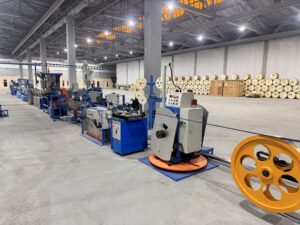
Regardless of cable type, the basic logic of an optical fiber cable production line is consistent: fiber → coloring → secondary coating → stranding → sheathing → finished product.
Equipment configuration differences by product type:
| Product Type | Core Equipment | Key Indicators |
|---|---|---|
| Outdoor loose-tube cable | Coloring machine + secondary coating + stranding machine + sheathing line | Tension ≤ ±0.4 N, pitch ≤ ±0.08 mm, concentricity ≥ 98.6% |
| FTTH butterfly drop cable | FTTH optical cable manufacturing machine (dedicated die) | Stable butterfly cross-section dimensions, high extrusion speed |
| Indoor cable | Indoor optical fiber production line (tight buffer + soft cable) | Pay-off tension ±0.05 N, uniform tight buffer thickness |
For fiber optic cable making machine selection, the first step is to clarify your product positioning. For outdoor cables, the stranding machine and sheathing line are the core. For FTTH cables, the die is key. For indoor cables, the tight-buffered production line and soft cable production line are the focus.
5. Selecting Equipment: Watch These Three Data Points
First: Precision data. Request the factory test report from the manufacturer. Every Hongkai machine comes with a factory test report – pay-off tension fluctuation, stranding pitch deviation, sheath concentricity – all listed.
Second: Changeover efficiency. Does the equipment have recipe storage? Can changeover be done with one-touch loading? Hongkai equipment can store process parameters for up to 20 different products – changeover completed in 1.5 hours.
Third: Data capability. Can the equipment connect to MES? Can it automatically record process parameters? Hongkai equipment comes standard with Siemens/Mitsubishi PLC platforms, supporting data acquisition and MES integration.
6. About Hongkai
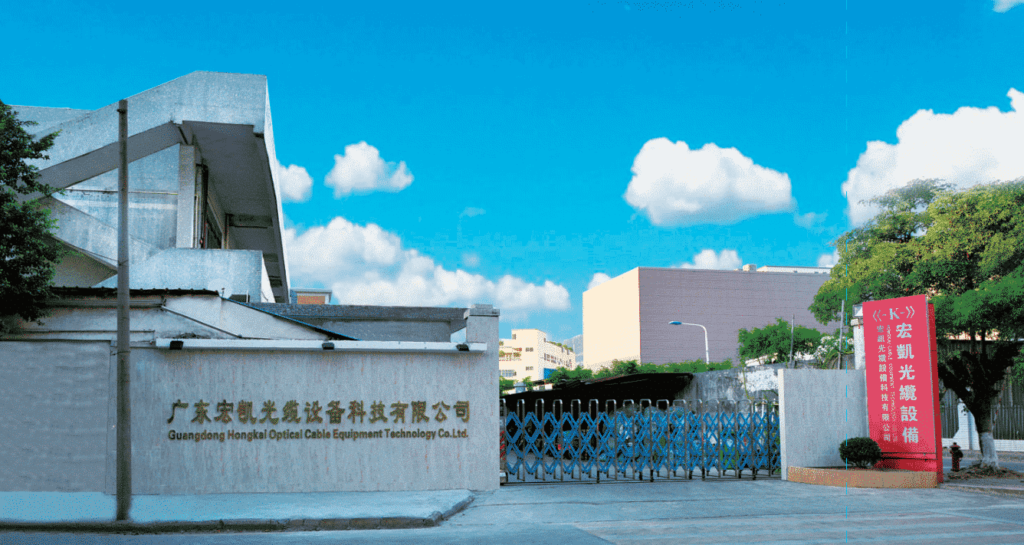
Guangdong Hongkai Optical Cable Equipment Technology Co., Ltd. began manufacturing wire and cable equipment in 2005 and was formally incorporated in 2015. Our main products cover the entire cable production process:
-
Fiber coloring machine / fiber optic coloring line: Coloring speed 3,000 m/min, pay-off tension accuracy ±0.05 N
-
Secondary coating line for optical fiber / loose tube line: Excess length control accuracy ±0.2‰, line speed 350 m/min
-
SZ stranding line: Pay-off tension fluctuation ≤ ±0.4 N, stranding pitch deviation ≤ ±0.08 mm
-
Fiber optic cable sheathing line: Concentricity ≥ 98.6%, wall thickness tolerance ≤ 0.04 mm
-
FTTH optical cable manufacturing machine: Compatible with PVC and LSZH, capable of producing single-core, dual-core butterfly drop cables
-
Indoor optical fiber production line: Adapted to data center cables and indoor soft cables
Every machine comes with a factory test report, a PLC program backup on USB, bilingual operation manuals (Chinese/English), and a wear-parts kit. Our equipment has been exported to more than 15 countries and regions, with over 160 sets currently running on production lines worldwide.
If you are planning to build or expand a fiber optic cable production line, or need to procure a fiber optic cable making machine, feel free to contact the Hongkai technical team. First, tell us what products you want to make and your approximate capacity target – then we’ll help you work out a solution.