When cable equipment has been in service for a while, it may suddenly start shaking. When that happens, do you panic?
A little more vibration or noise from a stranding machine, and operators might think, “It’s normal – old equipment is like this.” But vibration isn’t just “noise” – it’s an early warning signal from the equipment.
Vibration in a stranding machine can stem from five different problems. Guess wrong, and you can replace parts without fixing anything. Guess right, and tightening a single loose set screw solves the problem.
1. Mechanical Imbalance: An Invisible 0.3 mm Becomes Violent Vibration at 2,500 RPM
Imbalance in the rotating system is the most common cause of stranding machine vibration.
The stranding head, bows, and rotor of a stranding machine – if there is weight asymmetry, worn bearing supports, rotor misalignment, or even a slightly bent shaft – will generate vibration at high speed.
One number illustrates the point: even a 0.3 mm deviation in a static state gets amplified into extreme vibration at 2,500 RPM.
What does the operator see on the shop floor? Reels shaking, bows rattling, tension readings suddenly jumping. Behind these phenomena, mechanical imbalance may be the culprit.
Hongkai stranding machine heads undergo dynamic balancing tests during final assembly – not “close enough is good enough,” but measured with instruments and only passing if within allowable limits. The coupling between the differential gearbox and the main motor must be aligned – deviation beyond 0.05 mm causes vibration and noise.
2. Poor Tension Management: The Equipment “Thinks It’s the Problem”
Unstable tension equals vibration. That sounds simple, but many factories misdiagnose tension problems as “mechanical vibration.”
The reality is: if the process of feeding wire into the machine is unstable, the machine itself may be perfectly fine.
Passive pay-off units without brake compensation, worn felt pads, inconsistent dancer arm feedback, poorly tuned PID loops in old PLC systems – all of these cause tension fluctuation. When tension fluctuates, the tubes experience uneven stress during stranding – and the equipment appears to be “shaking.”
One example: a factory’s stranding machine was vibrating badly. The operator suspected the differential gears were damaged. They opened it up – the gears were fine. The real problem was the brake pads on the pay-off stand – worn thin, causing pay-off tension to fluctuate, which made the equipment “shake.” A new set of brake pads eliminated the vibration.
When tension is unstable, start checking from the “feed end” – don’t immediately suspect “the machine is broken.”
3. Bearing Degradation: By the Time It “Makes Noise,” It’s Too Late
Bearings don’t fail suddenly. They go through a degradation process.
Early symptoms of bearing degradation include: slight vibration, slight temperature rise, inconsistent lubrication, uneven torque demand.
A senior engineer once said: “We’ve seen cases where a single bearing increased vibration by 40% – but visually, it ‘looked fine.'”
Operators can’t disassemble bearings for inspection every day. But the early signals of bearing degradation can be detected – if vibration occurs every 2 to 5 seconds in a regular, repeating pattern, bearing degradation is the most likely cause.
Hongkai dancer bearings are SKF or NSK. It’s not that off-brand bearings won’t turn – it’s that off-brand bearings may already be increasing vibration by 40% while “looking fine.” A single SKF bearing lasts eight to nine years, during which operators don’t need to “listen for noise to judge whether the bearing is bad.”
4. Electrical Control Delay: When the Servo Motor “Reacts Half a Beat Late,” Vibration Appears
Electrical control problems are invisible to the naked eye.
Old stranding machines typically rely on outdated PID logic, slow refresh rates, analog tension control, and non-synchronized drives.
When one servo motor responds 50 to 80 milliseconds slower than another, the rotor enters a cycle of “micro-correction → over-correction → vibration.”
What does 50 milliseconds mean? A human blink takes about 100 to 150 milliseconds. A 50 ms delay is imperceptible to humans – but the equipment feels it. One motor has already adjusted into position while the other is still “catching up.” The two forces fight each other, and vibration is born.
Hongkai stranding machines use independent servo motors for active pay-off, with a tension sensor signal refresh cycle of 20 milliseconds. Each servo motor responds independently – no situation where “one waits for the other.”
5. Resonance: Every Rotating System Has a “Don’t Stay Here” Speed Zone
Every rotating system has a resonant speed zone. When equipment operates at that speed, vibration is sharply amplified.
The old approach is often to “avoid that speed” – operators learn from experience that “it shakes at this speed, so go a little faster or a little slower.” But that’s not a solution – it’s avoiding the problem.
The design logic for new equipment should be: keep the resonance zone outside the operating speed range. By optimizing the cage material, structure, and rotational inertia, the resonance point is “moved away” from the commonly used production speed range.
Hongkai cages use high-strength, low-density materials with low rotational inertia. This isn’t about “running faster” – it’s about keeping the equipment away from resonance points within the common speed range.
One Table to Understand: Different Vibration Symptoms, Different Causes
| Vibration Symptom | Most Likely Cause | What to Check First |
|---|---|---|
| Reel shaking, bow noise, vibration increases with speed | Mechanical imbalance | Cage dynamic balance, bearing wear, rotor alignment |
| Tension readings jumping, tube tension inconsistent | Tension management issue | Pay-off stand brake pads, dancer feedback, PID parameters |
| Vibration appears regularly every 2–5 seconds | Bearing degradation | Bearing temperature, lubrication condition |
| Obvious vibration during reversal, worse during acceleration/deceleration | Electrical control delay | Servo response time, encoder signal |
| Vibration only in a certain speed range, disappears when avoided | Resonance | Cage material, rotational inertia, structural design |
6. About Hongkai
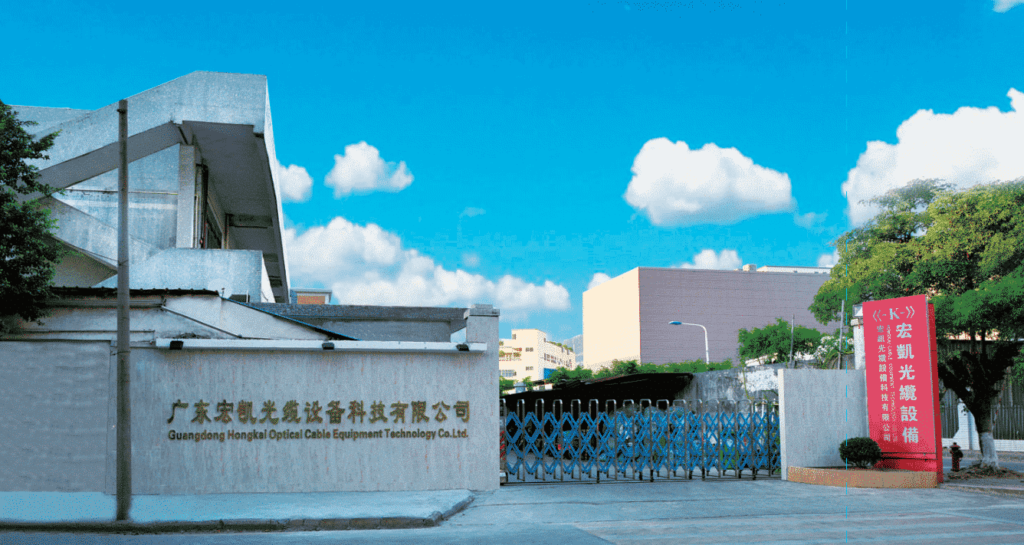
Guangdong Hongkai Optical Cable Equipment Technology Co., Ltd. began manufacturing wire and cable equipment in 2005 and was formally incorporated in 2015. Our main products include SZ stranding and cabling lines, fiber optic cable sheathing extrusion lines, and FTTH drop cable production lines.
Hongkai equipment addresses vibration reduction in several ways:
-
Stranding head dynamic balancing: Instrument-measured during final assembly – only shipped if dynamic balance is within allowable limits
-
Coupling alignment: Differential gearbox to main motor coupling alignment deviation controlled within 0.05 mm
-
Bearings: Dancer bearings use SKF/NSK, low-friction design, reducing vibration from degradation
-
Servo drive: Independent servo motors for active pay-off, signal refresh cycle 20 milliseconds, eliminating control delay
-
Cage material: High-strength, low-density materials with low rotational inertia, keeping away from resonance points in common speed ranges
Equipment measured data: SZ stranding machine pay-off tension fluctuation ≤ ±0.4 N, stranding pitch deviation ≤ ±0.08 mm. Every machine comes with a factory test report, a PLC program backup on USB, bilingual operation manuals (Chinese/English), and a wear-parts kit. Our equipment has been exported to more than 15 countries and regions, with over 160 sets currently running on production lines worldwide.
If you’re running a cable production line and experiencing abnormal vibration or noise, feel free to contact the Hongkai technical team. Tell us what the symptom is and under what conditions it occurs – we’ll help you figure out where the problem lies.