In its industry trends report released early this year, the UK-based Commodity Research Unit (CRU) pointed out that the optical fiber and cable markets are undergoing simultaneous transformations in multiple directions – AI-driven data center investment has rapidly emerged as the strongest growth engine, while traditional telecom demand has slowed in several markets. The supply landscape is also shifting, with Chinese fiber and cable manufacturers systematically expanding overseas.
While demand surges, supply lags significantly behind. CRU estimates a global supply-demand gap of approximately 16.4% for fiber optic cables in 2026. Against this backdrop, cable prices continue to rise, overseas orders are already booked through 2028, and cable manufacturers have a strong appetite for capacity expansion – directly driving procurement demand for optical cable manufacturing equipment.
Demand has changed. Products have changed. The equipment that makes cables must change too.
1. AI Data Centers Are Reshaping Cable Products in Three Core Directions
Direction 1: Rapidly growing demand for high-fiber-count cables
As data center operators continuously optimize for speed, low latency, throughput, and energy efficiency, demand for optical cables in internal links, DCI, and backbone upgrades has risen sharply – far outpacing traditional telecom demand growth. A single cable needs to integrate thousands of fibers to maximize bandwidth and space efficiency, and demand for high-fiber-count ribbon cables is surging. This means cable manufacturers must handle more tubes and higher-precision stranding operations – the traditional 6-to-12-tube loose-tube structure is being replaced by high-fiber-count configurations with dozens or even over a hundred tubes.
Direction 2: G.657 series bend-insensitive cables become a data center standard
The high-density cabling environment in data centers imposes extremely high requirements on cable bending performance. CRU reports indicate that data centers are driving continued growth in demand for high-spec, high-value-added products like G.657.A1/A2. G.657.A2 cables are primarily used for high-density cabling in data centers and are one of the biggest beneficiaries of the AI data center demand explosion. In the past, G.657 series cables were “barely produced by anyone”; now they account for over 50% of some manufacturers’ shipment mix.
G.657 series bend-insensitive cables have far more demanding sheath requirements than traditional G.652.D cables – smaller bending radii require more precise sheath concentricity and more uniform wall thickness. A sheathing extrusion line that cannot stably maintain concentricity above 98% will be unable to take on these high-margin orders.
Direction 3: Overseas demand becomes the core growth driver
In March 2026, China’s fiber optic cable exports reached USD 245 million, up 263.84% year-on-year. The accelerated construction of overseas cable factories has directly boosted procurement demand for optical cable manufacturing equipment. In 2026, US domestic cable demand is growing rapidly, making the North American market a key growth pole in the current market cycle.
2. Four New Requirements for Stranding and Sheathing Equipment Driven by Industry Trends
Requirement 1: Stranding accuracy must support high-fiber-count production
High-fiber-count cables demand far higher stranding accuracy than traditional products. Tension deviation on any single tube can scrap the entire cable. An SZ stranding and cabling line must maintain extremely high accuracy under high tube counts – pay-off tension fluctuation should be controlled within ±0.5 N, and stranding pitch deviation should be controlled within ±0.1 mm.
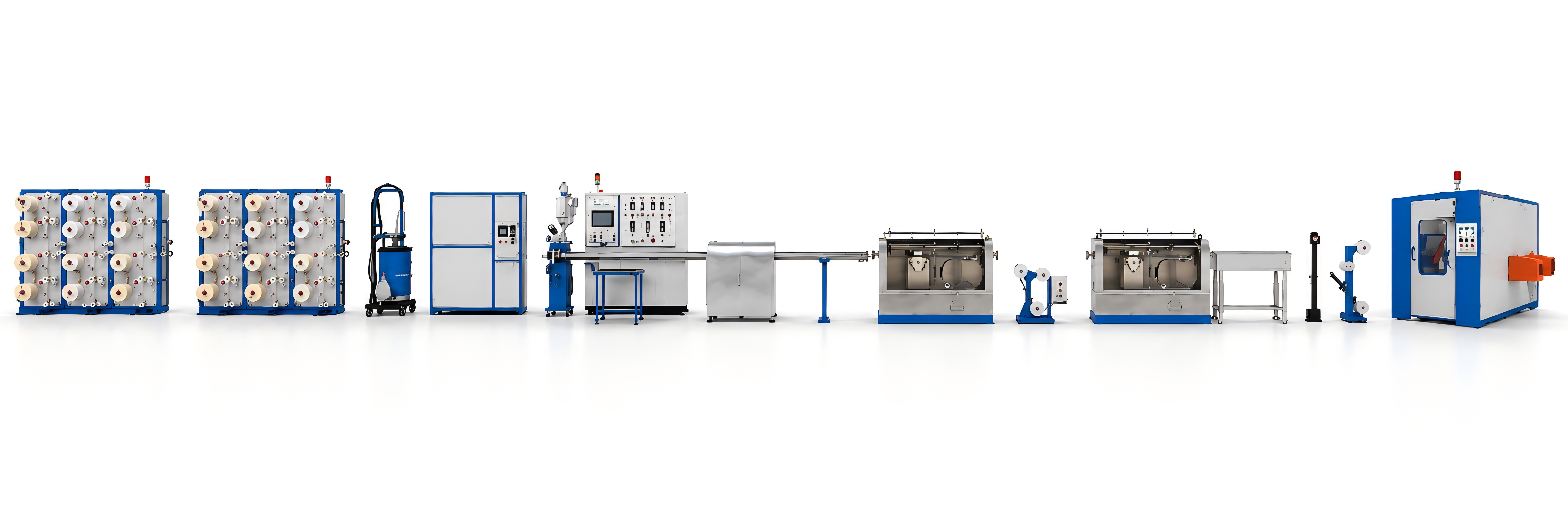
Hongkai’s SZ stranding machine uses independent servo motor active pay-off with real-time closed-loop tension sensor control. Measured pay-off tension fluctuation is ≤ ±0.4 N, pitch deviation ≤ ±0.08 mm, supporting simultaneous stranding of up to 12 tubes. The differential gears undergo high-frequency hardening and precision grinding to HRC 50–55 hardness, with SKF or NSK bearings, ensuring stable accuracy under long-term high-load operation.
Requirement 2: Sheathing accuracy must meet G.657 series requirements
G.657 series bend-insensitive cables have far more demanding sheath requirements than traditional products. A sheathing extrusion line must achieve concentricity ≥ 98% and wall thickness tolerance ≤ 0.05 mm (at 1.8 mm nominal) – otherwise, bending loss will be sharply amplified and the product will fail customer acceptance.
Hongkai’s sheathing line is equipped with a high-precision laser diameter gauge (accuracy 0.2 μm, scanning speed 200 mm/s), using PID algorithm to dynamically adjust extruder screw speed. Over 8 hours of continuous production, measured concentricity averages 98.6%, with wall thickness tolerance ≤ 0.04 mm. The screw is made of 38CrMoAlA material with nitriding treatment – nitriding depth 0.5–0.7 mm, hardness above HV 900 – ensuring wall thickness uniformity over long-term production.
Requirement 3: Equipment must support rapid changeover
Today’s cable orders are characterized by “multi-variety, small-batch” – loose-tube cables, FTTH drop cable production lines, high-fiber-count cables – requiring multiple specification changes daily. If a fiber optic cable making machine takes 4–5 hours per changeover, it will severely reduce the line’s annual effective output.
Hongkai equipment comes standard with Siemens/Mitsubishi PLC platforms. The touchscreen includes built-in recipe storage, capable of saving complete process parameters for at least 20 different products (pitch, tension, temperature, line speed, etc.). For changeover, simply select the recipe and load it with one touch – changeover time is compressed to under 1.5 hours.
Requirement 4: Equipment must have digital capability
Workshops are moving from “people watching machines” to “data managing machines.” If equipment on the fiber optic cable production line is still “mute” – lacking data interfaces and unable to connect to MES systems – it will gradually be phased out of mainstream supply chains.
Hongkai equipment comes standard with Siemens/Mitsubishi PLC platforms, supporting automatic production data recording (CSV export) and OPC UA/SQL interfaces for MES integration. Every machine includes complete electrical schematics, PLC program backup (USB drive), and a factory test report – containing measured data for pay-off tension fluctuation, stranding pitch deviation, sheath concentricity, and more – providing technical headroom for predictive maintenance and remote diagnostics.
3. Opportunities and Challenges in Cable Equipment Exports
With overseas demand becoming the core driver, cable equipment exports are facing a structural opportunity. But for fiber optic cable production line suppliers, exporting equipment is not simply a matter of “packing and shipping.” When procuring cable equipment, overseas customers focus on three key issues beyond the equipment’s accuracy and price:
How soon after arrival can the equipment go into production? Overseas cable factories often lack technical personnel familiar with cable equipment installation and commissioning. Whether the equipment supplier has overseas installation and commissioning capability, and whether bilingual operation manuals and electrical schematics are provided, determines whether the equipment takes 2–3 months or 12–18 days to go into production after arrival.
How quickly can it be repaired if it breaks down? Overseas customers face long lead times for spare parts. Whether the supplier provides a standard wear-parts kit, whether spares can be shipped quickly (DHL 3–5 business days), and whether remote video diagnostics are supported – these capabilities determine the duration of unplanned downtime.
Can the equipment pass destination country certification? Does the equipment have CE technical documentation? Are major electrical components from international brands (Siemens, Schneider, ABB)? Is the electrical system adapted to local voltage (North America 480V/60Hz, Europe 400V/50Hz)? These determine whether the equipment can clear customs and pass acceptance in the destination country.
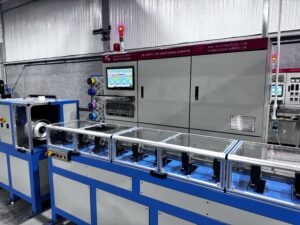
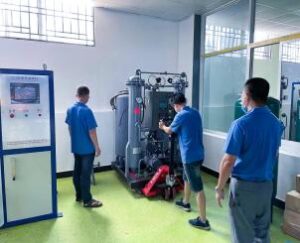
Hongkai cable equipment has been exported to more than 15 countries and regions across the Middle East, Southeast Asia, South Asia, Africa, and Europe, with over 160 sets delivered. We provide bilingual operation manuals, electrical schematics, and CE technical documentation; remote video support (2-hour response time during working hours); engineer on-site installation and commissioning (12–18 days from installation to trial production); and a standard wear-parts kit shipped with the equipment, with DHL express delivery of spares in 3–5 business days. Major electrical components include Siemens/Mitsubishi PLC, Siemens/Schneider low-voltage components, and ABB/Inovance drives – with global warranty coverage and locally available replacement parts.
4. Five Key Selection Criteria for Cable Equipment
Based on the above industry trends, cable manufacturers should focus on the following five criteria when procuring optical cable manufacturing equipment:
Criterion 1: Stranding accuracy
What is the pay-off tension fluctuation of the SZ stranding and cabling line? Can stranding pitch deviation be stably maintained within ±0.1 mm? Can it support simultaneous stranding of 12 tubes or more? These data directly determine whether the equipment can produce high-fiber-count cables.
Criterion 2: Sheathing accuracy
Can the sheathing extrusion line stably achieve concentricity of ≥ 98%? Can wall thickness tolerance be controlled within 0.05 mm? Is a laser diameter gauge equipped for online closed-loop control? These determine whether the equipment can take on high-value-added cable orders like G.657 series.
Criterion 3: Changeover efficiency
Does the equipment have built-in recipe storage? Can all process parameters be loaded with a single touch during changeover? Can changeover time be compressed to under 2 hours? These determine the line’s actual annual output under multi-variety order conditions.
Criterion 4: Digital capability
Does the equipment have data interfaces? Can it automatically record process parameters for each batch? Can it connect to MES systems? In the 5G fully connected factory era, equipment without digital capability will lose competitiveness.
Criterion 5: Export compliance capability
Does the equipment have CE technical documentation? Are major electrical components from international brands? Are bilingual operation manuals (Chinese/English) provided? Does the equipment supplier have international delivery experience? These determine whether the equipment can be successfully exported to overseas markets.
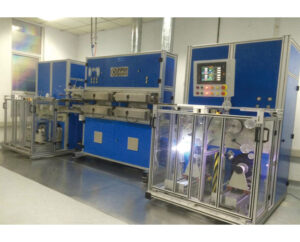
5. Final Thoughts
In 2026, the global fiber optic cable industry is in the midst of a structural transformation driven by AI computing power. Demand has changed. Products have changed. The equipment that makes cables must change too. Stranding accuracy, sheathing accuracy, changeover efficiency, digital capability, and export compliance capability – these five criteria are becoming the new standard for cable equipment selection.
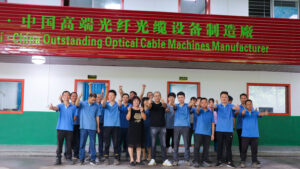
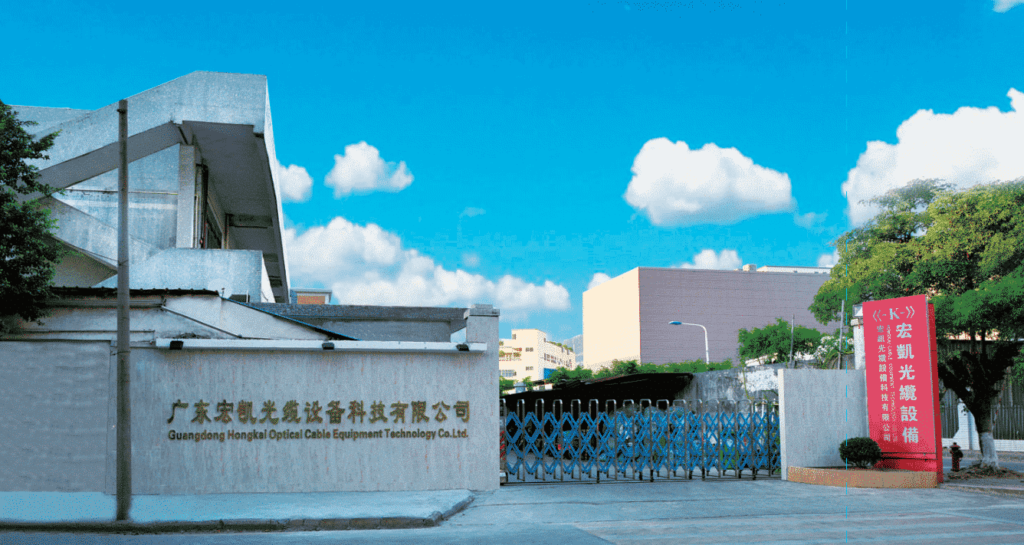
Guangdong Hongkai Optical Cable Equipment Technology Co., Ltd. began manufacturing wire and cable equipment in 2005 and was formally incorporated in 2015. Our main products include SZ stranding and cabling lines, fiber optic cable sheathing extrusion lines, and FTTH drop cable production lines. We focus on the stranding and sheathing processes – the two critical steps that determine cable mechanical properties and temperature performance.
Hongkai equipment measured data:
| Parameter | Measured Value |
|---|---|
| Stranding pay-off tension fluctuation | ≤ ±0.4 N |
| Stranding pitch deviation | ≤ ±0.08 mm |
| Sheathing concentricity (8-hour continuous production) | ≥ 98.6% |
| Wall thickness tolerance | ≤ 0.04 mm |
| Changeover time | ≤ 1.5 hours (one-touch recipe loading) |
Our equipment has been exported to more than 15 countries and regions, with over 160 sets currently running on production lines worldwide. Every machine comes with a factory test report, a PLC program backup on USB, bilingual operation manuals (Chinese/English), and a wear-parts kit.
If you’re setting up a fiber optic cable production line, or need a custom optical cable production line, feel free to contact the Hongkai technical team.