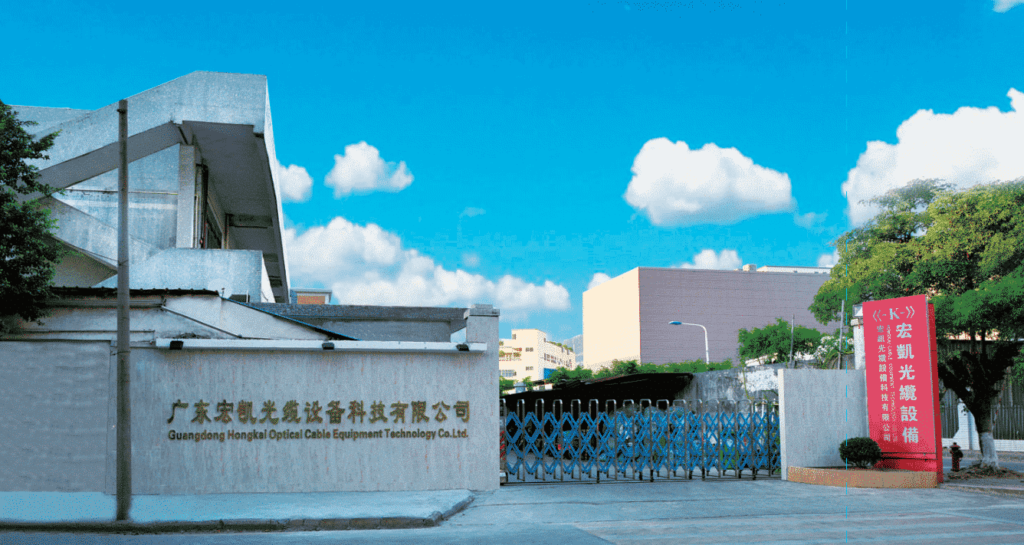
A complete fiber optic cable production line – from the moment optical fiber enters the factory to the finished cable leaving the facility – involves multiple stages. Today, let’s walk through the entire process step by step and see exactly what equipment you need to build a cable production line.

1. The Front End: Fiber Draw Tower – The “Source” of Cable Production
The starting point of any optical cable is the optical fiber itself. And the starting point of the fiber is the fiber draw tower.
The preform is heated to melting point in the draw tower and drawn into a 125-micron filament at speeds of tens of meters per second. After cooling, coating, and curing, it’s wound onto reels. The draw tower is the core equipment at the very front of cable production – it requires high technical expertise and substantial investment, so generally only large-scale cable manufacturers build their own.
If you’re starting from scratch with a smaller operation, you can also skip the draw tower and purchase finished optical fiber directly – starting your line from the coloring machine.
2. First Process: Fiber Coloring Machine – “Dressing” the Fiber
Optical fiber comes out of the draw tower transparent, each strand looking identical to the next. To distinguish different fiber counts during cable production, you need to apply color – red, blue, green, yellow, white, gray, black, brown, purple, pink, aqua, and orange – the 12 standard colors.
The equipment used for this process is called a fiber coloring machine.
The coloring machine applies color to the transparent fiber while rewinding it onto standard spools. Key factors to consider when selecting a coloring machine: speed (industry mainstream: 1,500–3,000 m/min), tension stability (generally controlled within 0.3–1.5 N), and UV curing quality.
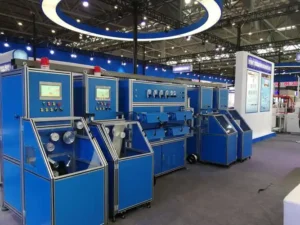
3. Second Process: Secondary Coating Line – Putting a “Jacket” on the Fiber
Colored fiber can’t be used directly just yet. A cable usually contains multiple fibers, so they must first be bundled into loose tubes – extruding a PBT or PP plastic tube around the fibers and filling it with water-blocking gel.
The equipment for this process is called a secondary coating line (or fiber tubing line).
The secondary coating line does three main things: pay-off (unwinding the colored fibers from spools), tube extrusion (using an extruder to apply a plastic tube around the fibers), and gel filling (filling the tube with fiber gel for moisture protection). When selecting equipment, focus on: fiber count capacity (typically 1–12 fibers, up to 24 in higher-end models), excess length control accuracy (fibers must be neither too tight nor too loose inside the tube), and production speed.
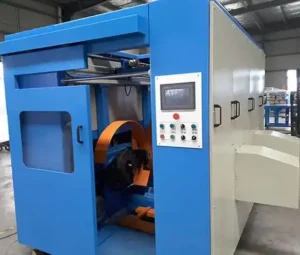
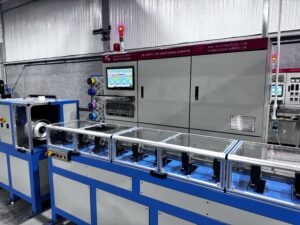
4. Third Process: SZ Stranding and Cabling Machine – “Twisting” the Tubes into a Cable Core
Once the loose tubes are ready, the next step is to strand multiple tubes together with strength members (steel wire or FRP) to form the cable core. This process is called cabling, and the equipment used is the SZ stranding and cabling line.
Why “SZ”? Because the stranding process alternates between forward and reverse rotation, creating a cable core with alternating S‑ and Z‑lay patterns. The rapid growth in demand for high‑fiber‑count cables has placed higher demands on SZ stranding machines – tube counts have jumped from the traditional 6–12 to dozens or even over a hundred, and pay‑off tension deviation on any single tube can scrap the entire cable.
Key factors to consider when selecting an SZ stranding machine:
-
Tension stability: Pay‑off tension on every tube must be stable. Excessive fluctuation means pitch accuracy is compromised. Industry standard: ≤ ±0.5 N.
-
Pitch accuracy: Stranding pitch is the cable’s “skeleton parameter.” Excessive deviation means uneven fiber stress.
-
Tube capacity: Typically 6–12 tubes; high‑fiber‑count cables need more.
Hongkai’s SZ stranding machine measures pay‑off tension fluctuation ≤ ±0.4 N and pitch deviation ≤ ±0.08 mm, supporting simultaneous stranding of up to 12 tubes.
5. Fourth Process: Sheathing Extrusion Line – Putting “Armor” on the Cable Core
With the cable core completed, the final process is to apply the outer sheath. The sheath is the cable’s “armor,” protecting the internal fibers from moisture, compression, and tensile stress.
The equipment for this process is called the sheathing extrusion line.
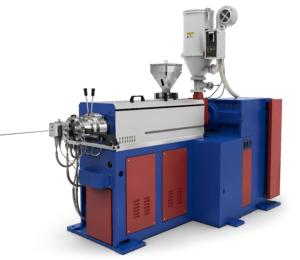
The sheathing line consists of several components: pay-off stand (unwinding the cable core), extruder (melting the sheath material and extruding it over the core), cooling trough (cooling and setting the sheath), capstan (pulling the cable forward), and take-up (winding the finished product).
Key factors to consider when selecting a sheathing line:
-
Concentricity: The sheath must not be eccentric – requirement ≥ 98%.
-
Wall thickness tolerance: Generally controlled within 0.05 mm.
-
Material compatibility: Can it handle PE (outdoor), PVC (indoor), and LSZH (data centers)?
-
Laser diameter gauge: Real‑time outer diameter monitoring with automatic adjustment when deviation occurs.
Hongkai’s sheathing line measures concentricity ≥ 98.6% and wall thickness tolerance ≤ 0.04 mm, compatible with PE, PVC, LSZH, and multiple other materials.
6. Final Step: Optical Cable Testing Equipment – Quality Control
The cable is made – but can it leave the factory? Not before testing.
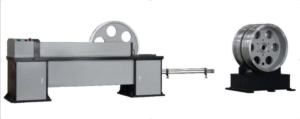
Cable testing equipment performs various performance checks on the finished cable – attenuation, length, sheath integrity, temperature cycling, and more. 5G+OTDR inspection technology can complete multi‑wavelength testing on a single fiber in under 500 milliseconds, covering over 30 data validations including sheath defects and outer diameter deviations, reducing quality risks by over 98%.
7. A Complete Cable Production Line – Five Machines in Series
String the above five steps together, and a complete fiber optic cable production line looks like this:
Fiber Draw Tower (optional) → Coloring Machine → Secondary Coating Line → SZ Stranding and Cabling Machine → Sheathing Extrusion Line → Cable Testing Equipment
Fiber comes in, gets colored; colored fiber becomes loose tubes; tubes get stranded into a cable core; the core gets sheathed; tested and passed – what comes out is finished optical cable.
Each process has its own “personality”: the coloring machine needs speed and stability; the secondary coating line needs precision and uniformity; the stranding machine needs tightness and flatness; the sheathing line needs consistent wall thickness and high concentricity. If any step goes wrong, the final cable won’t pass specification.
8. Several Common Cable Production Line Configurations
FTTH Drop Cable Production Line
If your primary focus is butterfly‑shaped drop cables for fiber‑to‑the‑home, the equipment configuration differs – steel wire pay‑off, strength member pay‑off, fiber pay‑off (2 or more routes), extruder (with dedicated butterfly‑shaped die), cooling trough, capstan, diameter gauge, inkjet printer, and automatic reel changer. The key component is the extrusion die – extruding the sheath into a flat butterfly shape with fibers in the center and strength members on both sides.
Armored Cable Manufacturing Equipment
If you’re making armored cables, you need to add a layer of steel tape or steel wire armor inside the sheath. This requires an additional armoring process between cabling and sheathing – a steel tape longitudinal wrapper or steel wire stranding machine.
Data Center Cable Manufacturing Equipment
Data centers primarily use high‑fiber‑count ribbon cables and G.657 series bend‑insensitive cables. These demand much higher stranding accuracy and sheath concentricity than standard cables – stranding tension fluctuation must be controlled within ±0.4 N, and sheath concentricity must reach above 98%.
Submarine Cable Production Line
Submarine cables have extremely high requirements for tensile strength, water‑blocking performance, and corrosion resistance. Beyond conventional stranding and sheathing equipment, they also require steel wire armoring machines and asphalt coating machines – the production line is much longer and far more complex than standard cable lines.
9. How to Select a Cable Equipment Supplier?
If you’re procuring equipment or looking for a cable equipment manufacturer, we recommend focusing on the following key areas:
Check accuracy: What’s the stranding machine’s tension fluctuation? What’s the sheathing line’s concentricity? Request the factory test report and review the actual measured data – not just brochure claims.
Check changeover capability: Today’s order mix is diverse – data centers want high fiber counts, overseas markets want G.657, telcos want loose‑tube cables. Does the equipment have recipe storage? How long does changeover take? Hongkai’s equipment can store up to 20 different product recipes; changeover takes under 1.5 hours.
Check data capability: Workshops are moving from “people watching machines” to “data managing machines.” Does the equipment have data interfaces? Can it connect to MES systems? Hongkai equipment comes standard with Siemens/Mitsubishi PLC, supporting data acquisition and automatic production data logging.
Check export experience: If the equipment is destined for overseas, does the supplier have international delivery experience? Can they provide bilingual operation manuals? Can they send personnel for on‑site installation and commissioning abroad? Hongkai equipment has been exported to more than 15 countries and regions, with over 160 sets currently running on production lines worldwide.
10. About Hongkai
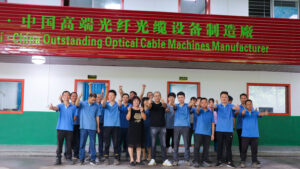
Guangdong Hongkai Optical Cable Equipment Technology Co., Ltd. began manufacturing wire and cable equipment in 2005 and was formally incorporated in 2015. Our main products include SZ stranding and cabling lines, fiber optic cable sheathing extrusion lines, and butterfly‑shaped drop cable production lines.
Hongkai equipment measured data: Stranding machine pay‑off tension fluctuation ≤ ±0.4 N, pitch deviation ≤ ±0.08 mm; sheathing line concentricity ≥ 98.6%, wall thickness tolerance ≤ 0.04 mm. Our equipment has been exported to more than 15 countries and regions, with over 160 sets currently running on production lines worldwide.
If you’re building a fiber optic cable production line, or if you already have upstream equipment and need supporting cabling and sheathing equipment, feel free to contact the Hongkai technical team.