With the strong market for optical cables this year, many factories are running their equipment 24/7. But the more the equipment runs, the more prone it is to problems. Tension drifting on the stranding machine, concentricity deviation on the sheathing line, aging UV lamps on the coloring machine – a problem at any stage can result in a pile of scrap, or worse, an entire reel of cable being discarded.
Today, let’s walk through the entire process from start to finish and identify the most common trouble spots on a complete fiber optic cable production line – and how to fix them quickly.

1. Fiber Coloring Machine: What Are the Most Common Problems in the First Process?
Fiber coloring is the first process in optical cable production. The fiber coloring machine applies one of 12 standard colors to natural fiber while rewinding it onto standard spools.
Common fault 1: Uneven coloring or faded color
Possible causes: Aging UV curing lamps, dirty reflectors, or insufficient nitrogen pressure.
Solutions: Replace UV lamps in time, clean or replace the quartz tube, clean dirt off the reflectors, and check nitrogen pressure and flow rate.
Common fault 2: Increased attenuation after coloring
Cause: Excessive pay‑off/take‑up tension creates internal stress in the fiber, leading to additional loss at the 1550 nm window.
Solution: Check and adjust pay‑off and take‑up tension to ensure stability and uniformity.
Common fault 3: Irregular winding
Cause: Tension wheel vibration or unstable tension causes jumping and overlapping, resulting in steps in the fiber’s reflection attenuation curve.
Solution: Check for tension wheel runout and adjust tension control parameters.
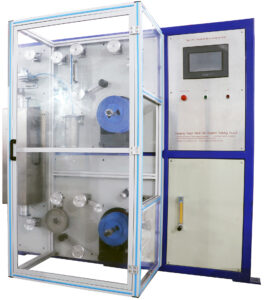
2. Secondary Coating Line: Bundling Fibers into Loose Tubes – Excess Length Control Is Key
After coloring, the fibers go through the secondary coating line to be formed into loose tubes – extruding a plastic tube around the fibers and filling it with water‑blocking gel.
The most critical parameter in secondary coating is excess length control. The fiber inside the tube must be neither too tight nor too loose – too tight and temperature changes will stress the fiber, increasing loss; too loose and the fiber may buckle when the cable bends.
Common fault 1: Unstable excess length control
Cause: Excess length is affected by multiple factors – pay‑off tension, hot water bath temperature, and haul‑off speed. Higher pay‑off tension stretches the fiber more, reducing the final excess length.
Solutions: Check that the pay‑off stand is stable and that the primary tension is not excessive; adjust hot water bath temperature and haul‑off speed.
Common fault 2: Fiber break or steps in attenuation curve
Cause: The loose tube uses PBT material, which shrinks significantly after hardening, making it impossible to maintain the fiber excess length within the process window.
Solutions: Check that the cooling water temperature is appropriate and that haul‑off tension is precisely controlled.
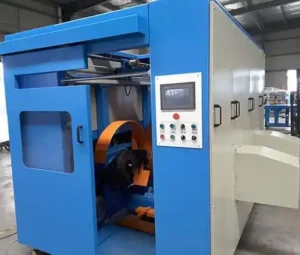
3. SZ Stranding and Cabling Machine: The Core Process – Unstable Tension Ruins Everything
Once the loose tubes are ready, they are stranded together with strength members using an SZ stranding line to form the cable core.
The SZ stranding machine is the heart of optical cable production. Whether it performs well comes down to two metrics: tension stability and pitch accuracy.
Common fault 1: Sudden surge in pay‑off tension
Symptom: The take‑up tension monitor reading suddenly jumps from 8 N to 25 N.
Possible causes: Tension sensor failure, dancer arm jamming, or pay‑off reel brake locking.
Troubleshooting: First check whether the dancer arm moves freely; then verify the tension sensor signal; finally inspect the pay‑off reel brake.
Common fault 2: Stranding pitch varies erratically
Formula: Pitch (P) = Haul‑off speed (V) ÷ Stranding bow speed (n).
Possible causes: Haul‑off speed fluctuation, unstable bow speed, or encoder signal interference.
Solutions: Check the haul‑off inverter and stranding motor encoder; use PLC encoder closed‑loop control to ensure synchronization error < 0.05°.
Common fault 3: Broken strands, loose stranding, and uneven pitch
Symptom: Under long‑term heavy‑load continuous production, many factories encounter broken strands, loose stranding, uneven pitch, equipment vibration, and abnormal noise.
Solutions: Check the coaxiality of all guide wheels; verify that pay‑off tension is uniform across all tubes. Bulges in filler ropes or loose tubes can also cause local core diameter to exceed specification.
Common fault 4: Fiber break during subsequent sheathing
Symptom: The cable core passes testing after stranding, but during the sheathing process, misaligned sections of the core are squeezed and deformed when passing through the sizing die, causing step‑like loss or fiber break.
Solutions: After stranding, check the roundness of the cable core to ensure there is no misalignment before the sheathing process.
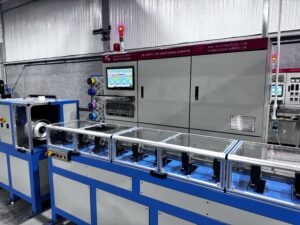
4. Fiber Optic Cable Sheathing Line: The Final Process – Concentricity Is the Key
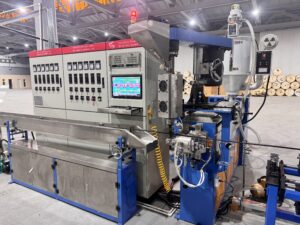
After the cable core is completed, the final process is the sheathing extrusion line – applying the protective outer sheath over the core.
The sheath is the cable’s “armor.” If the sheathing is not done properly, all previous work is wasted. The most common problem with sheathing is concentricity – uneven wall thickness, thicker on one side and thinner on the other.
Common fault 1: Sheath concentricity exceeds tolerance
Formula: Eccentricity = (Max thickness – Min thickness) / (Max thickness + Min thickness) × 100%. Industry standards require eccentricity within a specified range.
Causes: Misalignment between the core and the die; lateral displacement of the cable core within the die.
Solutions: Adjust die centering; check the position of guide wheels before the die. Some manufacturers use ultrasonic probes to monitor sheath wall thickness in real time.
Common fault 2: Rough sheath surface or visible particles
Cause: Contaminants such as dust or tensile component debris mixed into the LSZH compound; during extrusion, these impurities become trapped in the die or fiber gaps.
Solutions: Clean the sheath compound; check whether the screen pack is damaged.
Common fault 3: Large fluctuation in sheath outer diameter
Possible causes: Unstable extruder temperature, haul‑off speed variation, or dirty diameter gauge lens.
Solutions: Check whether heater bands are damaged and thermocouples are secure; clean the laser diameter gauge lens.
5. Optical Cable Testing Equipment: The Final Quality Gate Before Dispatch
Once the cable is produced, can it leave the factory? It must be tested first.
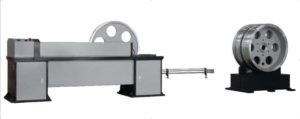
Fiber optic cable testing equipment performs various performance checks on the finished cable – attenuation, length, sheath integrity, temperature cycling, and more.
Common issue: Inaccurate test data
Possible causes: Dirty diameter gauge lens, worn measuring wheel, drifting temperature sensor – any of these can produce incorrect readings.
Solutions: Regularly clean sensor lenses; periodically calibrate the length counter; regularly verify temperature sensor accuracy.
6. Practical Maintenance Tips
Tip 1: Troubleshoot from “outside to inside, simple to complex”
First check external factors (power supply, temperature, cable connections), then consider internal faults. Prioritize easy, common causes (loose connections, poor contact, dirt) before delving into complex issues.
Tip 2: Set up a regular equipment “check‑up” calendar
-
Daily: Check the tension curve, listen for abnormal sounds, feel motor temperatures.
-
Weekly: Grease bearings; clean electrical cabinet cooling fans.
-
Monthly: Calibrate tension sensors; calibrate the length counter; check differential gearbox oil level.
-
Semi‑annually: Change differential gearbox oil; inspect gear wear.
Tip 3: Keep factory parameter backups
Every machine comes with a PLC program backup and a factory test report. If parameters are corrupted, you can restore them in 15 minutes – no need to wait for an engineer.
Tip 4: Keep a stock of common wear parts
Bearings, belts, sensors, fuses, heater bands – keep these frequently replaced items on hand so you can fix issues yourself without waiting for parts to arrive.
7. Special Considerations for Overseas Customers
If you are a fiber optic cable production line supplier exporting equipment overseas, pay special attention to the following:
-
Voltage systems: North America: 480V/60Hz; Europe: 400V/50Hz – ensure the equipment is adapted before shipment.
-
Certification: CE technical documentation for the EU, UL‑certified components for the US.
-
Operation manuals: Must be provided in both Chinese and English for local operators.
-
Spare parts supply: Overseas customers face longer lead times for parts; it is recommended to include a wear‑parts kit with the shipment, with DHL delivery available within 3 days.
8. About Hongkai
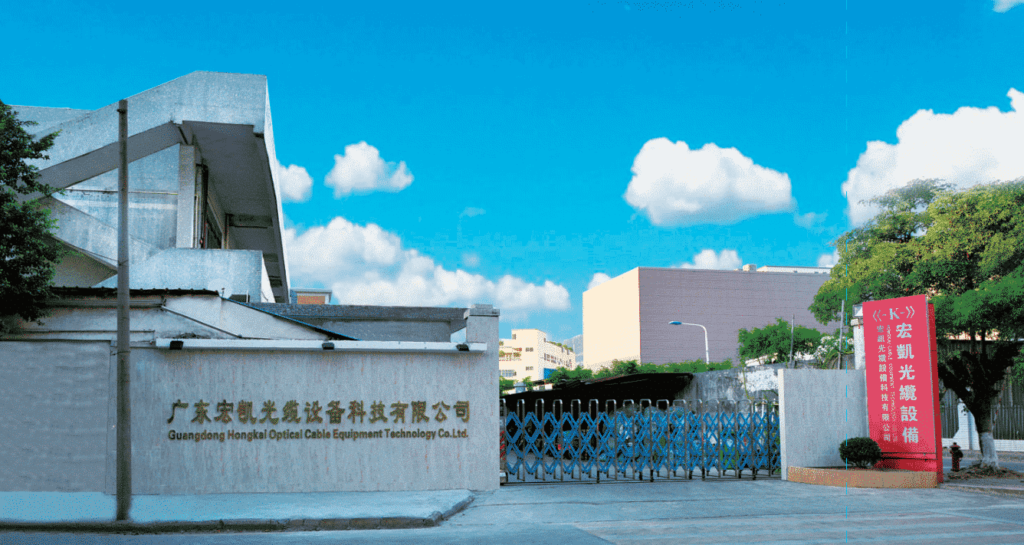
Guangdong Hongkai Optical Cable Equipment Technology Co., Ltd. began manufacturing wire and cable equipment in 2005 and was formally incorporated in 2015. Our main products include SZ stranding and cabling lines, fiber optic cable sheathing extrusion lines, and butterfly‑shaped drop cable production lines.
Hongkai does not manufacture coloring machines or secondary coating lines – we focus on what we do best: the stranding and sheathing processes, which are the critical steps that determine the cable’s mechanical properties and temperature performance.
Hongkai equipment measured data:
| Parameter | Measured Value |
|---|---|
| Stranding pay‑off tension fluctuation | ≤ ±0.4 N |
| Stranding pitch deviation | ≤ ±0.08 mm |
| Sheathing concentricity | ≥ 98.6% |
| Wall thickness tolerance | ≤ 0.04 mm |
Our equipment has been exported to more than 15 countries and regions, with over 160 sets currently running on production lines worldwide. Every machine comes with a factory test report, a PLC program backup on USB, bilingual operation manuals (Chinese/English), and a wear‑parts kit.
If you are setting up a fiber optic cable production line, or if your equipment has developed a fault and you’re not sure how to troubleshoot it, feel free to contact the Hongkai technical team.