Most people in the cable industry are familiar with SZ stranding and cabling lines and sheathing extrusion lines – after all, they are the “star players” in cable stranding and sheathing. However, many overlook the “front-end” processes of cable production: fiber coloring and secondary coating.
Without coloring, all fibers are transparent and indistinguishable during production. Without secondary coating, fibers lack the protection of loose tubes and would break easily during stranding.
These two processes are the “starting point” of a cable production line. If the starting point is done right, the subsequent stranding and sheathing processes will run smoothly.
1. Fiber Coloring Machine: “Dressing” the Fiber
When optical fiber comes out of the draw tower, it is transparent – each strand looking identical to the next. To distinguish different fiber counts during cable production, the fibers must be colored – red, blue, green, yellow, white, gray, black, brown, purple, pink, aqua, and orange – the 12 standard colors.
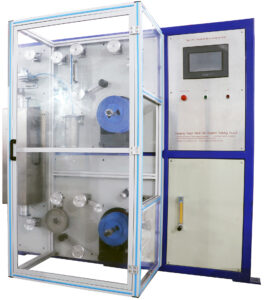
The fiber coloring machine does exactly this – applying color to the transparent fiber while rewinding it onto standard spools.
What Are the Main Components of a Coloring Machine?
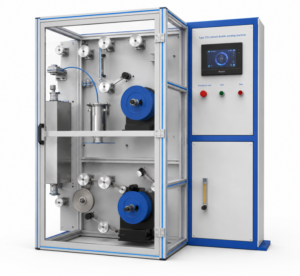
A typical fiber coloring machine mainly consists of: a fiber pay-off unit, a coloring unit (coating applicator), an ultraviolet (UV) curing unit, and a rewinding system. The pay-off tension unit steadily unwinds the fiber from the spool; the coating unit applies a uniform layer of ink onto the fiber surface; the UV curing unit rapidly cures the ink using ultraviolet light; and the take-up unit neatly rewinds the colored fiber onto spools.
Selecting a Coloring Machine – Watch These Three Data Points
First: Coloring speed. The industry mainstream speed ranges from 1,500 to 3,000 m/min. Higher speed means greater output, but also requires more precise tension control.
Second: Tension control accuracy. Optical fiber is fragile – excessive tension causes breakage, while insufficient tension causes slack. Industry standards require pay-off tension to be controlled between 0.3 and 2.0 N, with an accuracy of ±0.05 N. The tension control assembly consists of multi-wheel guide rollers, rotating components, displacement sensors, and more. The sensor measures the position data of the dancer, transmits signals to the PLC, and the PLC automatically adjusts the pay-off speed. If deviation exceeds ±0.05 N, the colored fiber may develop internal stress, affecting subsequent use.
Third: UV curing system. After ink application, it must be cured by ultraviolet light. Poor curing means the color rubs off easily. A good curing system features variable UV intensity control and cooling options to prevent overheating. Some equipment uses UV-LED curing, offering lower energy consumption and longer lifespan.
Hongkai’s high-speed fiber coloring machine uses a PLC control system with pay-off tension accuracy of ±0.05 N, coloring speed up to 3,000 m/min, and an energy-efficient, long-life UV-LED curing system.
2. Secondary Coating Line: Putting a “Jacket” on the Fiber
Colored fiber cannot be used directly just yet. A cable usually contains multiple fibers, so they must first be bundled into loose tubes – extruding a plastic tube around the fibers and filling it with water-blocking gel.
The equipment for this process is called the secondary coating line. It extrudes polymer materials (such as PBT, nylon, etc.) over the colored fiber to form a secondary coated fiber that offers mechanical protection, environmental resistance, and ease of stranding.
What Are the Main Components of a Secondary Coating Line?
-
Pay-off stand: Unwinds the colored fibers from spools
-
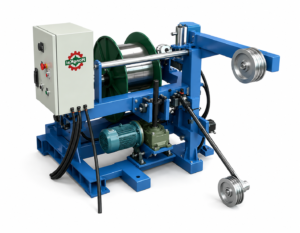
Extruder: Melts materials like PBT, PP, PE, nylon and extrudes them over the fiber through the die head to form loose tubes
-
Gel filling device: Fills the tube with thixotropic gel for water-blocking
-
Cooling trough: Cools and sets the freshly extruded loose tube
-
Capstan and take-up: Pulls the tube forward and winds it onto reels
The Most Critical Parameter in Secondary Coating: Excess Length Control
The fiber inside the tube must be neither too tight nor too loose – too tight means temperature changes stress the fiber, increasing loss; too loose means the fiber may buckle when the cable bends. Industry standards require fiber excess length to be controlled within 0–3‰, with an accuracy of ±0.2‰. Some high-end equipment can achieve ±0.05%.
Excess length control relies on precise control of the tension difference between the front and rear capstans. Higher pay-off tension stretches the fiber more, reducing the final excess length. The equipment uses a pinch-type capstan system to control the tension differential between the front and rear capstans, thereby achieving the desired excess length.
Selecting a Secondary Coating Line – Watch These Key Areas
Extruder screw: PBT material is sensitive to extrusion temperature and pressure. Poor screw design results in inadequate plasticization and uneven loose tube wall thickness. Screw material and length-to-diameter (L/D) ratio directly affect plasticization quality.
Fiber count capacity: Typically 2 to 12 fibers. Some equipment can handle secondary coating of fiber ribbons.
Line speed: The industry mainstream ranges from 300 to 1,000 m/min.
Hongkai’s secondary coating line uses a PLC control system with excess length control range of 0–3‰ ±0.2‰, line speed up to 350 m/min, and compatibility with PBT, PP, PE, nylon, and other materials.
3. Coloring and Secondary Coating: How to Match These Two Processes?
On a complete fiber optic cable production line, the front-end processes are arranged as follows:
Fiber Draw Tower (optional) → Fiber Coloring Machine → Secondary Coating Line → SZ Stranding and Cabling Machine → Fiber Optic Cable Sheathing Extrusion Line
The coloring machine turns transparent fiber into colored fiber; the secondary coating line turns colored fiber into loose tubes; the stranding machine strands tubes into a cable core; the sheathing line puts the “armor” on the core.
The coloring machine and secondary coating line are the “starting point” of cable production. If coloring speed falls behind, the secondary coating line has to wait. If the secondary coating line’s excess length control is inaccurate, even the best stranding and sheathing work will be wasted.
Matching issues between the two processes to watch for:
The speed of the coloring machine and the speed of the secondary coating line must be matched. If the coloring machine runs at 3,000 m/min but the secondary coating line only runs at 300 m/min – one day of coloring work would take the secondary coating line ten days to process. Either the coloring machine doesn’t need to run that fast, or the secondary coating line needs to be speeded up. When selecting equipment, look at the speeds of these two processes together.
The handoff of excess length control: the excess length from secondary coating is an “input parameter” for the stranding process. If excess length is not properly controlled, the fiber excess length will be thrown off during stranding – no matter how precise the stranding machine is, it can’t fix it.
4. About Hongkai
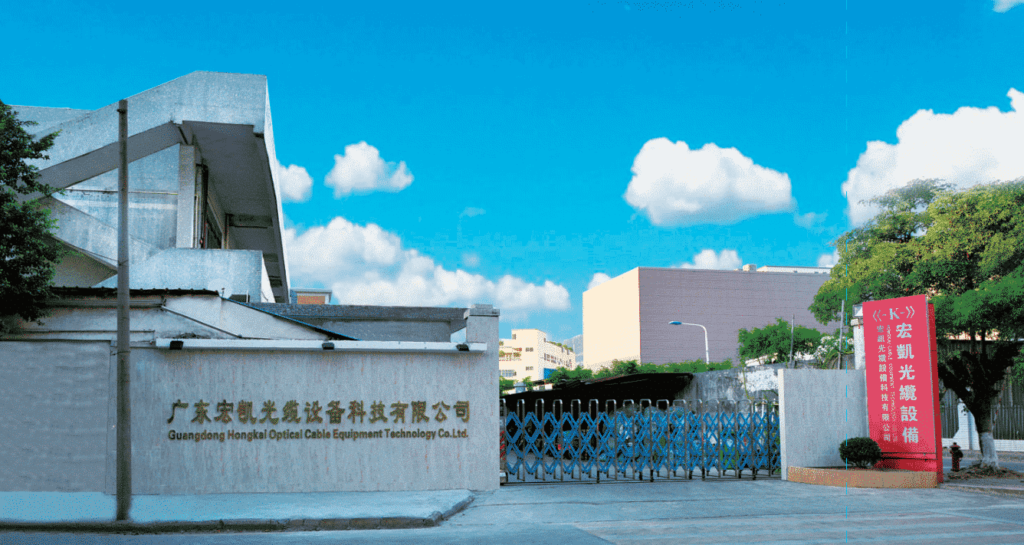
Guangdong Hongkai Optical Cable Equipment Technology Co., Ltd. began manufacturing wire and cable equipment in 2005 and was formally incorporated in 2015. Our main products cover the entire cable production process – from high-speed fiber coloring machines and secondary coating lines, to SZ stranding and cabling lines, fiber optic cable sheathing extrusion lines, and FTTH drop cable production lines.
Hongkai high-speed fiber coloring machine measured data: Coloring speed up to 3,000 m/min, pay-off tension accuracy ±0.05 N, equipped with UV-LED curing system.
Secondary coating line measured data: Excess length control accuracy ±0.2‰, line speed up to 350 m/min, compatible with PBT, PP, PE, nylon, and other materials.
Our equipment has been exported to more than 15 countries and regions, with over 160 sets currently running on production lines worldwide. Every machine comes with a factory test report, a PLC program backup on USB, bilingual operation manuals (Chinese/English), and a wear-parts kit.
If you’re setting up a fiber optic cable production line, or need a custom optical cable production line, feel free to contact the Hongkai technical team.