A while ago, a Turkish customer, Murat, sent me an urgent WhatsApp voice message.
“The pitch on my SZ stranding line keeps fluctuating – big, then small. The scrap rate has jumped from 1% to 5%. My customer is pushing for delivery. Can you come and take a look?”
Murat runs a cable factory on the outskirts of Istanbul. Two years ago, he bought a complete fiber optic cable production line from us, including a fiber coloring machine, a secondary coating line for optical fiber, an SZ stranding line, and a fiber optic cable sheathing line. The equipment had been running steadily. A sudden problem like this must have a cause.
I asked him to take a few photos of the touchscreen and send them over first. In the photos, the pay-off tension curve was jumping up and down like an ECG. The pitch was set at 180 mm, but the measured value was fluctuating between 165 and 195.
“Check the encoder coupling first, then the dancer arm,” I said in the voice message.
Half an hour later, he replied: “Checked both. No problem.”
I then asked him to send over the operating parameters of the fiber coloring machine and the secondary coating line for optical fiber. One look, and I found the problem.
The Problem Wasn’t in the Stranding Machine – It Was in the Front-End Processes
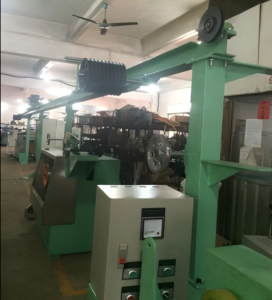
In the photos, the coloring machine’s take-up speed was set to 2,800 m/min, and the secondary coating line’s capstan speed was set to 350 m/min. These two speeds themselves were not a problem – the problem was that, in order to rush orders, the customer had set the coloring machine speed too high, and the take-up tension had been increased accordingly.
With higher take-up tension on the coloring machine, the fiber was pulled tight on the reel. When this batch of fiber was later run on the secondary coating line to make loose tubes, the pay-off tension became unstable. The loose tube excess length control accuracy dropped from ±0.2‰ to ±0.5‰. With inaccurate excess length, the stress on the tubes inside the stranding unit during cabling became uneven – and the pitch naturally fluctuated.
The root cause was not in the SZ stranding line. It was in the collaboration between the two front-end processes.
I called Murat: “Don’t touch the stranding machine. Lower the take-up tension on the coloring machine, and recalibrate the excess length on the secondary coating line. Then use the stranding machine’s recipe function to save the new tube parameters.”
He was skeptical: “The stranding machine is fine?”
“The stranding machine is fine. But you need to let it ‘know’ that the front-end parameters have changed.”
I Flew Over and Adjusted It Step by Step
It was hard to explain over the phone, so I flew over anyway. Twelve hours, two transfers.
When I arrived at his factory, I first walked over to the fiber coloring machine and had the operator lower the take-up tension from the setpoint. Then I walked over to the secondary coating line for optical fiber and re-tuned the excess length control parameters. Finally, I walked over to the SZ stranding line and opened the recipe interface on the touchscreen.
“Look – there are 20 recipe groups here. Save ’12-fiber loose tube, tube excess length 0.2‰’ as one group. Next time you change over, load it with one touch. No need to enter everything manually every time.”
Murat looked at the screen and said: “So I was the one who messed up the parameters?”
“When you’re rushing orders and the speed goes up, tension easily gets out of control. The equipment has closed-loop control, but if the front-end parameters change and the back-end doesn’t know, problems arise.”
I had the operator run a trial on the spot. The coloring machine was slowed to 2,500 m/min, the secondary coating excess length was restored to ±0.2‰, and the stranding machine loaded the new recipe. The measured pitch of the cable core came out at 179.9 mm, 180.0 mm, and 180.1 mm. All three sections were within tolerance.
Murat patted the guard on the stranding machine: “Old friend, I blamed you wrongly.”
We Also Made an Improvement Along the Way
The fault was solved, but Murat raised a new issue: his orders were becoming more and more varied – 12-fiber today, 24-fiber tomorrow, and G.657 bend-insensitive cable the day after. Every changeover, the operators had to manually adjust parameters. Although the stranding machine had recipe functionality, the front-end fiber optic coloring line and loose tube line still had no recipe storage.
I helped him with one thing: bringing the process parameters of the fiber coloring machine and the secondary coating line for optical fiber into recipe management as well. We created recipe groups for the corresponding products on the touchscreen, so that during changeover, all three machines could load with one touch.
Hongkai’s entire fiber optic cable making machine series – including the FTTH optical cable manufacturing machine and indoor optical fiber production line – supports recipe storage. But the customer had only been using the stranding machine’s recipes; the front-end equipment had never been set up.
After the change, Murat did the math: changeover time was compressed from four hours to an hour and a half. With two changeovers a day, that saved five hours. Five hours could produce more than three hundred extra meters of cable.
He told me: “This improvement is worth more than fixing the pitch.”
On the Way Back, I Kept Thinking About One Thing
When many overseas customers encounter equipment problems, their first reaction is “the equipment is broken.” But after actual troubleshooting, a considerable portion of problems are not in the equipment itself – they come from uncoordinated parameters between upstream and downstream processes, inconsistent operating habits, or recipes that were never set up properly.
As a Premier Cable Machine Manufacturer, Hongkai doesn’t just sell individual machines on a fiber optic cable production line – fiber coloring machine, fiber optic coloring line, secondary coating line for optical fiber, loose tube line, SZ stranding line, fiber optic cable sheathing line, FTTH optical cable manufacturing machine, indoor optical fiber production line – we sell full-line collaboration solutions.
Equipment comes with a factory test report, a PLC program backup on USB, bilingual operation manuals (Chinese/English), and a wear-parts kit. But after the equipment arrives at the customer’s factory, how to use it, how to adjust it, and how to make the upstream and downstream processes “talk” to each other – that still requires people.
If you’re running a cable production line overseas and encounter a strange equipment problem, or want to learn about full-line collaboration and recipe management solutions, feel free to contact the Hongkai technical team. First, tell us what you’re dealing with – we’ll see if we can help you diagnose it remotely. You don’t necessarily need me to fly 12 hours to get there.
📧 Email: sales2@hkofcmachine.com
🌐 Website: https://hkofcmachine.com/