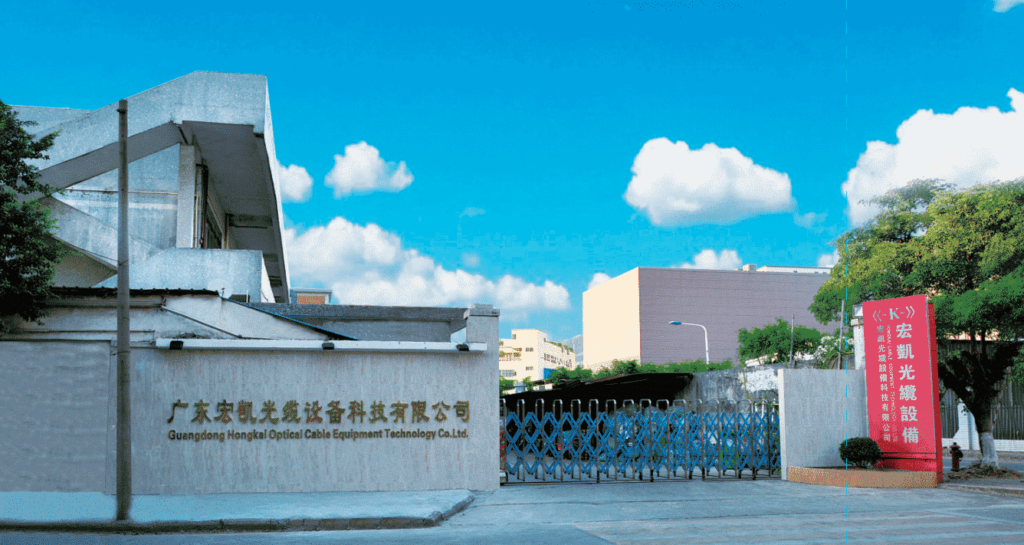
For a long time, everyone’s focus has been on how much tension fluctuates, how much pitch deviates, and what the concentricity is. These figures are important, but there’s another question that’s often overlooked: how are these precision levels maintained?
The answer: inline inspection + closed-loop control.
Traditional cable production relies on “post-production inspection” – run a full reel, then cut a section to measure pitch and check concentricity. If it fails, the entire reel is scrapped or downgraded. On a fiber optic cable production line, if every process relies on post-production inspection, defects have already occurred and losses have already been incurred.
The core functionality of modern cable equipment is shifting from “post-production inspection” to “real-time feedback, real-time adjustment.” Today, from the perspective of core equipment functions, let’s discuss Hongkai’s design in inline inspection and closed-loop control as a Premier Cable Machine Manufacturer, and the practical value it brings to overseas factories.
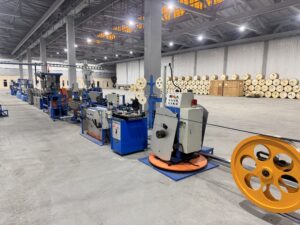
1. SZ Stranding Line: Inline Tension Inspection, Real-Time Pitch Stabilization
Traditional approach: Pay-off tension uses open-loop control – set a value and forget it. If tension drifts, operators discover it by experience, or wait until pitch deviates and then adjust.
Core function of Hongkai’s SZ stranding line: Independent servo motors for active pay-off + real-time closed-loop tension sensor control. The tension sensor samples actual tension at a 20-millisecond cycle, the PLC compares it with the setpoint, and adjusts the pay-off motor speed in real time. Pay-off tension fluctuation ≤ ±0.4 N, stranding pitch deviation ≤ ±0.08 mm.
Value to the customer: If tension drifts, the equipment pulls it back itself – no waiting for operators to notice, no waiting for pitch to deviate. For high-fiber-count cables with 24 tubes stranding simultaneously, the tension of each tube is independently closed-loop controlled, so one deviating tube won’t drag down the entire cable.
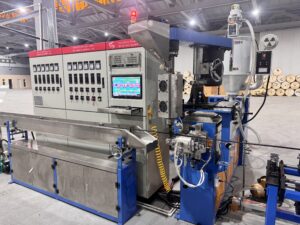
2. Fiber Optic Cable Sheathing Line: Inline Outer Diameter Inspection, Real-Time Concentricity Stabilization
Traditional approach: Sheath outer diameter is spot-checked by operators with calipers – if deviation is found, extruder speed is adjusted manually. Cable produced between spot checks may already be out of tolerance.
Core function of Hongkai’s fiber optic cable sheathing line: High-precision laser diameter gauge (accuracy 0.2 μm) + PID closed-loop control. The gauge samples outer diameter data every 0.1 seconds, the PLC compares it with the setpoint, and adjusts extruder screw speed in real time. Sheath outer diameter fluctuation is controlled within ±0.03 mm; 8-hour continuous production concentricity average ≥ 98.6%, wall thickness tolerance ≤ 0.04 mm.
Value to the customer: If the outer diameter deviates by 0.01 mm, the equipment adjusts it back itself. G.657.A2 cable requires concentricity ≥ 98% – inline inspection + closed-loop control doesn’t rely on operator experience, and every reel of cable is consistent.
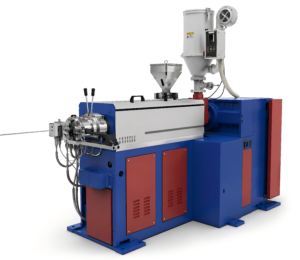
3. Secondary Coating Line / Loose Tube Line: Inline Excess Length Inspection, Real-Time Temperature Linkage
Traditional approach: Loose tube excess length is spot-checked after production – if it deviates, hot water trough temperature or capstan speed is adjusted.
Core function of Hongkai’s secondary coating line for optical fiber / loose tube line: Inline monitoring of capstan speed and hot water trough temperature; the PLC automatically calculates and adjusts the speed differential between front and rear capstans based on the set excess length. Excess length control accuracy ±0.2‰. Hot water trough temperature control ±1°C – PBT crystallization is stable and shrinkage is consistent.
Value to the customer: If excess length deviates, the equipment adjusts the speed differential itself – no waiting for the stranding process to discover uneven fiber stress. Stable excess length means stable stranding pitch, and attenuation won’t exceed limits after temperature cycling.
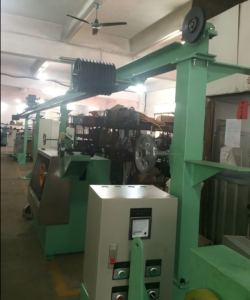
4. Fiber Coloring Machine: Inline Tension Inspection, Real-Time Coloring Uniformity Assurance
Traditional approach: Coloring tension uses open-loop control – tension fluctuation causes uneven coloring layer thickness and color that is too dark or too light.
Core function of Hongkai’s fiber coloring machine / fiber optic coloring line: Pay-off tension accuracy ±0.05 N, with real-time tension sensor feedback and PLC adjustment of the pay-off motor. UV-LED curing energy is monitored in real time, with automatic compensation when energy is insufficient. Coloring speed 3,000 m/min, with stable color consistency.
Value to the customer: Stable tension means uniform coloring layer; stable curing energy means good color fastness. In subsequent SZ stranding line and fiber optic cable sheathing line processes, colors won’t fade or bleed.
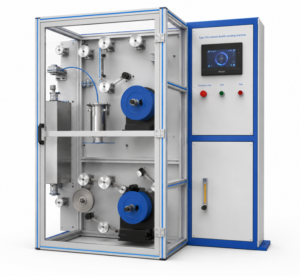
5. Inline Inspection Data Can Also “Speak”
Inline inspection is not just about “real-time adjustment” – it also generates data. Hongkai equipment comes standard with Siemens/Mitsubishi PLC platforms, supporting data acquisition and MES integration. The entire fiber optic cable making machine series – fiber coloring machine, fiber optic coloring line, secondary coating line for optical fiber, loose tube line, SZ stranding line, fiber optic cable sheathing line, FTTH optical cable manufacturing machine, indoor optical fiber production line – automatically records tension, temperature, outer diameter, and speed data, which can be exported and traced.
Value to the customer: When data center customers audit the factory, they want to see production data for each batch of cable. The inline inspection system records it automatically – retrieve it and show it. It’s not “a spreadsheet filled in after the fact” – it’s real data collected by the equipment in real time.
6. What Do Inline Inspection and Closed-Loop Control Mean for Overseas Factories?
It means less scrap. Real-time adjustment when deviation occurs – no waiting until a full reel is finished to discover it. Full-line inline inspection on the optical fiber cable production line keeps scrap rates low.
It means less dependence on operators. The equipment inspects itself and adjusts itself – new employees don’t need to rely on experience to judge “is the tension off” or “is the outer diameter too large.”
It means confidence during customer factory audits. Production data is automatically recorded – when data center customers ask for data, it can be retrieved at any time.
It means high-value-added orders can be taken. G.657.A2 requires concentricity ≥ 98%, and high-fiber-count cables require pitch deviation ≤ ±0.1 mm – inline inspection + closed-loop control is what keeps these indicators stable.
7. What Should Overseas Buyers Ask When Selecting Equipment?
Question 1: Is tension under closed-loop control? What is the fluctuation? SZ stranding line pay-off tension fluctuation ≤ ±0.4 N.
Question 2: Is sheath outer diameter under inline inspection + closed-loop control? Laser diameter gauge accuracy 0.2 μm, concentricity ≥ 98.6%.
Question 3: Is excess length under inline inspection? Is temperature automatically linked? Secondary coating line for optical fiber excess length control accuracy ±0.2‰.
Question 4: Can production data be automatically recorded and exported? Supports MES integration, data traceable.
Question 5: Can inline inspection data be used for customer factory audits? Automatically recorded, authentic and verifiable.
📩 Get an Inline Inspection and Closed-Loop Control Configuration Proposal
If you are procuring a fiber optic cable production line for an overseas project, or want to learn about Hongkai equipment’s core functions and measured data in inline inspection and closed-loop control, feel free to contact the Hongkai technical team.
Just tell us three things:
-
What type of cable do you want to make? (Loose-tube / FTTH / indoor cable)
-
Where will the factory be built? (This affects voltage system and certification requirements)
-
Approximately what capacity? (How many kilometers per month or per year)
We will provide a preliminary equipment configuration proposal, inline inspection function description, and quotation within 5 working days.
📧 Email: sales2@hkofcmachine.com
🌐 Website: https://hkofcmachine.com/