Customers from the Middle East, Africa, and Southeast Asia often ask: “Our power grid is unstable – there are frequent outages, and voltage goes up and down. Can your equipment handle it?”
This is not a minor issue.
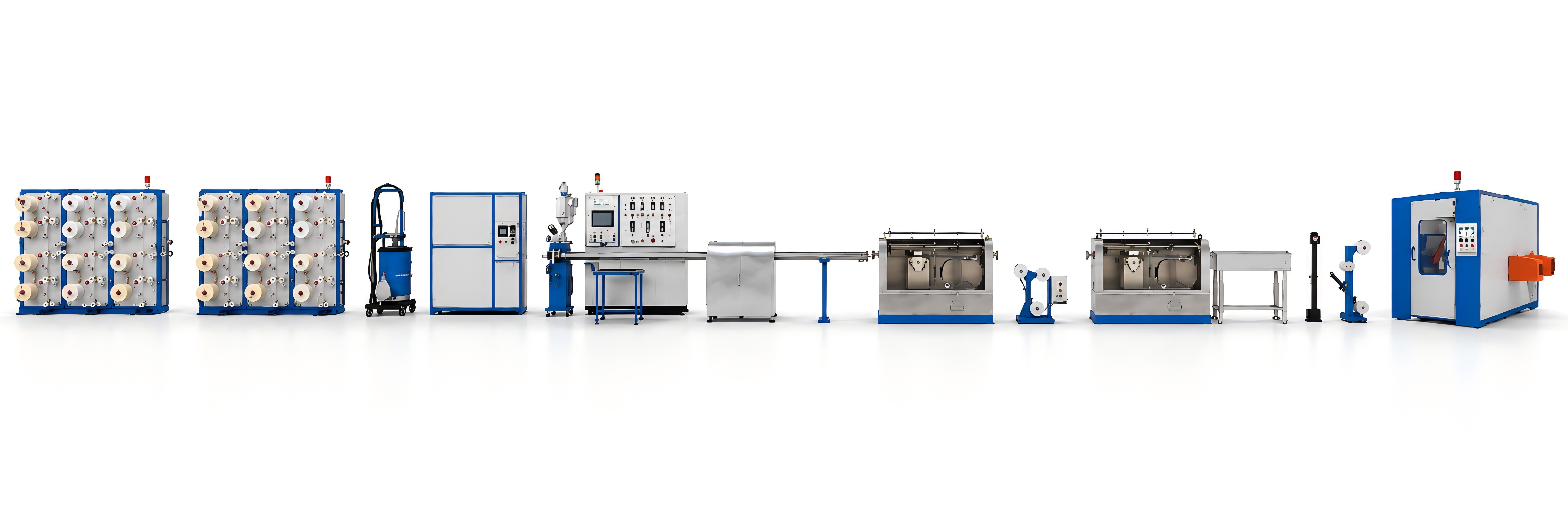
Cable production is a continuous operation. Once an SZ stranding line starts up, it runs 24/7. The extruder on a fiber optic cable sheathing line runs continuously at high temperature – a mid-process power outage can cause the screw to seize, material waste, and die blockage. A single unplanned outage can scrap an entire reel of cable core.
Even more troublesome is the voltage surge at the moment the grid recovers – it can directly burn out PLCs, inverters, and sensors.
Today let’s discuss stable operation solutions for a fiber optic cable production line in regions with unstable power grids, helping overseas buyers solve the “power” problem upfront.
1. Three Critical Impacts of Grid Fluctuation on Cable Equipment
Impact 1: PLC restart, production data loss.
The PLC of a fiber optic cable making machine is the “brain” of the entire production line. A sudden voltage drop or surge can cause the PLC to restart. After restart, recipe parameters, production data, and alarm records are all lost. Operators must re-enter parameters, re-thread the line, and re-run trial production – hours of work.
Impact 2: Inverter alarms, equipment shutdown.
The inverters on the SZ stranding line and fiber optic cable sheathing line are sensitive to voltage fluctuations. When voltage is low, the inverter may trigger undervoltage protection; when voltage is high, it may trigger overvoltage protection. After the alarm, the equipment stops and can only be reset once voltage stabilizes.
Impact 3: Motor overheating, long-term damage.
When voltage is low, the motor draws more current to maintain output power, generating excessive heat. Long-term operation at low voltage accelerates motor insulation aging and shortens lifespan. The pay-off motor of the fiber coloring machine, the capstan motor of the secondary coating line for optical fiber, and the extruder motor of the loose tube line – all are affected.
2. Design Countermeasures at the Equipment Manufacturing Stage
Design 1: Inverter selection with sufficient margin.
Hongkai equipment inverters are selected to accommodate ±15% voltage fluctuation. When voltage fluctuates between 323V and 437V, the inverter operates normally. Grid fluctuation ranges in parts of the Middle East, Africa, and Southeast Asia are typically within ±10% – a ±15% margin is sufficient.
Design 2: Regulated power supply for control circuits.
Precision components such as PLCs, touchscreens, and sensors are sensitive to voltage. Hongkai equipment configures regulated power supplies in control circuits to ensure stable operation during voltage fluctuations. The UV curing system of the fiber optic coloring line and the laser diameter gauge of the fiber optic cable sheathing line are also connected to regulated circuits.
Design 3: Lightning protection and grounding.
Parts of the Middle East and Southeast Asia experience frequent thunderstorms – lightning surges are the “invisible killer” of electrical equipment. Hongkai equipment installs surge protective devices (SPD) in electrical cabinets, uses shielded cables for signal lines, and provides independent grounding terminals for PLCs and inverters.
Design 4: Parameter power-loss protection.
Hongkai equipment PLC recipe parameters and production data feature power-loss protection. Even with a sudden power outage, parameters are not lost. After power is restored, the equipment can quickly resume production.
3. How to Configure Backup Power? Matching Diesel Generators with Equipment
Many overseas factories have diesel generators for switching during outages. But matching generators with equipment requires attention.
First, generator capacity must be sufficient.
The starting current of cable equipment is greater than the running current. When the main motor of an SZ stranding line starts, the current can be 3 to 5 times the rated current. The extruder of a fiber optic cable sheathing line has high heating power and a heavy starting load. Generator capacity is recommended at 1.5 to 2 times the total equipment power.
Second, switching time must be short.
From grid outage to generator supply, there is a switching time. If too long, equipment stops. It is recommended to install an ATS automatic transfer switch cabinet, with switching time controlled within 10 seconds. For PLCs and control systems, it is recommended to install UPS uninterruptible power supplies, with zero-millisecond switching time.
Third, generator output voltage must be stable.
Diesel generator output voltage and frequency may not be as stable as grid power. It is recommended to install a voltage regulator to ensure generator output voltage is within the equipment’s allowable range. The FTTH optical cable manufacturing machine and indoor optical fiber production line also require stable power.
Fourth, generator grounding must be independent.
Generator grounding and grid grounding should be separated to avoid grounding circulating currents. Equipment grounding resistance should be ≤ 4Ω.
4. Daily Power Management Recommendations for Overseas Factories
Recommendation 1: Install voltage monitors.
Install voltage monitors in workshop distribution cabinets to record voltage fluctuations. If voltage is frequently low or high, adjust promptly.
Recommendation 2: Stagger startup of high-power equipment.
Do not start the SZ stranding line, fiber optic cable sheathing line, fiber coloring machine, secondary coating line for optical fiber, and loose tube line simultaneously. Staggered startup reduces impact on the grid.
Recommendation 3: Regularly inspect electrical connections.
In areas with large voltage fluctuations, electrical terminals tend to loosen and oxidize. Inspect distribution cabinets and equipment electrical connections quarterly – tighten terminals and clean contacts.
Recommendation 4: Keep spare parts on hand.
Every Hongkai machine comes with a standard wear-parts kit – including electrical spares such as fuses, contactors, and relays. For major parts, DHL delivery within three days. Major electrical components use Siemens/Mitsubishi/Schneider, with global warranty coverage and locally available replacements.
5. A Real-World Grid Adaptation Case Study
Last year, a customer in Nigeria built a cable factory. The local grid had large voltage fluctuations, with power outages 2 to 3 times per day. He bought a Hongkai optical fiber cable production line, including the fiber coloring machine, secondary coating line for optical fiber, SZ stranding line, and fiber optic cable sheathing line.
Before factory release, Hongkai did three things:
-
Inverter selection accommodating ±15% voltage fluctuation.
-
Control circuits equipped with regulated power supply and UPS.
-
Electrical cabinets equipped with surge protective devices.
The customer’s factory installed a diesel generator and ATS automatic transfer switch cabinet. After production launch, when grid power failed, the equipment automatically switched to the generator – PLCs and inverters did not restart, and production was not interrupted. The customer later reported: “With other equipment before, a power outage meant a line stoppage. Now I barely notice the outages.”
6. Selection Recommendations for Overseas Buyers
If you are building a cable factory in a region with unstable power grids – the Middle East, Africa, Southeast Asia – when procuring a fiber optic cable making machine, it is recommended to specify the following requirements in the technical specification:
-
Inverter voltage adaptation range: Not less than ±15%.
-
Control circuits: Equipped with regulated power supply; UPS recommended.
-
Lightning protection design: Electrical cabinets equipped with surge protective devices.
-
Power-loss protection: PLC parameters not lost during power outage.
-
Generator matching: Confirm equipment starting current matches generator capacity.
-
Remote support: Confirm whether the supplier provides remote diagnostic services.
For all machines on the fiber optic cable production line – fiber optic coloring line, loose tube line, SZ stranding line, fiber optic cable sheathing line, FTTH optical cable manufacturing machine, indoor optical fiber production line – it is recommended to configure power adaptation solutions under the same standard.
📩 Get Grid Adaptation Solutions and Selection Recommendations
If you are procuring an optical fiber cable production line for an overseas project, or want to learn about Hongkai equipment’s adaptation solutions for regions with unstable power grids, feel free to contact the Hongkai technical team.
Just tell us three things:
-
What type of cable do you want to make? (Loose-tube / FTTH / indoor cable)
-
Which country will the factory be built in? (This affects grid conditions and voltage system)
-
Approximately what capacity? (How many kilometers per month or per year)
We will provide a preliminary equipment configuration proposal, power adaptation description, and quotation within 5 working days.
📧 Email: sales2@hkofcmachine.com
🌐 Website: https://hkofcmachine.com/